
Case study · SEO + GEO consulting view
Notion’s advantage is not “good documentation.” It has designed a public answer system where discovery, routing, explanation and verification reinforce one another.
The system we audited
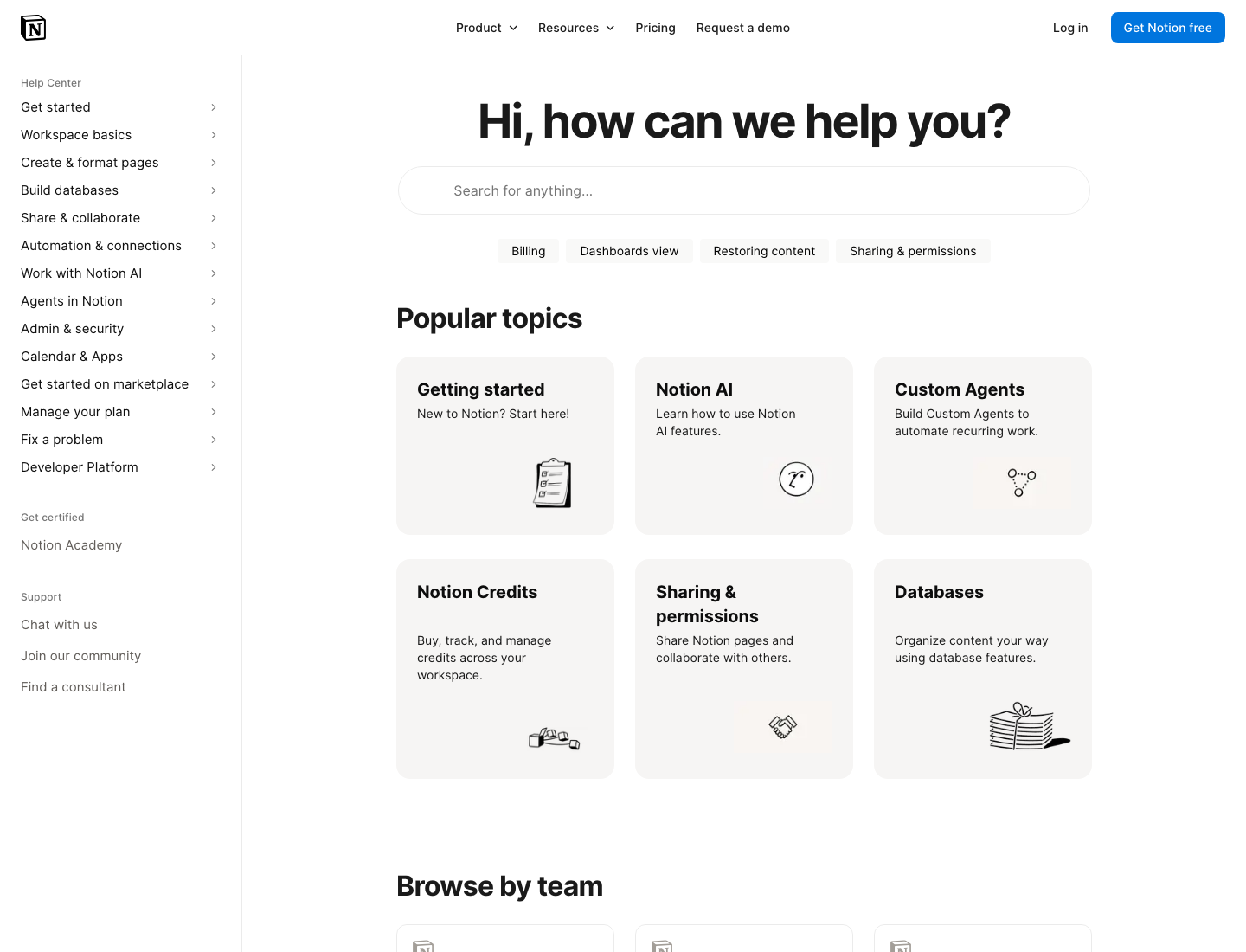
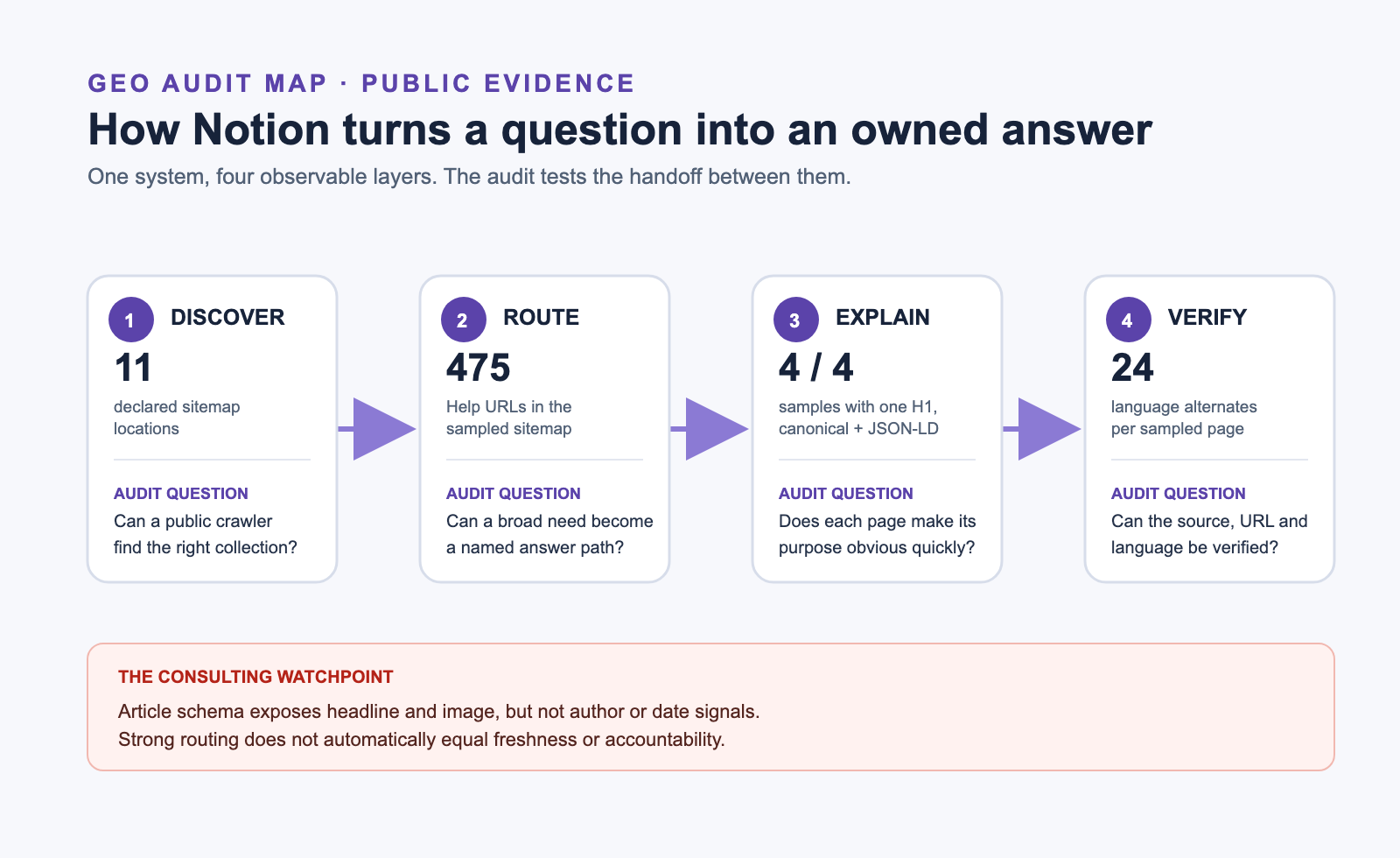
Instead of scoring isolated tags, we traced the handoff from a crawler finding public content to a reader reaching a named answer, then checking who owns it.
Three signals that matter
SIGNAL 01 · DISCOVERY IS DELIBERATE
Notion separates its public knowledge systems before anyone reads a page.
Evidence: its public robots.txt declares 11 sitemap locations, while the Help sitemap contained 475 answer URLs at inspection. Marketing, customer stories, releases and Help content are not one undifferentiated pool.
Why it matters: the retrieval problem starts before content quality. Clear collections reduce the effort required to find the relevant source class.
SIGNAL 02 · THE TEMPLATE SURVIVES DIFFERENT INTENTS
A tutorial, a permission policy, a security page and an AI overview all retain the same identity layer.
Evidence: the four sampled Help pages each had a specific title, one H1, a canonical URL, two JSON-LD blocks and 24 alternate-language links. Their body structures differ, but the page identity does not.
Why it matters: scalable GEO is a publishing system, not a hero page. Template consistency makes intent, ownership and preferred URLs predictable across the corpus.
SIGNAL 03 · PAGES OFFER MORE THAN ONE WAY TO EXTRACT THE ANSWER
The answer is framed, navigable and connected — not just written as a long article.
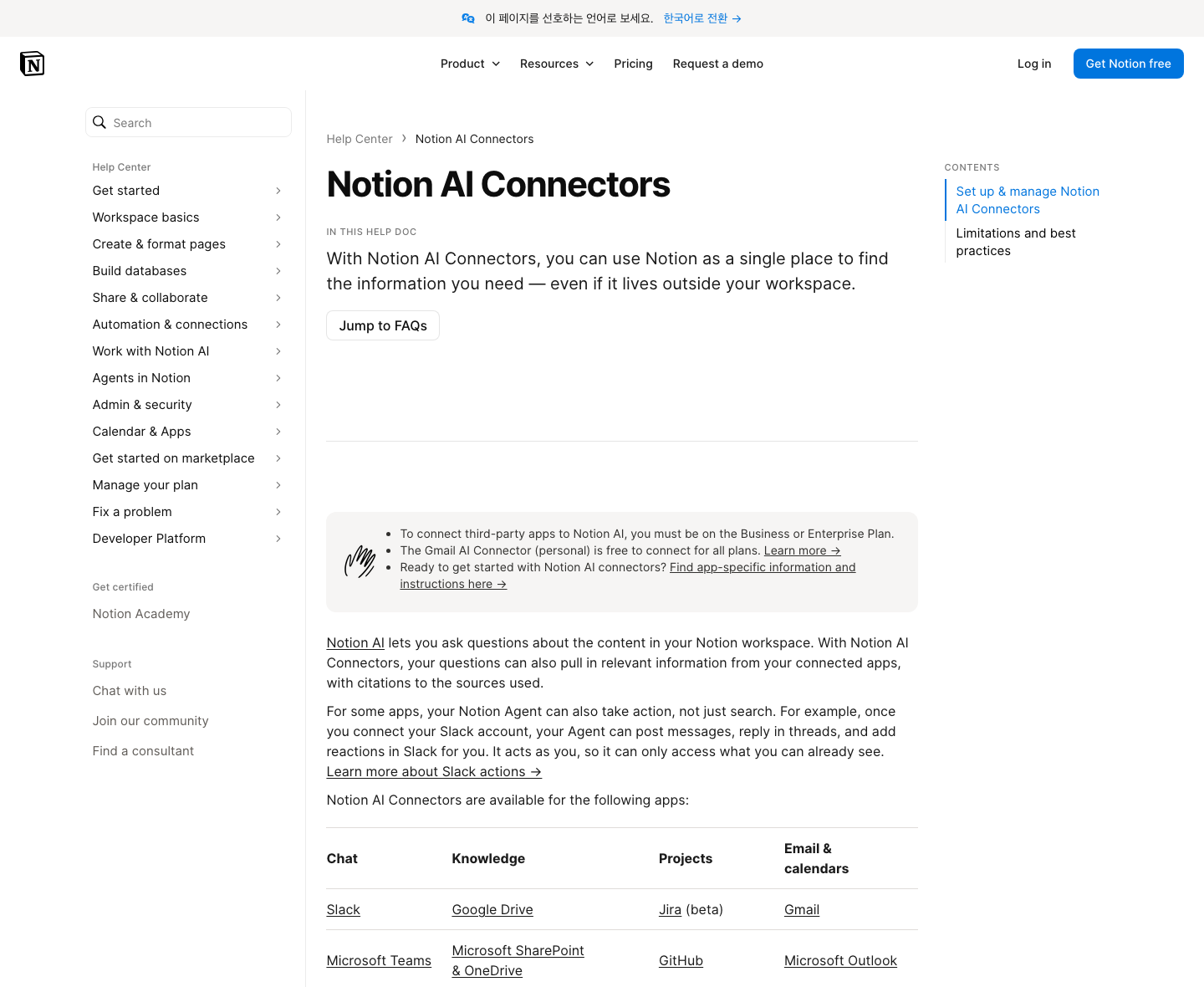
Evidence: the AI Connectors page combines breadcrumb context, a direct introductory definition, a contents rail, a FAQ jump, callout guidance, contextual links and a labelled category table. Its HTML contains 21 links back into the Help path.
Why it matters: prose, headings, lists, links and tables create different entry points into the same answer space. That helps both human scanning and source verification.
What the answer page actually looks like
The consulting watchpoint
Routing is stronger than freshness proof.
The sampled Article JSON-LD exposes a headline and image, but we did not observe an author, datePublished, or dateModified. For changing, high-stakes documentation, that makes the source less explicit about accountability and recency than it could be.
What we would recommend to a client: first establish real owner/reviewer and update governance, then expose it visibly and in structured data. Adding dates without editorial control is cosmetic, not GEO.
What to copy — and what not to copy
- Separate public answer collections by job.
- Use one answer-page template across intents.
- Make each page’s next step descriptive.
- Link answers into a visible knowledge graph.
- Don’t add schema fields without real governance.
- Don’t treat sitemap dates as editorial proof.
- Don’t call a clean template “AI citation success.”
- Don’t measure one domain-wide number only.
Your Monday-morning GEO plan
- Map the answer estate. Label every existing URL as guide, use case, product page, support answer, release note or proof.
- Choose one repeatable answer template. Context, direct definition, named subsections, evidence, next answer — every time.
- Assign ownership and review rules. Especially for product, policy and safety claims.
- Measure a defined query set. Track visibility, citations, referral sessions and conversions separately in AI Search Measurement.
Open the evidence packet: scope, samples and limits
Inspection: October 15, 2026, logged out. Sources: Help homepage, robots.txt, and Help sitemap.
Document sample: Create a database, Sharing & permissions, Custom Agents security, and Notion AI Connectors.
Not measured: rankings, citations, crawls by a specific AI platform, private analytics, referral traffic, conversions, mobile behavior, localization parity, or editorial workflows. This is a public-signal audit, not a performance claim.
Leave a Reply