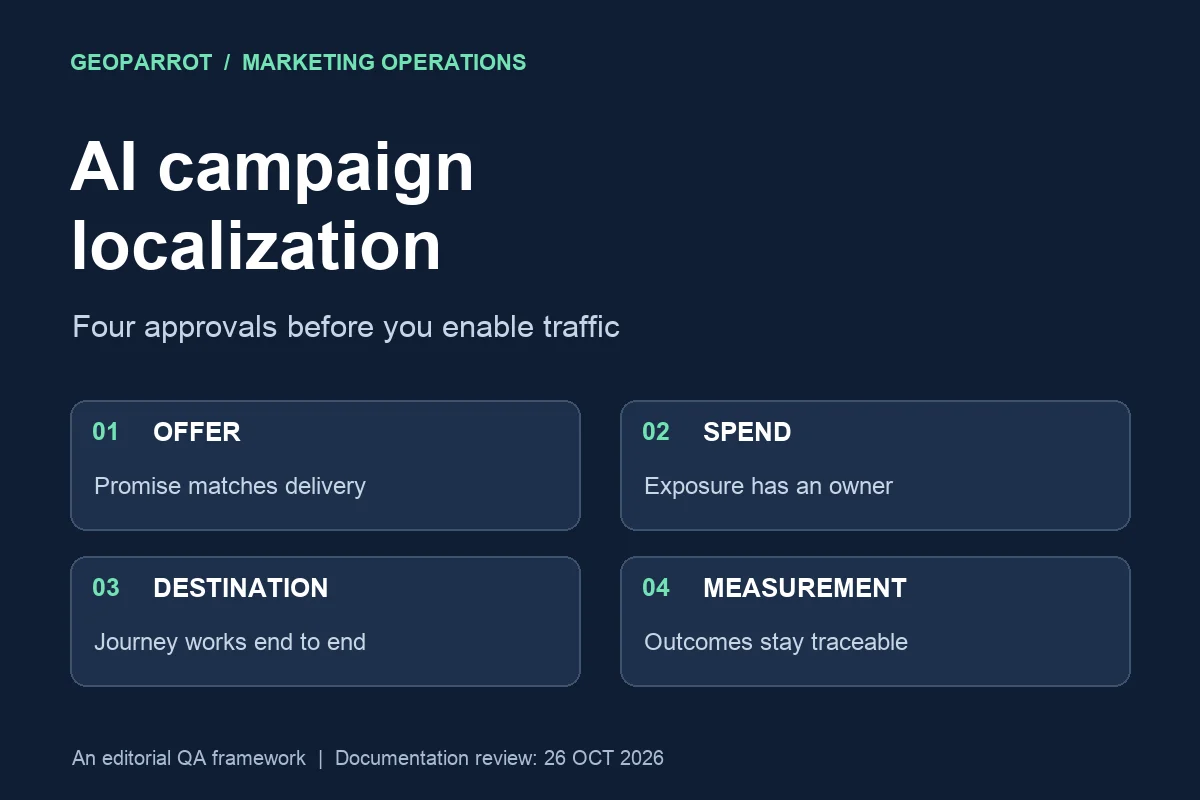
Before enabling a localized Google Ads campaign, approve four things separately: the offer, the spending boundary, the destination, and the measurement path. A convincing translation can still lead to an unavailable product, an unsuitable budget, or a conversion report that cannot distinguish the new market.
This is a documentation-based operational checklist, reviewed October 26, 2026. GeoParrot has not tested the beta in an advertiser account. Google’s help page has no visible publication date; this article does not establish a new rollout date or universal account access. The review workflow below is our editorial recommendation, not a vendor benchmark.
What the documented beta does
Google’s AI campaign localization documentation describes a separate campaign created from an eligible English (US) Search campaign. It translates assets and keywords, offers landing-page translation or URL replacement, and copies budgets and bids without currency conversion. The default publication state is paused.
Check the live documentation for supported target languages and account exclusions. The page also mentions planned Performance Max support from September 2026, while its main eligibility text describes Search. Confirm support in your account rather than treating that date as verified access.
Use four approval gates
Assign an accountable person to each gate. One person can own several, but each approval should name the evidence reviewed. This prevents the translation reviewer from implicitly approving campaign economics or the analytics reviewer from approving a commercial promise.
Editorial launch-control worksheet: proposed checks, not measured results.
Gate
Question to resolve
Evidence to retain
Reason to hold
Offer
Can this market receive what the ad promises?
Reviewed copy, destination, fulfillment terms
Unsupported claim or unavailable service
Spend
Is the new exposure explicitly approved?
Account currency, budget, bidding target, owner
Copied settings lack a market rationale
Destination
Can the visitor complete the promised journey?
Mobile journey and form or checkout QA
Language or destination mismatch
Measurement
Can we identify and evaluate this market?
Tracking checks and conversion definitions
Missing identifiers or ambiguous outcomes
1. Review the commercial promise before polishing language
Begin with the offer that will actually be available after the click. List service geography, delivery restrictions, supported payment methods, customer-support language, cancellation terms, and the owner who can verify each item. A translated asset is ready only when the destination and operational team can honor it.
Have a fluent reviewer evaluate the complete ad-to-page combination. Ask whether a first-time visitor would infer the same price, commitment, and eligibility from both. Back-translation can help flag changed meaning, but it cannot establish local suitability. Keep brand names, product terms, and claims requiring evidence in a shared review list.
Review the visual message too. Google’s documentation describes text removal from images with translated messaging supplied separately. Check whether the remaining image still makes sense without its original wording. A promotion whose qualification lived inside an image may need a clearer accompanying asset. This is a review concern, not a claim that the tool routinely removes disclosures.
Save the version that received approval. If another team changes the landing-page offer before launch, reopen the offer gate. Approval of yesterday’s copy is weak evidence for today’s customer experience.
2. Give the localized campaign its own spending decision
Build a small configuration record before enabling traffic: account currency, average daily budget, bid strategy, targets, campaign objective, conversion actions, and any budget relationships visible in the account. Compare the copied configuration with the approved launch plan field by field. A familiar number is easy to overlook precisely because it looks intentional.
The initial market budget should express an acceptable business exposure. Ask who can authorize additional spending, which outcome would justify it, and what would trigger a pause. Use your own contribution margin and customer qualification criteria. There is no evidence here for a universal starter budget or a guaranteed translation-driven uplift.
Our guide to ROAS, CPA, CTR, and conversion rate helps distinguish response metrics from business value. A market can generate inexpensive inquiries while producing few qualified customers. Record which definition will govern the review before the first result arrives.
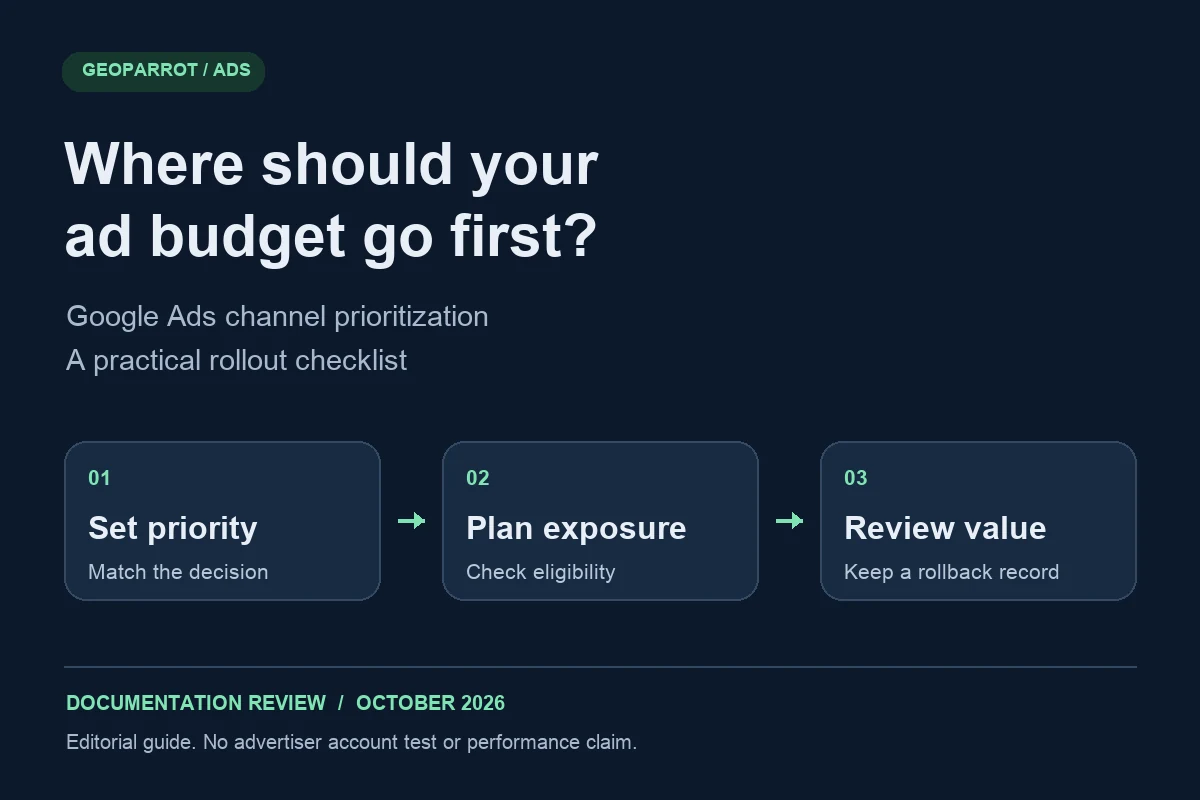
If inventory policy also needs attention, use the separate Google Ads spending-control checklist. Campaign localization and inventory prioritization solve different decisions. Avoid changing both together unless the launch requires it; if you do, record both so later analysis does not attribute every movement to translation.
3. QA the destination as a customer journey
Choose the destination strategy with the website owner. An existing local-language page may have established pricing and support workflows; a dynamically translated page may need a different review path. Neither approach should be approved solely because the headline reads well.
Walk from the intended entry page through the primary action on mobile and desktop. Check language persistence, navigation, price presentation, form labels, validation errors, confirmation messages, and the support handoff. Include a return visit and any relevant consent choices. Record the browser, device, page version, and steps so someone else can reproduce a problem.
A URL replacement rule deserves its own sample review. Check representative product pages, category pages, and unusual paths, rather than only the homepage. A syntactically valid destination can still resolve to a generic page that has lost the original intent. Record both the requested URL and the final URL.
The official instructions contain a standalone note about not updating URLs near their URL-replacement guidance. Do not invent an interpretation of that ambiguity. Use the workflow actually shown in your account and seek clarification before applying broad replacements. This checklist deliberately avoids providing a bulk-edit command.
4. Preserve attribution through the localized journey
Check redirects and language routing with the analytics owner. Google’s redirect troubleshooting guidance explains that losing the Google Click Identifier can break the association between a click and subsequent conversions. Record where identifiers enter, where navigation redirects, and which final page receives them. A synthetic parameter check can inspect URL handling; it does not prove an actual ad click was attributed.
If your organization has an intentional manual-tagging requirement, apply a shared UTM naming convention across markets. Use the UTM Builder to inspect the resulting URL, then verify it against the account’s tracking design. These resources support a documented exception; adding UTMs everywhere can create conflicting reporting assumptions.
Define how the new market will be separated in reporting: campaign identity, destination language, business geography, and conversion action. A language label is not proof of customer location. Agree on the dimension that answers each question instead of treating all four as interchangeable.
A worked planning example
Imagine an English-language subscription business preparing a French campaign. This is a hypothetical planning exercise, not a GeoParrot campaign result. Its team first confirms that French-speaking customers can buy the advertised plan and receive the promised support. The website owner maps the ad destination through signup and confirmation.
The media owner then reviews the proposed budget against an approved exposure boundary. Analytics checks the identifier path and defines a qualified signup consistently with the source campaign. A fluent reviewer finds that a translated phrase suggests a broader support commitment than the business offers. The campaign stays paused until the ad and destination share an accurate promise.
After launch, the team plans to review qualified outcomes using a window appropriate to its own conversion delay. Early clicks may help diagnose delivery; they cannot establish customer quality. If the cohort remains incomplete, the record says so. That restraint makes the eventual decision more useful than an immediate success claim based on a small response count.
Copy this release record
Scope: source campaign, destination campaign, language, geography, and account owner.
Economic approval: currency, budget, targets, exposure boundary, and spending approver.
Journey evidence: device, route, form or checkout result, and remaining defects.
Measurement evidence: identifier checks, reporting dimensions, conversion definition, and limitations.
Release decision: hold or enable, responsible owner, review trigger, and pause procedure.
Keep the record short enough to maintain. Review it when an offer, URL route, consent setup, or conversion definition changes. The useful output is a traceable decision about one market, with clear evidence and a named owner for the next check.
Frequently asked questions
Can we assume the beta is available in every account?
No. Check the current account and official eligibility guidance. This article did not test access or verify a universal rollout date.
Does a translated campaign need a separate budget review?
Yes. Review the proposed exposure against the new market’s economics and get an accountable owner to approve it before enabling traffic.
Should every localized campaign use manual UTM tags?
No. Start with the existing auto-tagging and Analytics linkage design. Use manual tags only for a documented reporting requirement reviewed by the analytics owner.
What evidence would justify keeping the campaign paused?
An unsupported offer, an incomplete customer journey, an unapproved spending boundary, or unresolved measurement defects are practical reasons to hold the launch.




Leave a Reply