
Evidence-first case study · sports brand SEO + GEO series, part 1 of 20
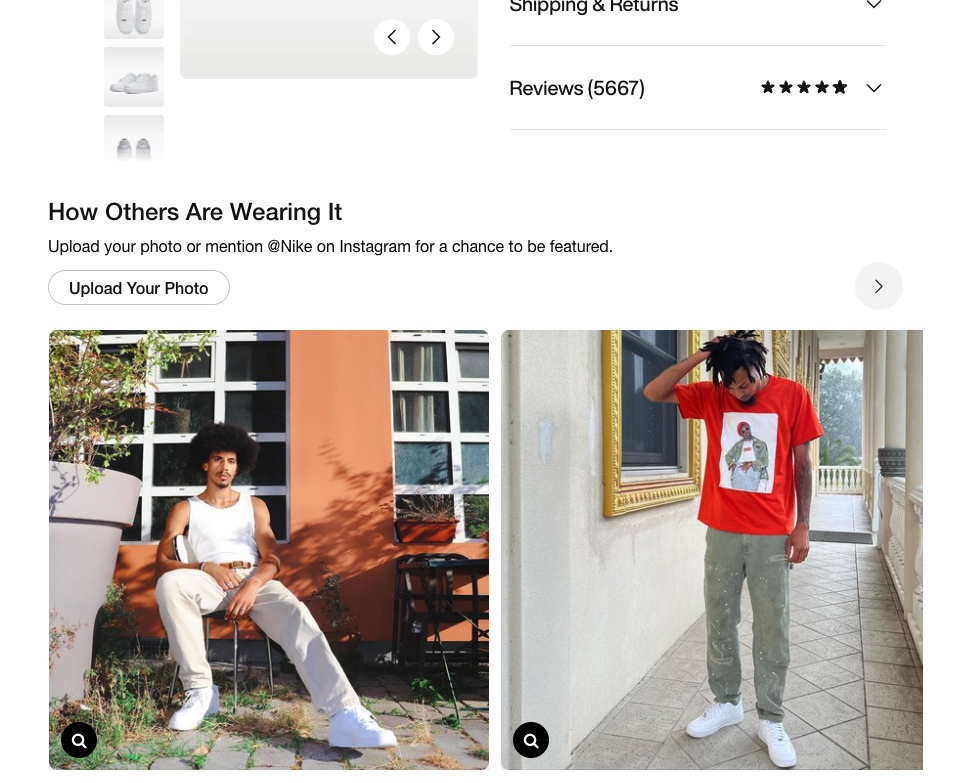
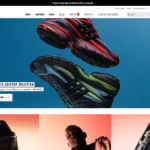
Nike’s commerce plumbing is solid — structured Offer data, 62 locale sitemaps, no AI-crawler blocks — but its answer-engine readiness is thin. Across 10 real queries sent to Google AI Mode, nike.com was cited (by brand-name chip) in exactly half; across 6 pages scored on our 8-pillar hygiene checklist, the average G-score was 0.44, dragged down by zero FAQ schema anywhere on the site, no byline/author markup, and no AggregateRating data despite a visible “5667 reviews” badge on the product page.
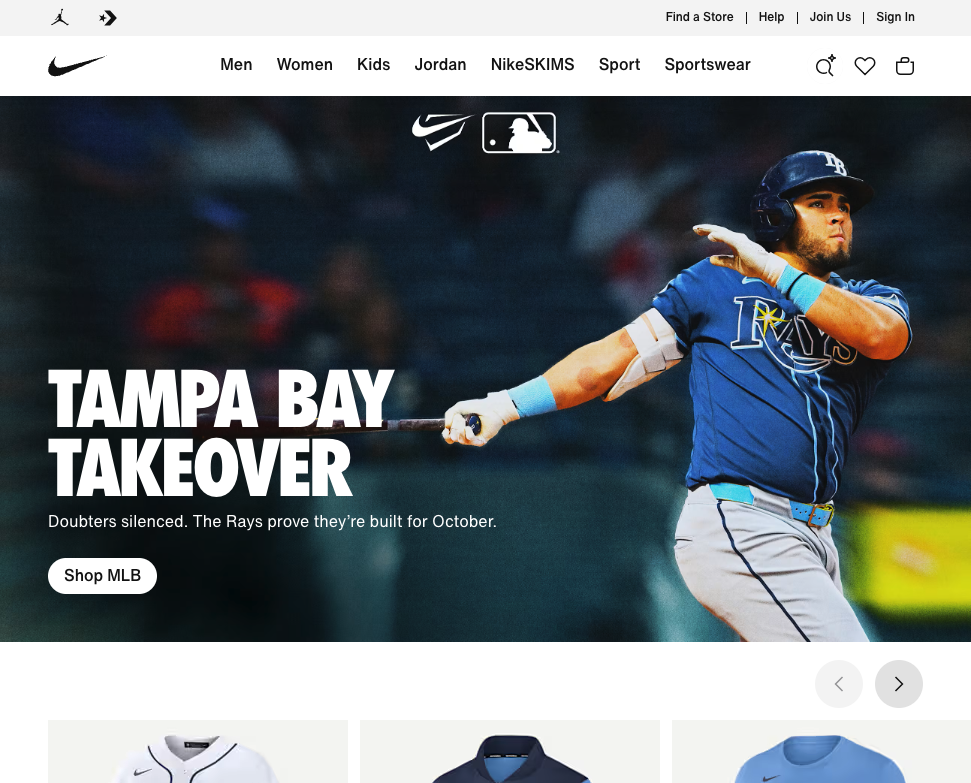
What is Nike.com trying to do — and why audit it?
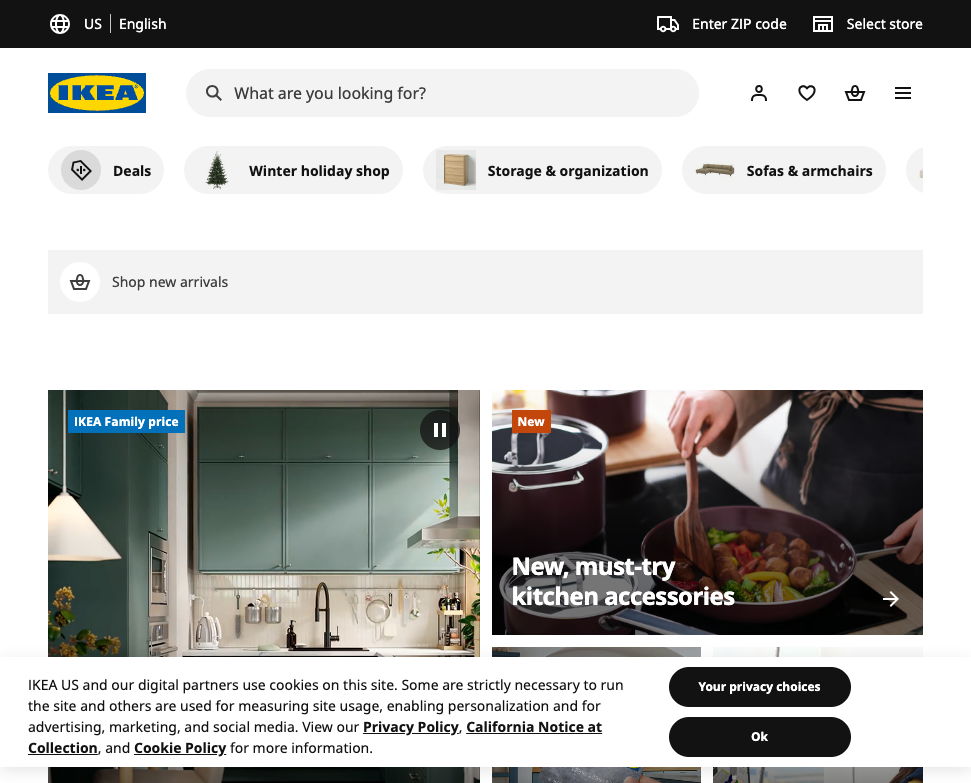
This is the first entry in a new GeoParrot series: one major sports and athletic-wear brand audited per day, using the exact same evidence-first method we already ran on IKEA and four travel-booking platforms. Nike is the natural starting point — the largest athletic brand by revenue, a hybrid catalogue-plus-membership commerce model, and a site that has to serve the same product identity (the Air Force 1, in this case) across dozens of country storefronts.
Global athletic footwear, apparel and equipment retailer; hybrid e-commerce + membership model (Nike Member).
Find a shoe or product that fits a sport, foot and budget, trust the sizing and reviews enough to buy, then get support if it doesn’t work out.
Carry structured product data and review trust signals through to AI answer engines, while keeping dozens of per-market catalogues (different SKUs, different colour ranges, different URLs) in sync.
The product we tracked: Nike Air Force 1 ’07
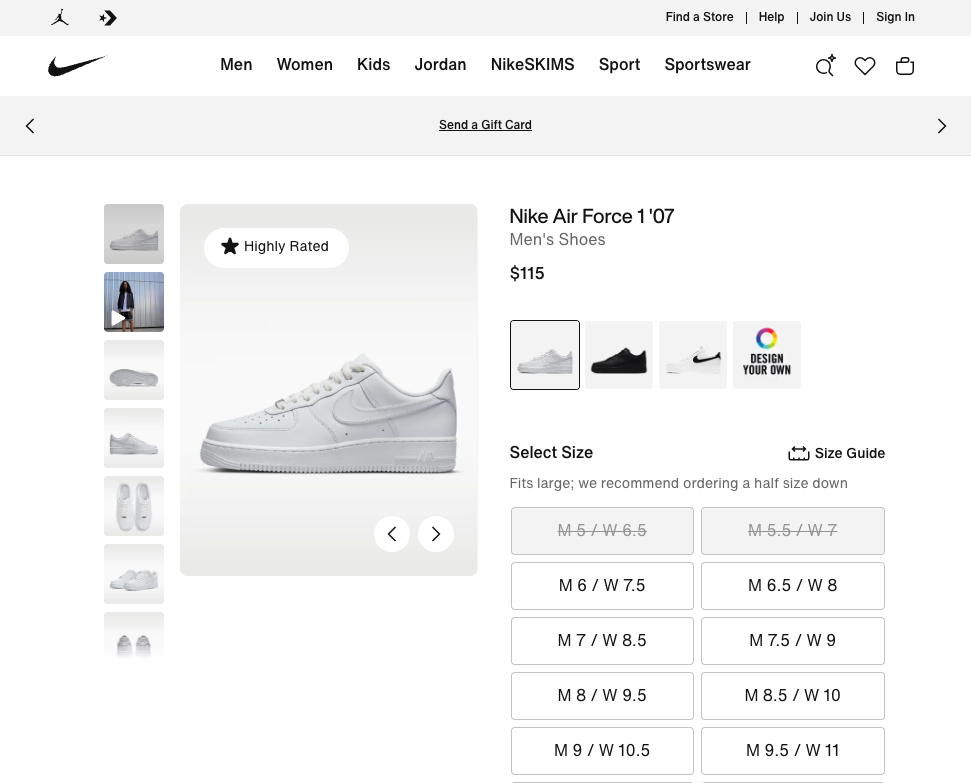
AI citation snapshot: 10 real queries, Google AI Mode
We sent 10 verbatim queries covering brand, product and comparison intent to Google AI Mode (udm=50) and recorded whether a cited source was labelled with the Nike brand name. Method note, reported honestly: our usual direct-URL capture (a[href]) returned almost no raw links this run — a change from what we documented in our Week 17 citation experiment on October 15 — so the signal below comes from AI Mode’s citation-chip publisher labels (aria-label text), which confirms the brand was cited but not the exact URL. We are not papering over that gap.
| Query | Nike.com cited? | Who else showed up |
|---|---|---|
| nike air force 1 07 review | ✅ Yes | RunRepeat, YouTube |
| nike return policy | ✅ Yes | (Nike-dominated) |
| are nike shoes true to size | ✅ Yes | Quora, whentocop.com |
| best nike shoes for flat feet | ✅ Yes | (Nike-dominated) |
| nike member rewards benefits | ✅ Yes | Rivo |
| best nike running shoes 2026 | ❌ No | iRunFar, RunRepeat, Gear Patrol, RTINGS, Running Culture (YouTube) |
| nike vs adidas running shoes | ❌ No | RunRepeat, Marathon Handbook, The Running Channel, EDDBUD (YouTube) |
| nike pegasus vs vaporfly | ❌ No | RunRepeat |
| nike air force 1 history | ❌ No | WWD, KICKZ, Finish Line, Farfetch, Instagram, Footshop (YouTube) |
| nike vs hoka marathon shoes | ❌ No | RunToTheFinish, Marathon Handbook, The Run Testers (YouTube), RTINGS |
Result: nike.com cited in 5/10 queries. The pattern is clean — Nike wins every direct brand/policy/product query (returns, sizing, member benefits, a named-model review) and loses every ranked “best of” or head-to-head comparison query to independent review publishers like RunRepeat and Marathon Handbook. We could not get a usable ChatGPT read this run: the web composer selector failed to load on all 3 attempted queries, consistent with the ChatGPT web-UI fragility we flagged in our Week 17 arc — reported as a measurement failure, not a zero.
G-score audit: the 8-pillar hygiene checklist, six pages
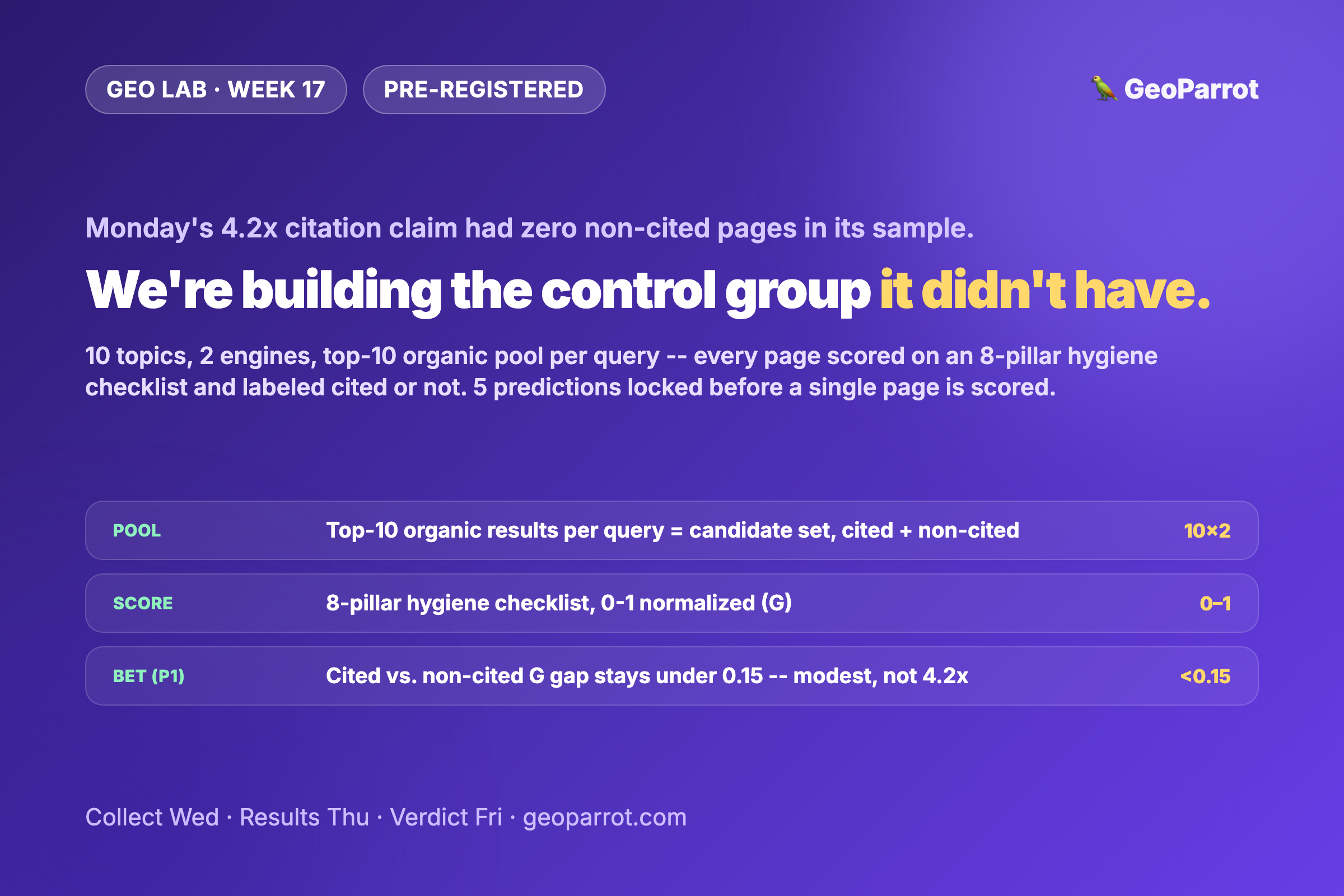
We scored six representative Nike URLs with the same 8-pillar static-HTML checklist (JSON-LD present, FAQ content, visible date, author byline, concrete data points, table/list structure, 3+ subheadings, a 30–500 character early answer) used in our Week 17 quality-score experiment.
| Page | G-score | Passes | Fails |
|---|---|---|---|
| US homepage | 0.375 | JSON-LD, lists, subheadings | FAQ, date, author, data points, early answer |
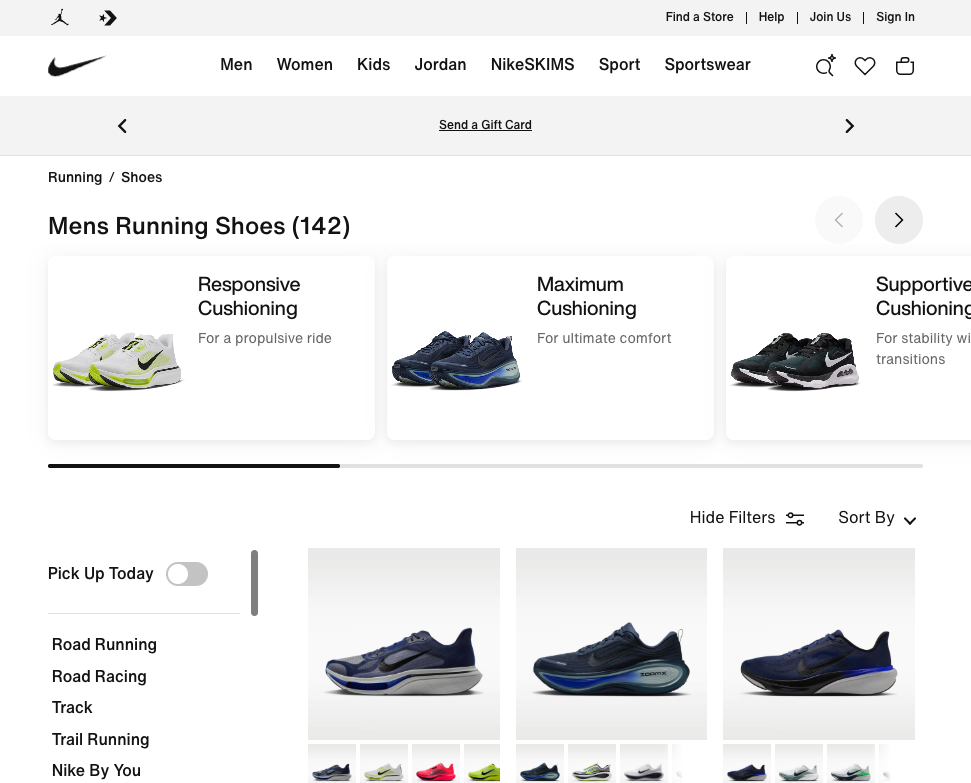
| Running shoes category | 0.625 | JSON-LD, date, data points, lists, subheadings | FAQ, author, early answer |
| Air Force 1 ’07 product page | 0.5 | JSON-LD, data points, lists, subheadings | FAQ, date, author, early answer |
| Pegasus 42 product page | 0.5 | JSON-LD, data points, lists, subheadings | FAQ, date, author, early answer |
| Korea homepage | 0.375 | JSON-LD, lists, subheadings | FAQ, date, author, data points, early answer |
| Get Help centre | 0.25 | Lists, subheadings | JSON-LD (zero script tags), FAQ, date, author, data points, early answer |
Average G-score across six pages: 0.4375.
Two pillars fail on every single page we checked: no page anywhere on nike.com carries FAQPage schema or author/byline markup, including the Get Help centre, which visually displays “Quick Assists” Q&A-style content with zero supporting JSON-LD at all.
Technical check: robots.txt, llms.txt, sitemap, schema
User-agent: * block disallows member-account pages, */p/, /checkout/, PDFs and a handful of regional help paths, plus /kr/en specifically (the English-language Korea storefront). No directive names GPTBot, ClaudeBot, PerplexityBot, CCBot, Google-Extended or OAI-SearchBot — AI crawlers fall under the same general rule as everything else, same pattern we found on IKEA. Separate narrow rules scope Baidu/Sogou/Haosou spiders to /cn only.www.nike.com/llms.txt returns HTTP 404; the bare nike.com/llms.txt 301-redirects into the same 404. See our explainer on what llms.txt actually does before treating this as a ranking problem — Google Search does not read it.ko-kr file for Korea.ProductGroup JSON-LD block with 24 size variants, each with its own Offer (price, currency, GTIN, MPN, condition). Solid machine-readable commerce data. Gap: no AggregateRating or Review schema anywhere on the page, despite the UI visibly showing a 5-star badge and “Reviews (5667).”nike.com/kr/ko/ returns a “Page not found” title in a real browser; the actual Korean-language homepage lives at the bare nike.com/kr/. The identical Air Force 1 ’07 Low carries a different style code in each market (US CW2288-111 vs Korea DO6701-100), a slightly different product name (Korea’s listing explicitly adds “로우”/”Low”), and the Korea swatch row shows 11 colourways against four on the US page. List price was $115 (US) vs ₩169,000 — roughly in line once converted, not a glaring mismatch.What works / What to verify
Structured Offer data at the SKU/variant level, a sitemap architecture built for dozens of locales from the start, and a category page (142-item running shoe grid) that resolves a broad need into a filterable comparison set — the same discovery pattern our IKEA audit flagged as effective.
This audit sampled one product family (Air Force 1 ’07) and six URLs — not the full catalogue. Whether the FAQ/author/AggregateRating gaps hold across Nike’s apparel and equipment categories (not just footwear) and whether the AI-citation pattern replicates on a larger query sample are both open questions the next pass in this series, or a reader’s own spot-check, should test.
Target query check — reported honestly, not inflated
Keyword-volume data for “[brand] SEO” style queries is what first surfaced this series’ core limitation: when we ran this exact check for five earlier case-study subjects on October 20, 2026 (Keyword Planner, US), four of five showed no measurable search volume at all, and the fifth (IKEA) showed only roughly 10 monthly searches. We did not have fresh Keyword Planner access in this session to re-measure “nike seo” or “nike geo audit” specifically, so rather than guess a number, we’re stating the pattern plainly: branded “SEO/GEO audit” long-tail queries like this one do not carry meaningful organic search demand on their own. The traffic case for this series rests on distribution — internal links, our own index, and readers who already follow the GEO Lab arc — not on ranking for the title phrase itself.
Frequently asked questions
Does Nike’s structured Offer data mean it’s well-positioned for AI shopping answers?
Partially. Price, GTIN, MPN and stock-condition data are all present and machine-readable at the variant level, which is genuinely useful for product-matching. But the pieces that tend to carry trust signals into an AI-generated answer — FAQ schema, author attribution, and AggregateRating — are absent everywhere we checked, including the page that visually displays “Reviews (5667).”
Why did Nike get cited in half the test queries but not the other half?
The split tracked intent cleanly: Nike.com was cited for direct brand, policy and single-product queries (returns, sizing, a named shoe’s reviews, member benefits) and was absent from every ranked “best of” or brand-vs-brand comparison query, where independent review publishers like RunRepeat and Marathon Handbook filled the citations instead.
Does a G-score of 0.44 mean Nike is unlikely to be cited by AI engines?
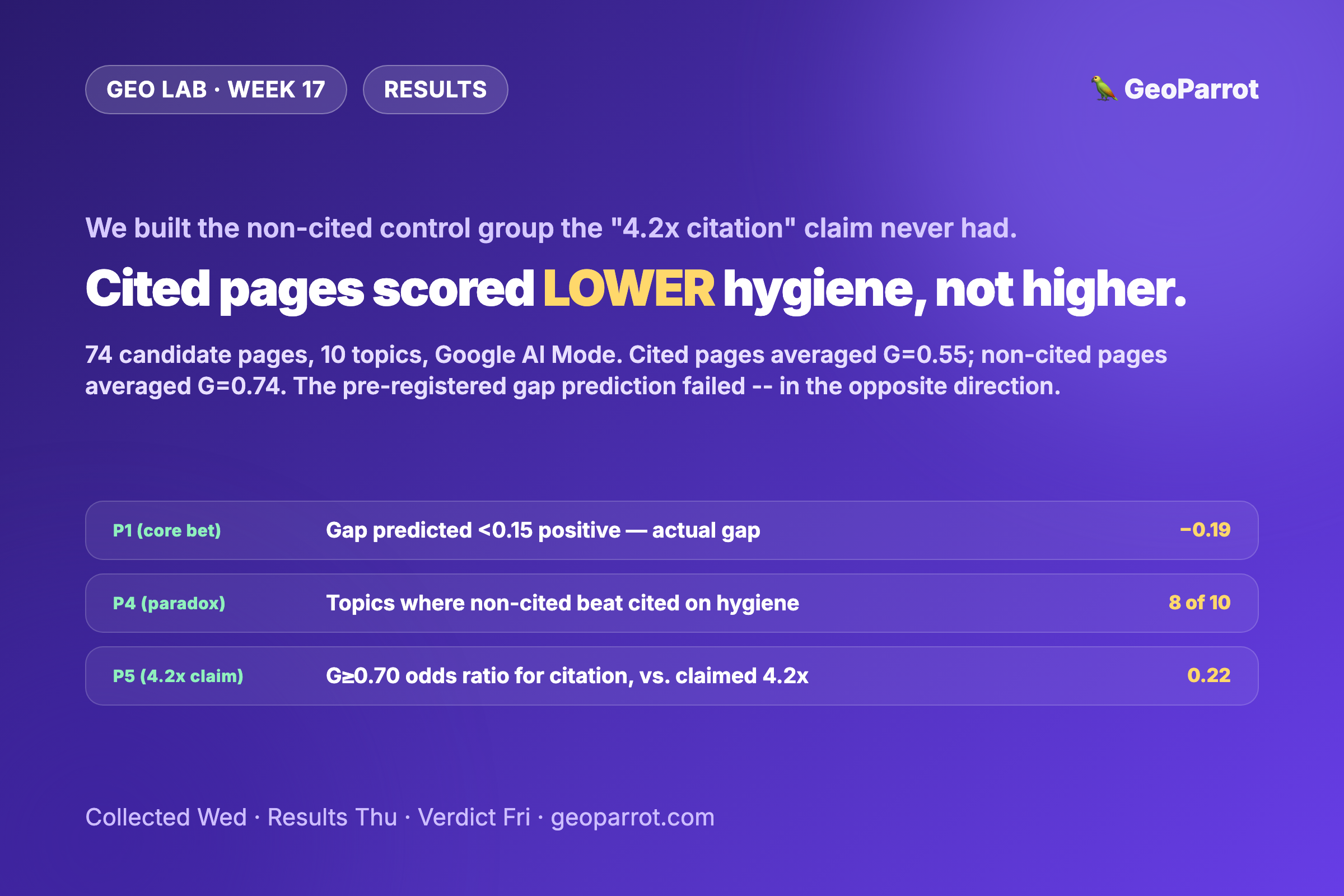
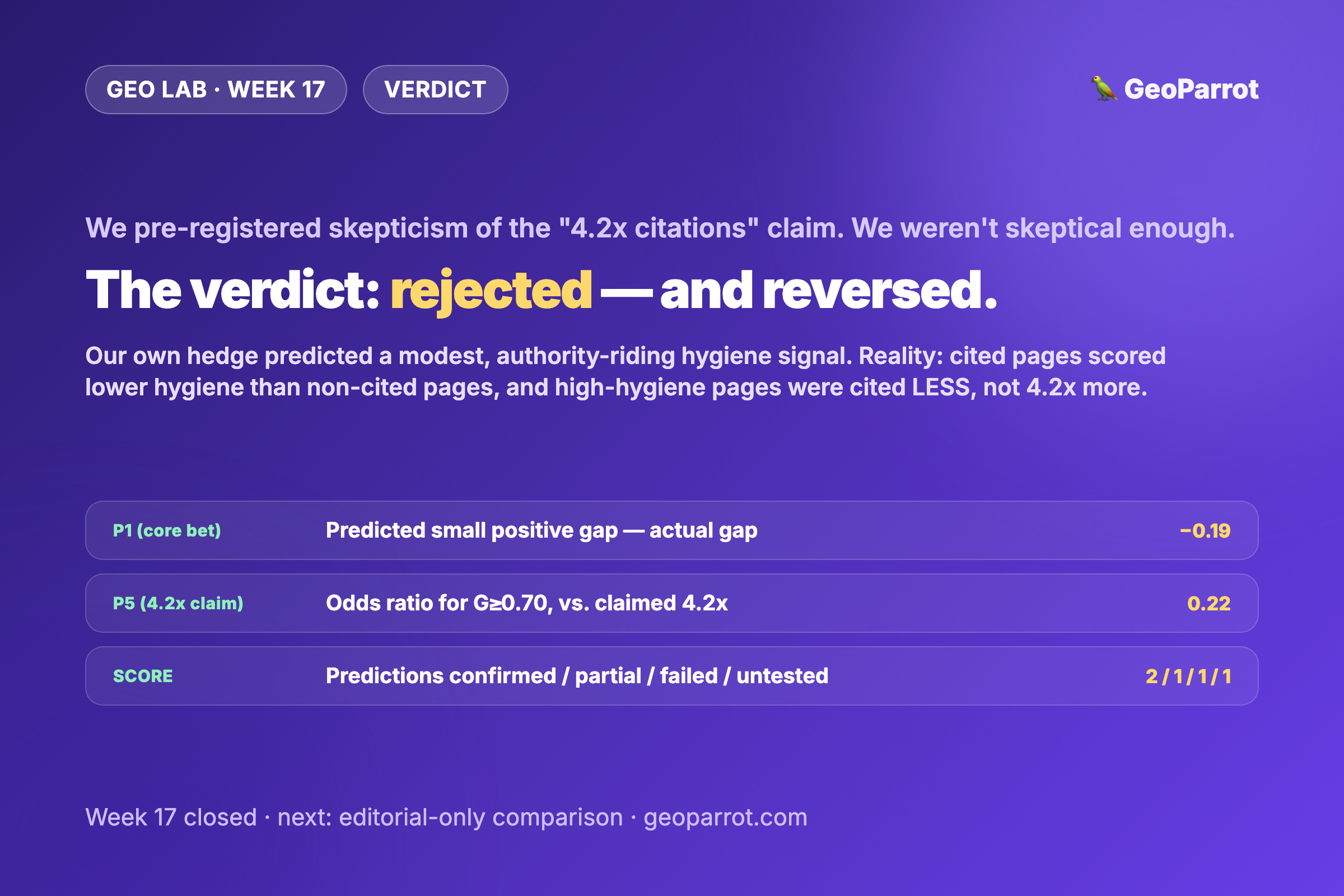
Not necessarily — and that’s worth saying plainly given our own prior research. Our Week 17 experiment found hygiene/structure score was not a reliable predictor of AI citation; cited pages in that test actually averaged a lower score than non-cited ones (odds ratio 0.22 for the “G≥0.70” threshold, the opposite direction from the 4.2x figure widely cited in GEO marketing material). Nike’s 0.44 average alongside a 5/10 brand-citation rate is consistent with that finding: domain and brand authority appear to be doing more work here than page-level hygiene.
Is the missing llms.txt file something Nike should fix first?
Probably not the priority. Google Search and Google AI Mode don’t read llms.txt — see our full breakdown of what llms.txt actually does. The FAQPage schema and AggregateRating gaps found in this audit are the more concrete, verifiable items worth fixing first.
Audit evidence, scope and limits
Inspected: October 22, 2026, public logged-out access from a Korea-based IP. Screens: US homepage, Men’s Running Shoes category, Air Force 1 ’07 product page (top and Reviews section), US Get Help centre, Korea homepage, and the matching Korea Air Force 1 product page — plus robots.txt, sitemap.xml and llms.txt checks, a 10-query Google AI Mode citation snapshot, and an 8-pillar G-score scored on six fetched pages (including the Pegasus 42 product page, not screenshotted).
Not measured: rankings, Search Console performance, analytics, conversion, signed-in/member flows, ChatGPT citations (attempted, composer failed to load on all 3 tries), or the complete product/locale catalogue beyond the one product family and six URLs sampled here. This is a public-signal snapshot, not a performance claim or a full-catalogue crawl.
This is part 1 of a daily series. Every day, GeoParrot runs this same evidence-first method — real screenshots, a 10-query AI citation snapshot, an 8-pillar G-score audit, and an honest target-query check — against one more major sports and athletic-wear brand. Tomorrow: the next name on the list.

Leave a Reply