Quick answer: We ran five brand-name searches for GeoParrot itself — plain name, plus name, blog, GEO Lab, and a research-framed query — and every single one triggered a Google AI Overview. The summaries were accurate. The citations overwhelmingly pointed back to our own domain, and within our own domain they skewed heavily toward GEO Lab experiment and data posts rather than our guides or trend coverage. Running this check also surfaced a real external backlink we weren’t tracking (a blog post engaging directly with one of our findings) and two name-collision false positives (unrelated sites that merely share part of our name).
Self-audit — published October 21, 2026, in the GEO Lab. Not a pre-registered experiment like our usual weekly arcs — this one started as a simple question (what does Google’s AI say about us?) and turned into a small audit worth writing down.
Why check your own brand name at all?
Most GEO advice is about getting cited for topic queries — “best X,” “how does Y work.” Brand-name queries are a different, smaller test: does the AI engine actually understand what you are, and when it answers, does it reach for your own pages or for what other people have said about you? That second question is the one that matters for a site our age. If an AI Overview describing us pulls almost entirely from our own domain, that is a visibility win but not yet an authority signal. If it starts pulling from independent third-party coverage, that is the signal we are actually chasing.
What we ran
Five queries, logged out, US results: geoparrot, geoparrot blog, geoparrot geo lab, what is geoparrot.com, and geoparrot ai citation research. For each one we recorded whether an AI Overview appeared, what it said, and every external link attached to the overview’s citation chips.
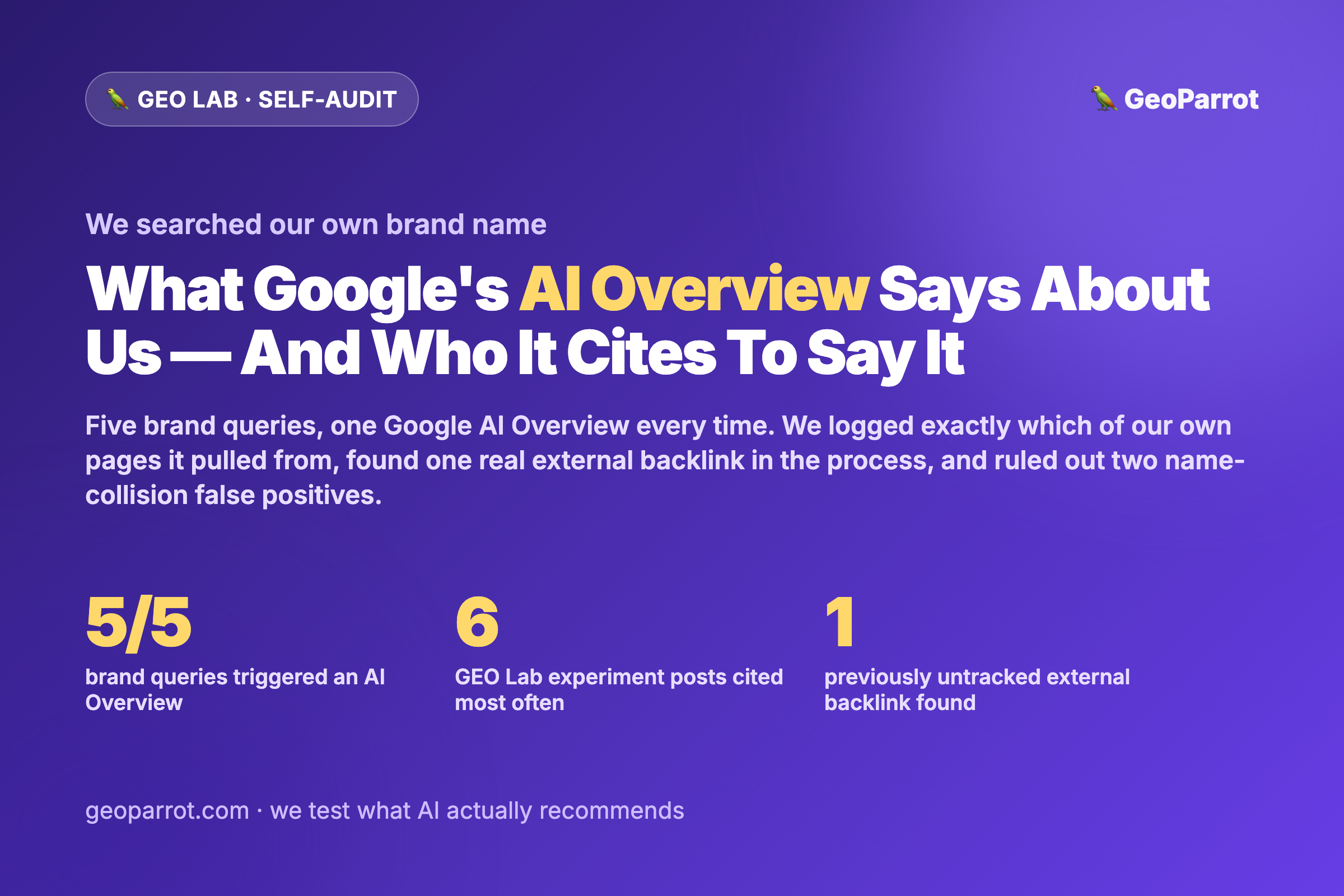
All 5 queries we ran, whether each triggered an AI Overview, and what it cited to answer it.
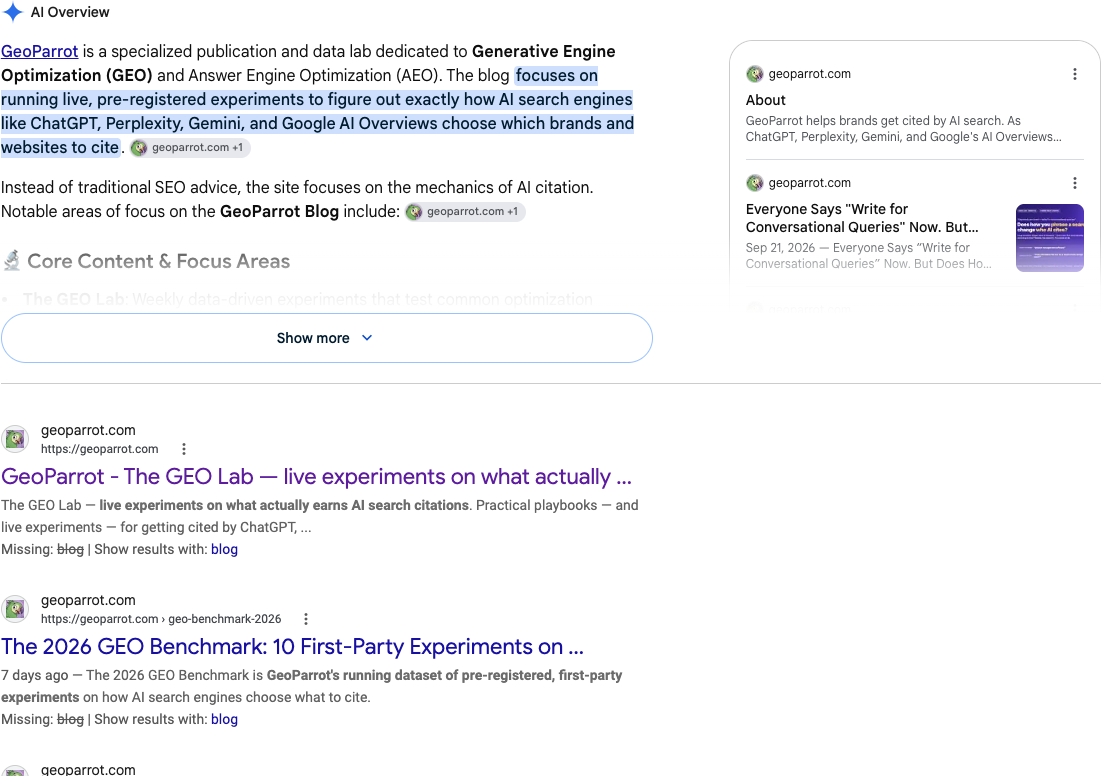
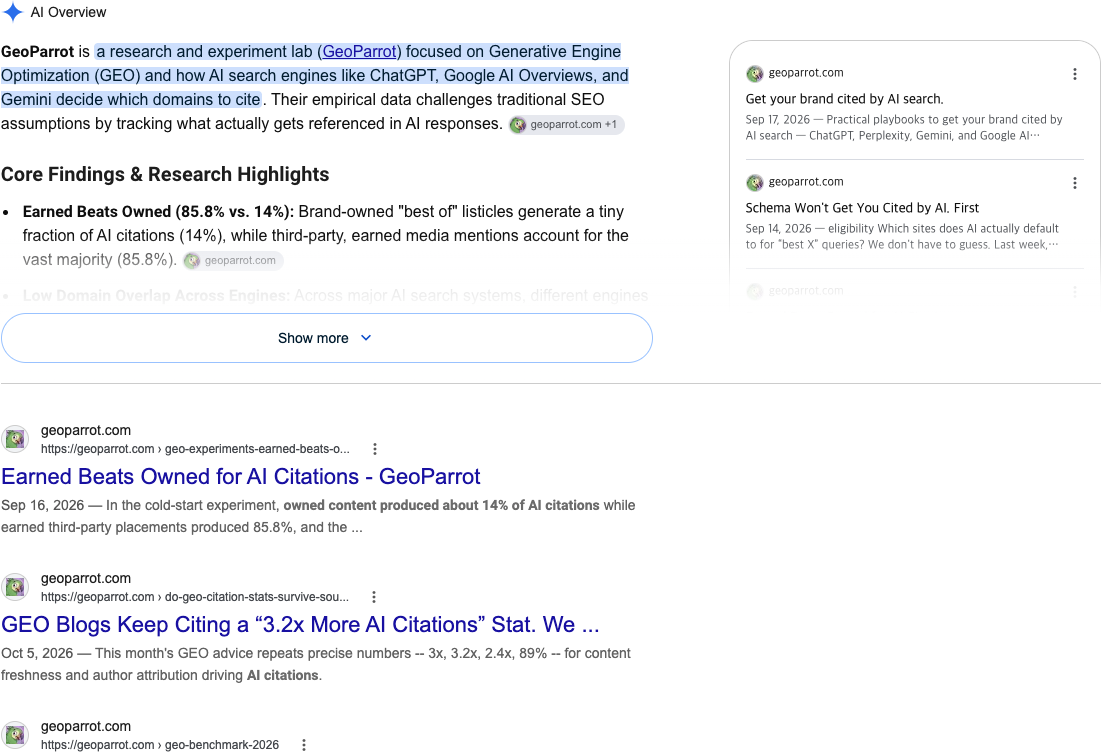
Actual AI Overview for “geoparrot blog” — citation chips on the right pull from our About page and a specific trend post, not just the homepage.
Result 1 — 5 of 5 queries triggered an AI Overview, and the summaries were accurate
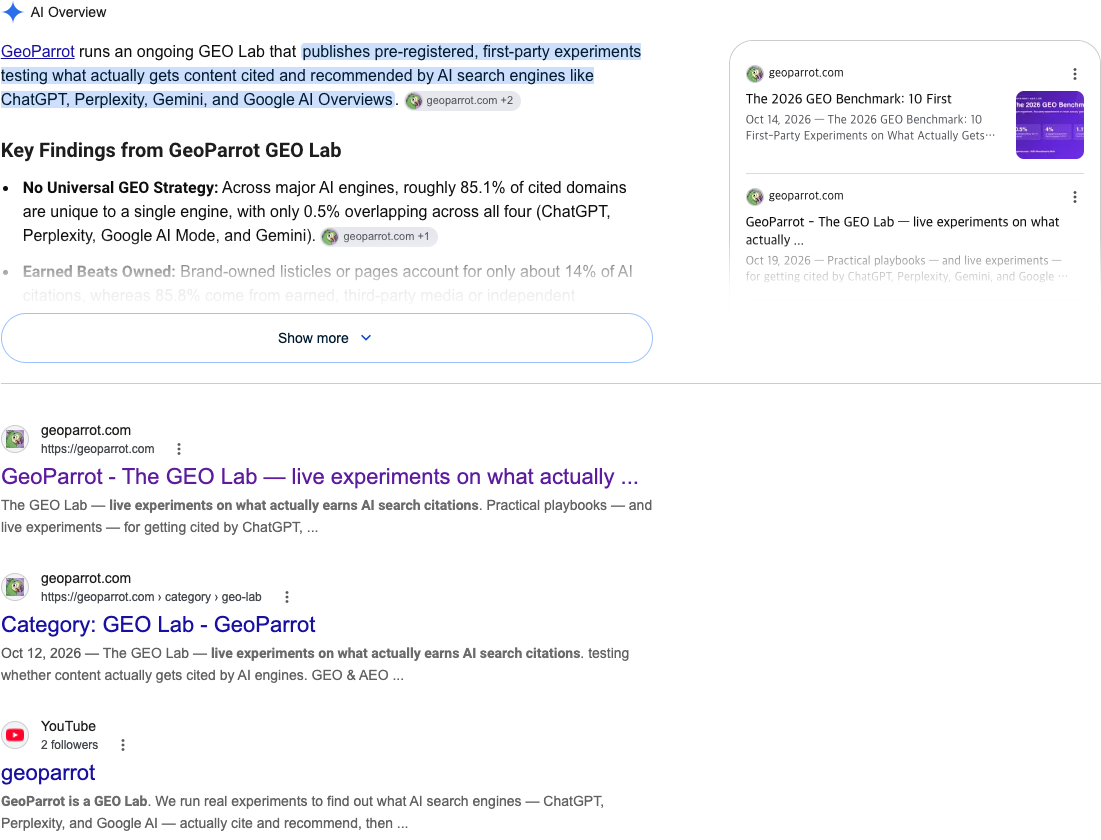
Every query produced an AI Overview, not just a regular SERP. More notable: the summaries correctly described what GeoParrot actually is — a GEO research lab that runs pre-registered experiments on ChatGPT, Perplexity, Gemini, and Google AI Overviews citation behavior — and pulled specific, correct findings, including the cross-engine overlap number from our own first experiment (“only about 0.5% of cited domains overlap”). Brand comprehension is not the gap here.
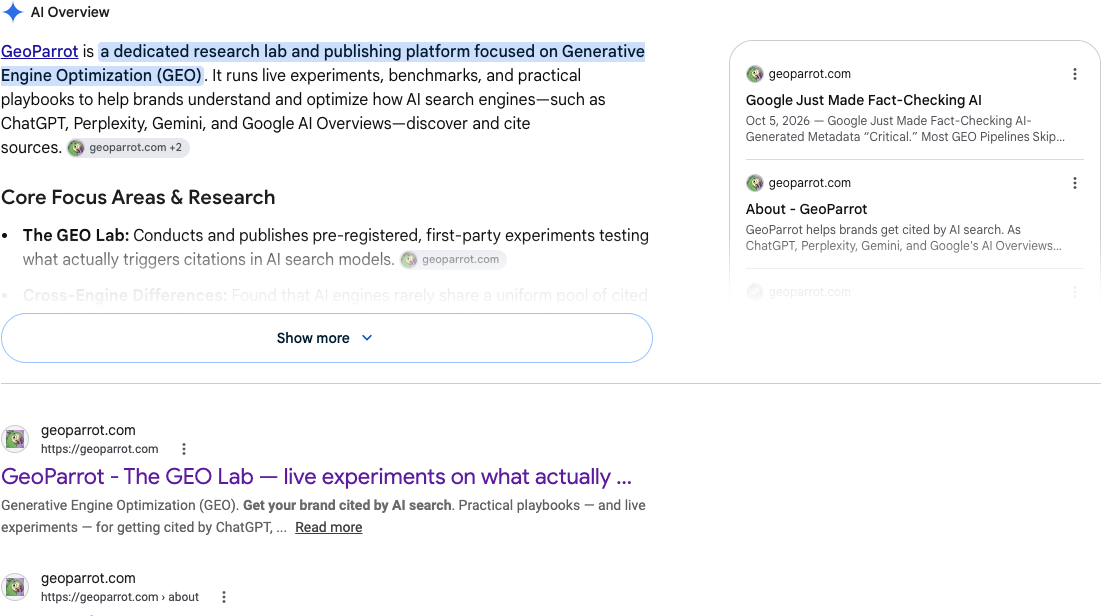
AI Overview for the plain query “geoparrot” — chips cite our About page and a recent trend post directly, alongside the summary paragraph.
Result 2 — citations skew hard toward GEO Lab data posts, not guides or trend pieces
Result 3 — a real external backlink we weren’t tracking
One citation chip under the “geoparrot ai citation research” query pointed to a third-party blog, dalindegraff.com. We checked the actual page rather than trusting the snippet: it’s a real post about AI visibility tracking and model-version confounds, and it directly engages with our October 14 trend-watch analysis, at one point writing “GeoParrot’s advice here is right.” That’s a genuine earned citation from an independent writer — not one we had logged in our own backlink tracking before this check. Small, but it’s exactly the kind of signal we flagged as the real bottleneck in our backlink work: someone outside our own domain, unprompted, engaging with a specific finding.
Result 4 — two false positives worth knowing about
Two other domains showed up adjacent to our brand queries that, on inspection, have nothing to do with us: geopard.tech and thegeolab.net. Both just happen to share part of our name or niche terminology (“GEO,” “lab”). We checked both pages directly for any mention of “geoparrot” — zero hits on either. If you run this same self-audit on your own brand, don’t assume every adjacent result is really about you; check the page text, not just the fact that Google surfaced it near your query.
What this means if you’re running a small GEO-focused site
Searching your own brand name is a cheap, five-minute audit that most sites skip. It tells you three things at once: whether the AI engine understands what you do (ours did), which of your own pages it treats as authoritative (ours skewed toward original-data posts, which is the lever worth doubling down on), and whether anyone outside your domain is actually talking about you (we found exactly one, which is one more than we knew about an hour earlier). We’re folding this into the AI Overviews playbook‘s open question about what correlates with citation, and we’ll re-run this same five-query check periodically to see whether the external-citation count moves.
Frequently asked questions
Does an AI Overview appearing for your brand name mean you rank well?
Not on its own. A brand-name AI Overview mostly tells you Google’s AI has enough training and crawl exposure to describe what you are. It says little about competitive, non-branded queries, which are a separate and much harder test.
Why did GEO Lab experiment posts get cited more than guide-style content?
We don’t have a controlled test proving causation from this check alone, but it lines up with a broader pattern: original data and first-party findings tend to get picked up as citation material more than general advice content, because there is a specific, quotable number or finding to point to rather than a restated best practice.
How do you tell a real backlink from a name-collision false positive?
Open the actual page and search it for your brand name directly. Don’t rely on Google surfacing it near your query as proof of a real mention — in our check, two of the adjacent results had zero actual mentions of our name once we looked at the page text.
Will you repeat this self-audit?
Yes, periodically, mainly to track whether the count of genuine external citations grows over time as a simple proxy for whether our backlink and outreach work is landing.
Sources
Google Search AI Overview results for 5 brand queries, collected October 21, 2026 (US, logged-out results).
Leave a Reply