
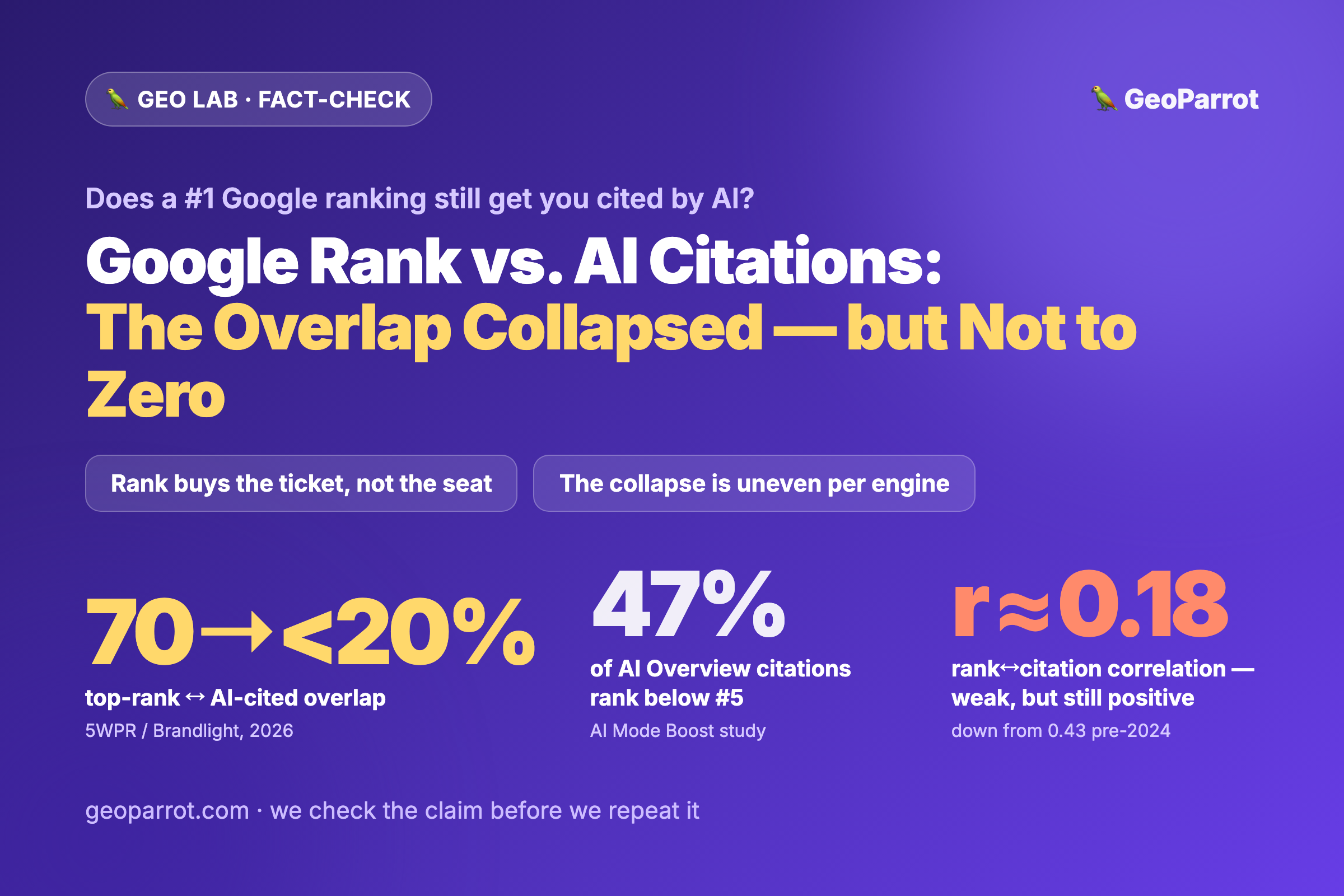
Quick answer: Not reliably — but “SEO is dead for AI” overshoots the data. A widely-cited 5WPR/Brandlight analysis found the overlap between top Google rankings and AI-cited sources fell from ~70% to under 20%, and one study puts 47% of AI Overview citations on pages ranking below #5. So a #1 Google ranking no longer buys you an AI citation. But the correlation collapsed; it didn’t reach zero. It’s still positive (one study measures r≈0.18), and ~92% of AI Overviews still cite at least one top-10 domain — rank still gets you into the candidate pool, it just no longer wins the citation. And the decoupling is uneven by engine: Google’s AI Overviews sit on Google’s own index, so rank still matters more there, while ChatGPT and Perplexity drift toward Reddit and community sources where rank barely predicts anything. Treat “rank predicts citation” as a per-engine, testable question — which is exactly what we’re measuring this week.
GEO Lab — Week 11, article 1 of 4. This is a fact-check post: we report what the studies actually found, flag what’s still a single-source hypothesis, and set up an experiment to test the claim on our own data. Follow the arc in the GEO Lab.
Did Google rank and AI citations really decouple?
Yes — this part of the story holds up. In its “GEO vs. SEO: The 2026 Venn Diagram” research (released May 2026), the communications firm 5WPR reported an independent Brandlight analysis finding that the overlap between the pages ranking at the top of Google and the sources AI engines actually cite collapsed from roughly 70% to under 20%. Put plainly: four out of five sources an AI answer cites are no longer the same pages sitting in Google’s top organic positions.
A separate study — attributed to AI Mode Boost, analyzing 15,847 AI Overview results across 63 industries — lands in the same direction from a different angle: 47% of AI Overview citations come from pages ranking below position #5, and it measures the rank-to-citation correlation at r≈0.18, down from 0.23 in 2024 and 0.43 before that. Both findings say the same thing: the tight, dependable link between “I rank #1” and “I get cited” has genuinely weakened over the last two years. That’s not hype — it’s a measurable trend, and it’s happening while zero-click searches climbed to roughly 68%, meaning the answer increasingly resolves on the results page without a click at all.
Does “70% → under 20%” mean SEO is dead for AI?
No — and this is where most of the coverage overshoots. A collapsing correlation is not a zero correlation. Look at the same numbers again with the other eye:
- r≈0.18 is still positive. Weak, yes — but higher-ranked pages are still more likely to be cited than lower-ranked ones, not equally likely and certainly not less likely. “Weak predictor” is not “no predictor.”
- ~92% of AI Overviews still cite at least one top-10 domain. In the AI Mode Boost data, the AI answer almost always includes a page that already ranks on page one. What weakened is position within the top 10 — being #1 versus #7 barely moves your citation odds — not whether ranking on page one matters at all.
- Rank buys the ticket, not the seat. The cleanest reading: ranking gets you into the candidate pool an engine retrieves from, but something else decides which candidate gets quoted. Freshness, off-site mentions, and machine-extractable evidence increasingly do the work rank used to — the levers we broke down in what AI search actually uses to decide what to cite.
So the honest headline isn’t “SEO is dead.” It’s: ranking is now necessary-ish but no longer sufficient. You still generally have to be indexed and visible enough to be retrieved — but being retrieved is the start of the citation contest, not the end of it.
Why does the decoupling differ by engine?
Here’s the caveat the single “under 20%” number hides: it’s an average across engines that behave very differently, so it flattens the most useful part of the story.
Google’s AI Overviews and AI Mode are a generative layer sitting on top of Google’s own index — the point we made in what “AI SEO” really means. They retrieve from the same ranked pool that classic search ranks, so rank still carries more weight there than the blended average implies. ChatGPT and Perplexity, by contrast, retrieve through their own stacks and lean heavily on Reddit, Wikipedia, and community forums — sources where your Google organic position predicts almost nothing about whether you get pulled in. When you blend a rank-correlated engine with two rank-indifferent ones, the composite overlap looks like a collapse even though the collapse is far steeper on some engines than others.
We’ve seen exactly this shape in our own first-party runs: across engines, the sources cited for the same buyer-intent question overlapped only about 3% in common, with ~84% cited on a single engine and nowhere else (our cross-engine citation results). If the engines barely agree with each other on what to cite, no single “rank predicts citation” number can be true for all of them at once — which is the whole reason there’s no universal GEO strategy.
What does a collapsed correlation actually mean for your strategy?
Three practical reads, in order of confidence:
- Don’t stop ranking — stop expecting ranking alone to earn the citation. Page-one visibility is still the retrieval ticket for index-backed engines. But budget for the second contest too: the evidence, freshness, and off-site signals that decide who gets quoted from the pool.
- Refuse a single blended target. “Get our AI-citation overlap up” is a vanity framing if it averages three engines that source differently — the same trap we flagged with AI share-of-voice as a vanity metric. Measure per engine, or you’ll optimize for a number that describes no real engine.
- Treat the exact figures as hypotheses, not physics. The 70%→20% collapse is corroborated across outlets; the r≈0.18 and 47%-below-#5 figures come from a single study we haven’t reproduced. They point the right way, but the responsible move is to test them on your own queries before you re-cut a budget around them.
How are we testing this in the GEO Lab this week?
Instead of repeating the “70% → 20%” line, we’re going to measure the overlap ourselves. This week’s theme question: does ranking on Google still predict whether AI engines cite you — and how much does that answer change per engine? The plan for the rest of the arc:
- Tomorrow (design + pre-registration): lock a set of buyer-intent queries, define exactly how we’ll capture Google’s top-10 organic results and the sources cited by ChatGPT, Perplexity, and Google AI Mode, and commit our predictions before we look.
- Midweek (collection): run the queries with our browser harness and record the raw citations and rankings — no peeking at the prediction table.
- Thursday (results): score the overlap between Google rank and AI citations, per engine, with charts.
- Friday (verdict): a plain-English ruling on whether rank still predicts citation, and a per-engine playbook.
Bottom line: the decoupling is real — a #1 Google ranking is no longer a receipt for an AI citation. But “SEO is dead for AI” is the wrong lesson. Rank still opens the door on index-backed engines; it just stopped choosing who walks through it, and it never had much say on the community-sourced engines to begin with. The number that matters isn’t a viral average — it’s the one you measure on your own queries, one engine at a time. We start measuring tomorrow.
Frequently asked questions
Did the overlap between Google rankings and AI citations really drop from 70% to under 20%?
That figure comes from a Brandlight analysis reported by 5WPR in its 2026 “GEO vs. SEO” research, and it has been repeated across multiple outlets. It says the overlap between the top Google-ranked pages and the sources AI engines cite fell from roughly 70% to under 20% — meaning about four of five AI-cited sources are no longer top organic pages. The direction is well-corroborated; the precise percentage is one firm’s measurement, so treat the exact number as indicative rather than settled.
Does this mean SEO no longer matters for AI search?
No. The rank-to-citation correlation weakened but stayed positive (one study measures r≈0.18), and roughly 92% of AI Overviews still cite at least one page from Google’s top 10. Ranking still gets you into the pool an engine retrieves from; it just no longer guarantees you’ll be the source it quotes. What changed is that ranking became necessary-ish rather than sufficient — you now also have to win on freshness, off-site mentions, and extractable evidence.
Why is the decoupling stronger on some AI engines than others?
Because engines source differently. Google’s AI Overviews and AI Mode are built on Google’s own ranked index, so classic rank still correlates with citation there. ChatGPT and Perplexity retrieve through their own systems and lean heavily on Reddit, Wikipedia, and community forums, where your Google position predicts little. A single blended “overlap” number averages these very different behaviors, so no one figure is true for every engine at once.
Should I stop investing in Google rankings?
No — but stop treating rank as the finish line. For index-backed engines like Google’s, page-one visibility is still the retrieval ticket. The shift is that you should also budget for the second contest: the evidence, freshness, and off-site signals that decide which retrieved page actually gets cited. Measure citation performance per engine rather than chasing a single blended overlap target.
How can I tell if my own rankings predict my AI citations?
Test it directly: pick a set of queries you care about, record Google’s top-10 organic results, then check which sources ChatGPT, Perplexity, and Google AI Mode actually cite for the same queries, and measure the overlap per engine. That’s precisely the experiment we’re running in the GEO Lab this week — the aggregate studies point the way, but your own query set is the only benchmark that describes your situation.
Leave a Reply