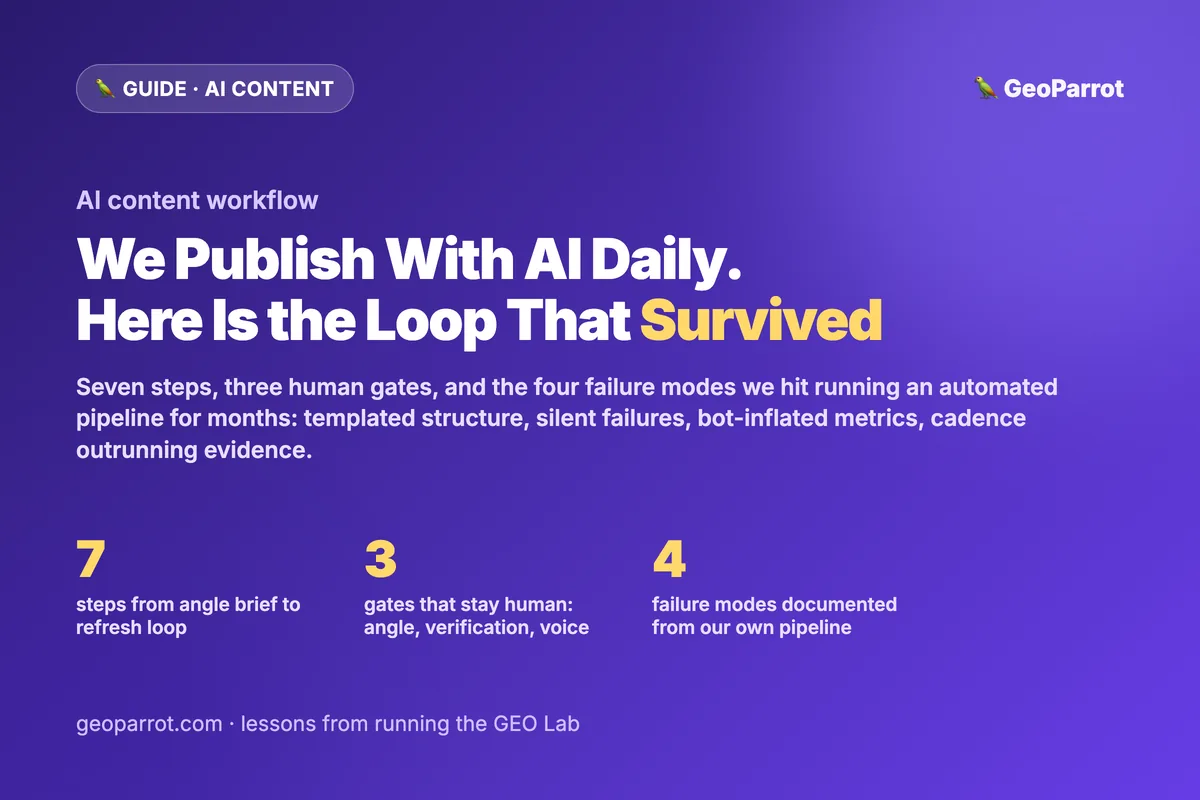
Quick answer: a workable AI content workflow puts humans at three gates (angle selection, claim verification, final voice pass) and lets AI do the expensive middle (research synthesis, drafting, variation). We publish on an AI-assisted pipeline daily on this site; this is the loop that survived contact with reality, including the failures.
The 7 steps, and who owns each
Step
Owner
Output
1. Angle brief
Human
One sentence: who searches this, what they get here that exists nowhere else
2. Evidence gathering
Human + AI
First-hand data, test results, screenshots, source links
3. Claims outline
AI, human-approved
Headings plus the specific claims each section will make
4. Constrained draft
AI
Full draft written against the outline and evidence only
5. Verification pass
Human
Every number, name, and quote checked against its source
6. Voice and structure pass
Human
Rewritten opening, varied structure, removed AI tells
7. Measure and refresh
Human + AI
GSC and analytics review at 28 days; refresh or prune
The order matters more than the tools. Evidence before outline means the AI drafts from facts you gathered, instead of inventing plausible-sounding ones. Outline before draft means you catch a weak angle at the cost of ten minutes, not a finished article.
Step details that are easy to get wrong
Step 1, the angle brief, is the only step that cannot be delegated. AI will cheerfully produce content for any topic; it cannot tell you whether the internet needs it. Our rule: if the brief cannot name something first-hand (our data, our test, our screenshots, our mistake), the piece does not enter the pipeline.
Step 4, the constrained draft, works only with real constraints. The prompt includes the approved outline, the gathered evidence verbatim, banned phrases, and the instruction to flag any claim it cannot support from the provided material rather than filling the gap. Unconstrained drafting is where hallucinated statistics enter; we have caught invented survey percentages that looked entirely credible.
Step 6 is about structural variety, not just wording. This one we learned the hard way: an automated line quietly converged on one title pattern and one article skeleton across five consecutive posts, which reads as templated content to both readers and search quality systems. We now check the last five published pieces before each new one and force a different format (how-to, comparison, case walkthrough, Q&A) whenever a pattern repeats twice.
Failure modes we hit so you do not have to
Cadence outran quality. Doubling publishing volume without doubling evidence gathering degraded the average post and did not double traffic. Volume is downstream of how much first-hand material you can generate, not of how fast models write.
Silent pipeline failures. Automated steps fail quietly: a login expires, an image renders broken, a schema field corrupts. Anything automated needs a verification step that looks at the live result, not just the exit code.
AI-flavored uniformity. Identical FAQ counts, identical section rhythms, identical hedging phrases across posts. Individually fine, collectively a fingerprint. Deliberate irregularity is now part of our style guide.
Measurement theater. Pageview dashboards hid the fact that most of our traffic was bots until we segmented properly. Decide the honest metric per piece (indexed, impressions, citations, conversions) before publishing it.
The measurement loop (step 7 in practice)
Every piece gets a 28-day review: indexed or not, impressions and average position in Search Console, engaged sessions, and increasingly, whether AI assistants cite it. AI citations are becoming a distribution channel of their own; if that matters for your content, instrument it properly (our guide to tracking ChatGPT traffic covers the GA4 setup). Distribution links you control get tagged with the UTM builder so channel attribution stays clean, and when someone asks whether the content program pays for itself, the honest arithmetic lives in the marketing ROI calculator: content costs (tools, time, editing) against the gross profit of the revenue it influences.
The refresh decision at 28 days has three branches: pages with impressions but weak click-through get a title and opening rework; pages with engagement but no rankings get internal links and consolidation; pages with neither get pruned or merged. Refreshing proven pages beats producing near-duplicates every time we have measured it.
Frequently asked questions
Will Google penalize AI-generated content?
Google’s published position targets scaled content abuse, content produced at volume primarily to manipulate rankings, regardless of whether humans or AI wrote it. In practice the risk concentrates where our failure modes were: templated structure, no first-hand value, volume without evidence. The workflow’s gates exist precisely to keep you out of that category.
How much time does the human side take per piece?
For us, the brief takes minutes, verification and the voice pass take the bulk: roughly 30 to 90 minutes depending on how many claims the piece makes. If your human time per piece approaches zero, you are shipping step-4 output, and it will read like it.
Which steps can be fully automated?
Formatting, image generation, publishing mechanics, schema markup, and the measurement data pull all automate well. Angle selection and claim verification automate badly; every incident of embarrassing published error we have had traces to skipping one of those two.
How do you keep a consistent brand voice with AI drafts?
A written style guide in the drafting prompt helps less than a strong step-6 editor with examples. We maintain a short list of banned constructions and AI tells, plus three exemplar posts the editor compares tone against. Voice lives in the edit, not the generation.
Does this workflow apply outside blog content?
The gates generalize: email, social, and video scripts all benefit from evidence-before-draft and verification-before-publish. What changes is step 7; each channel needs its own honest success metric, not pageviews borrowed from the blog.


Leave a Reply