Evidence-first case study · sports brand SEO + GEO series, part 10 of 20
Converse.com’s signature Chuck Taylor All Star product page carries zero structured data of any kind — no Product schema, no JSON-LD at all, even after full JavaScript rendering — while its Korea storefront, operated by a Nike-affiliated entity called Converse Korea LLC, ships a complete ProductGroup schema with per-size Offers and a 4.9-star AggregateRating. Converse.com also returns a flat HTTP 403 “Access Denied” to any plain, non-browser HTTP request — including its own homepage and robots.txt — while its llms.txt and agents.md both resolve to HTTP 200 but silently serve the same generic “Select Location & Language” page instead of real content. Despite all of that, Google AI Mode cited Converse’s domain family in 7 of 10 real queries this run.
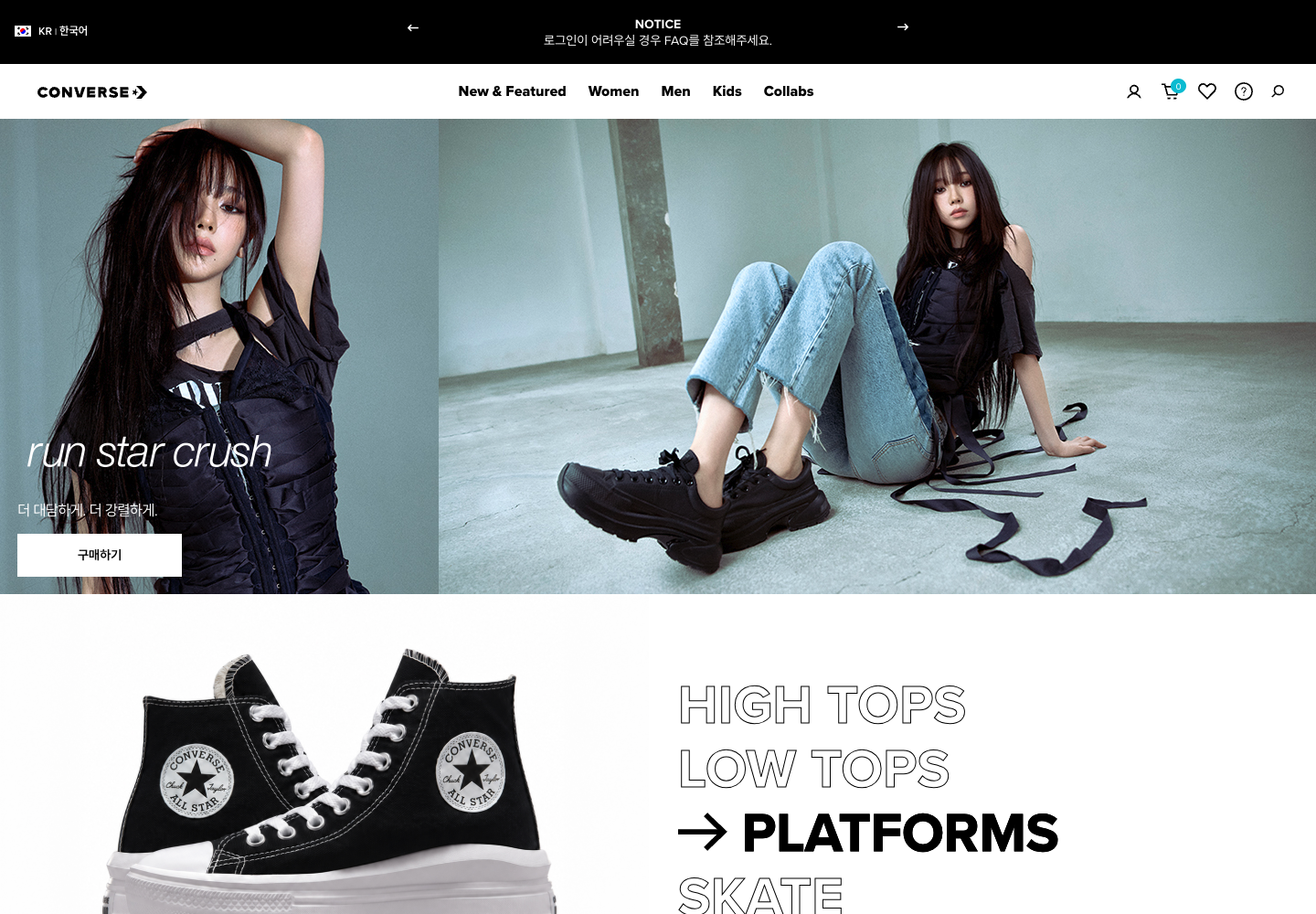
Actual public homepage captured during this audit, November 6, 2026.
What is Converse.com trying to do — and why audit it tenth?
This is part 10 of GeoParrot’s sports-brand series, running the same evidence-first method we used on Reebok, New Balance and eight other major brands. Converse is a useful tenth name because, unlike most of this series, it’s not an independent company at all — Nike has owned Converse outright since 2003, yet converse.com runs on its own separate Salesforce Commerce Cloud storefront (confirmed via the catalog path visible in its own image URLs, Sites-cnv-master-catalog), completely independent of nike.com’s infrastructure. That gave us a genuine within-family comparison point worth checking: does a wholly-owned subsidiary inherit its parent’s GEO practices, or run its own, for better or worse?
Brand category Heritage canvas sneaker brand, wholly owned by Nike since 2003, with the Chuck Taylor All Star — in continuous production since 1917 — as its defining product.
Primary user job Find the Chuck Taylor All Star (high-top or low-top, standard or wide width) in the right colorway and size, backed by visible star ratings, with easy access to returns and sizing help.
SEO + GEO challenge A flagship PDP with no structured data whatsoever even after full browser rendering, a llms.txt/agents.md pair that returns HTTP 200 but serves no real content, and a plain-HTTP block so broad it covers the homepage and robots.txt themselves.
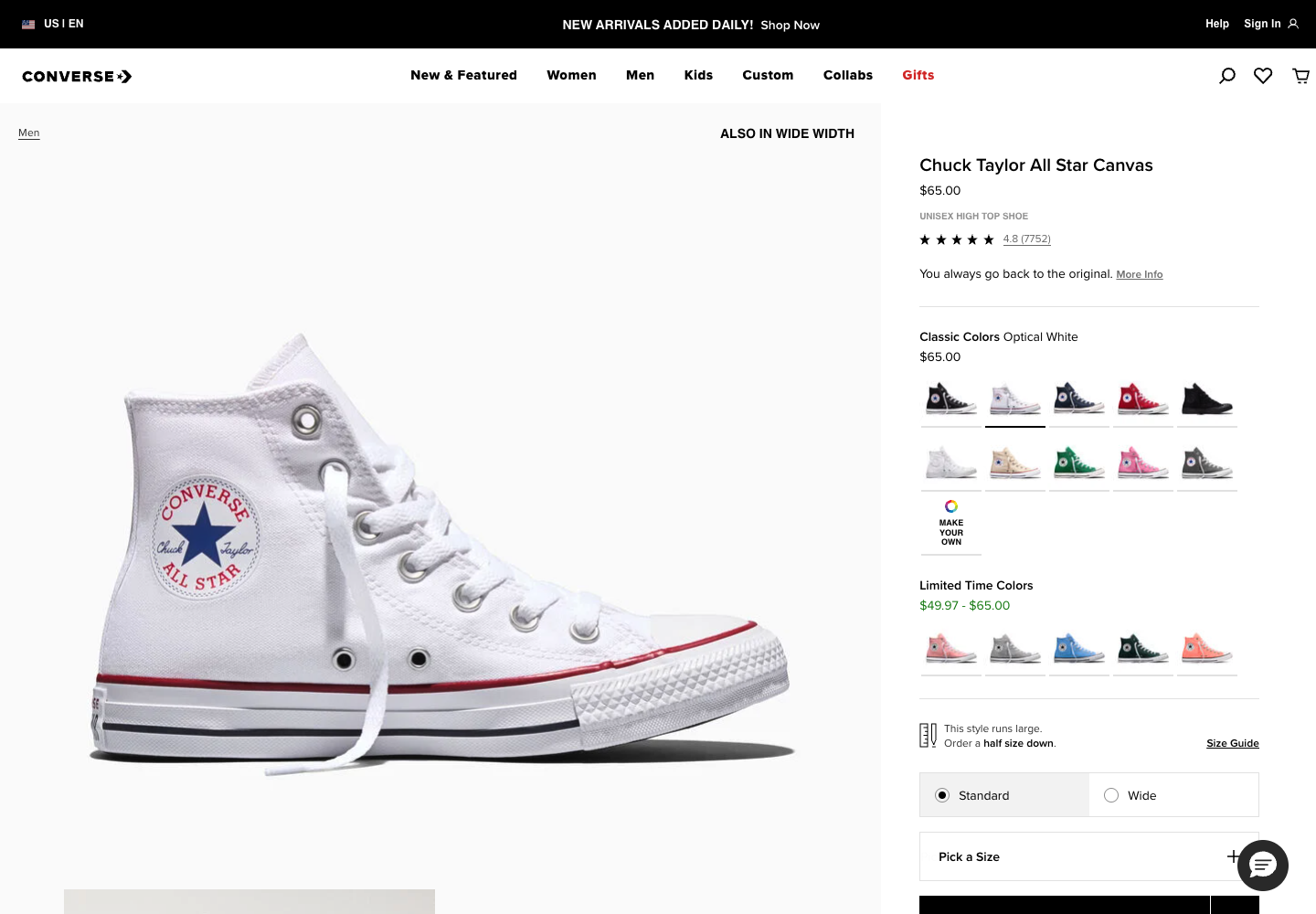
The product we tracked: Chuck Taylor All Star Canvas
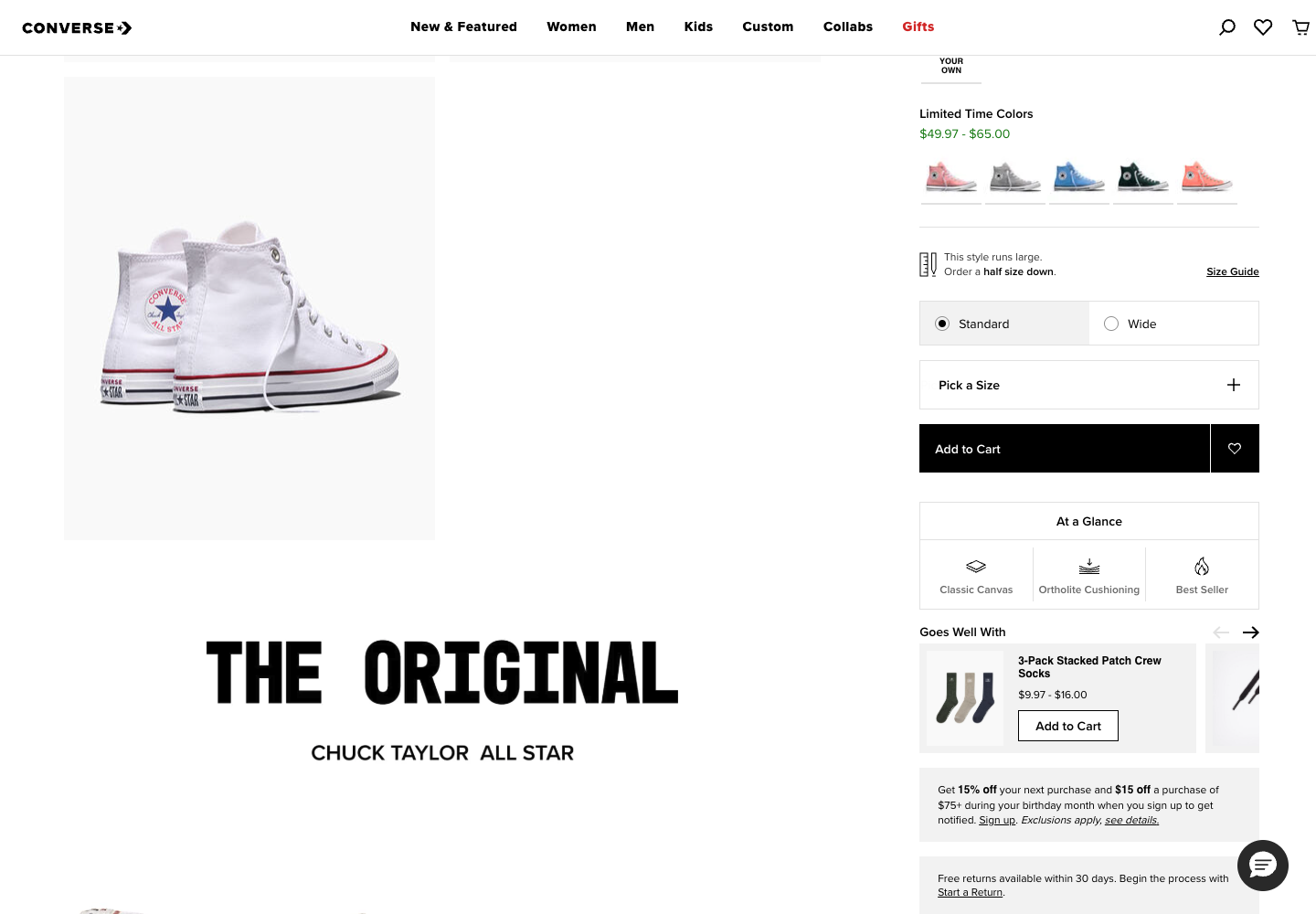
US product page: Optical White, $65, a 4.8-star rating linking to 7,752 reviews — by far the highest review count of any single PDP in this series so far.Scrolling past the fold surfaces a plain brand-statement section (“The Original Chuck Taylor All Star”) rather than a cross-sell carousel or review list — no visible customer review text anywhere on the rendered page.
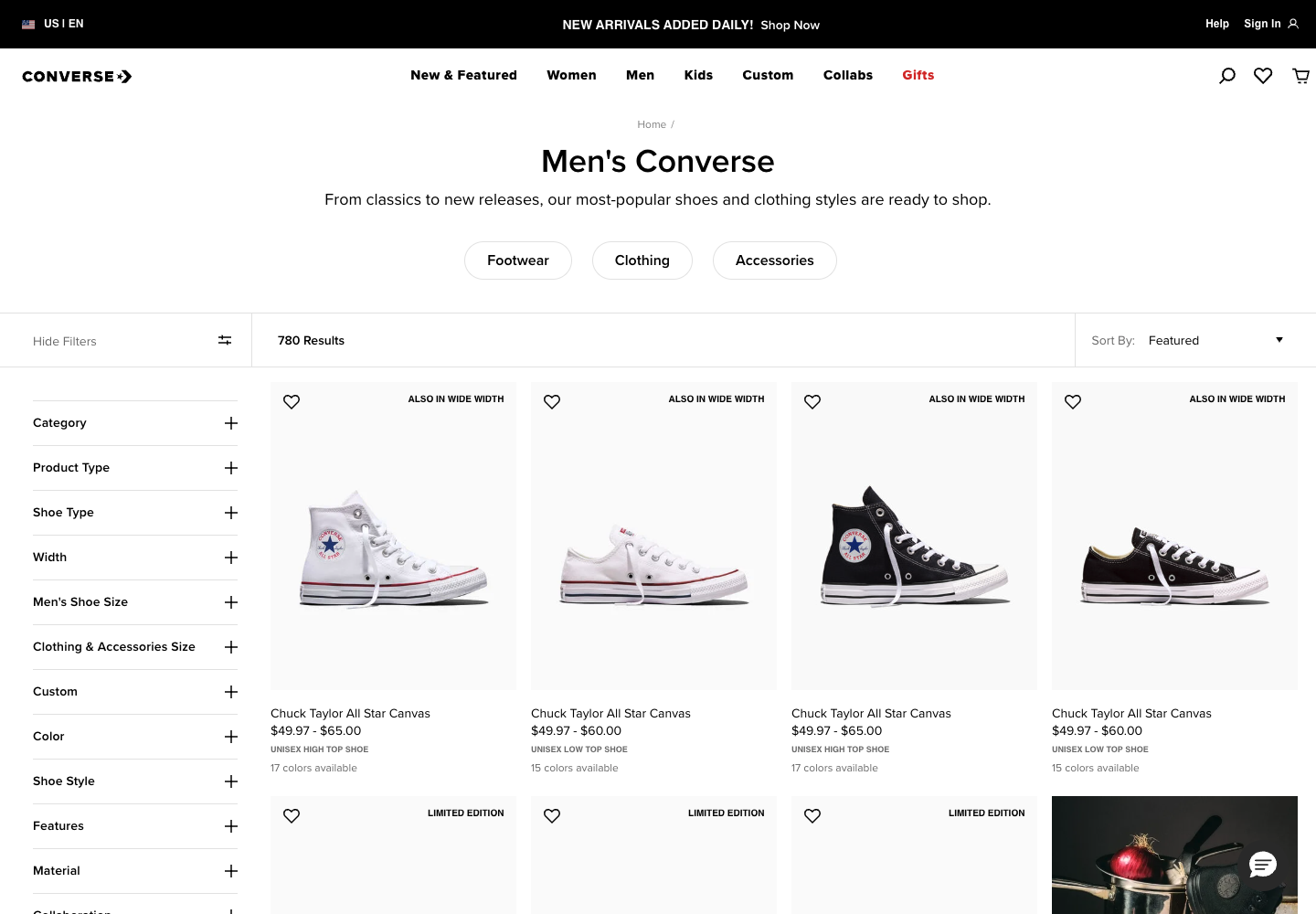
The category layer: “Men’s Converse” at 780 results — the widest single-category count in this series — with four Chuck Taylor All Star Canvas colorways as the top four tiles.
AI citation snapshot: 10 real queries, Google AI Mode
We sent 10 verbatim queries to Google AI Mode (udm=50) and checked both direct a[href] links and citation chip aria-labels for the Converse brand family (converse.com, converse.co.kr, converse.com.au and other regional ccTLDs). Method note, reported honestly: direct link capture worked for every query this run, so counts lean on actual hrefs rather than chip labels alone — the same convention used for Reebok and New Balance.
Query
Converse domain family cited?
Who else showed up
best converse chuck taylor colorways
✅ Yes
goodhoodstore.com, reddit.com, sneakerfiles.com, stockx.com, gearpatrol.com — converse.co.kr cited directly, not the .com domain
converse chuck taylor all star review
❌ No
garagegymreviews.com, thatfitfriend.com, reddit.com, stridewise.com — third-party review sites only, continuing this series’ pattern of “[brand] [product] review” queries rarely citing the brand’s own domain
converse vs vans sneakers
✅ Yes
nextdirect.com, kream.co.kr, theoutlet.co.nz, sportspar.com — both converse.com and converse.co.kr cited in the same result, plus converse.com.au
converse return policy
✅ Yes
site.com — converse.com’s own returns page cited directly, almost no competing third-party result
are converse true to size
✅ Yes
sneakerjagers.com, warsawsneakerstore.com, runrepeat.com, reddit.com — converse.com’s own sizing guidance cited alongside four third-party sources
converse chuck 70 vs chuck taylor classic
✅ Yes
reddit.com, nike.com — converse.co.kr cited, and Nike’s own domain showed up in the same result (unsurprising, given common ownership)
companieshistory.com, wikipedia.org, instagram.com — third-party and corporate-history sources answered, not Converse’s or Nike’s own domain
converse vs nike sneakers
❌ No
captaincreps.com, insidehook.com, facebook.com, instagram.com, nike.com, modaes.com — Nike’s own domain appeared, Converse’s did not, in a query that’s directly about Converse
how to clean converse sneakers
✅ Yes
livinginyellow.com, fashionjournal.com.au, america-today.com — converse.com’s own care guide cited directly
Result: Converse’s domain family cited in 7/10 queries (Nike 5/10, Adidas 4/10, Puma 5/10, Under Armour 8/10, New Balance 6/10, ASICS 7/10, Skechers 4/10, Lululemon 8/10, Reebok 7/10) — tied for second-highest alongside ASICS and Reebok. The one finding worth flagging: on “converse vs nike sneakers,” a query explicitly about Converse, it was Nike’s domain that surfaced and Converse’s that didn’t — the opposite of what you’d guess from common ownership. Named-product review queries again failed to surface the brand’s own domain, continuing a pattern that’s now held across most of this series.
G-score audit: the 8-pillar hygiene checklist, and a genuine zero
We scored six representative Converse URLs with the same 8-pillar static-HTML checklist (JSON-LD present, FAQ content, visible date, author byline, concrete data points, table/list structure, 3+ subheadings, a 30–500 character early answer) used in our Week 17 quality-score experiment and on all nine prior brands. What we found this time is a genuine first for the series: converse.com returns a flat HTTP 403 to every plain-HTTP request we sent — not just robots.txt, but the homepage itself — so we could only score the US pages via a fully browser-rendered DOM. After rendering, both the homepage and the Chuck Taylor PDP carry zeroapplication/ld+json blocks — not hidden behind JavaScript like Reebok’s, just genuinely absent — leaving only two bare Open Graph tags (og:url, og:image) on the product page, no og:title, no og:description, no product-specific Open Graph fields at all.
1 ProductGroup JSON-LD block with per-size Offers + AggregateRating
Six-page average: 0.5208 (Nike: 0.4375, Puma: 0.354, Under Armour: 0.5208, New Balance: 0.5833, Adidas: 0.6458, ASICS: 0.4583, Reebok: 0.5417) — squarely mid-pack, and coincidentally identical to Under Armour’s average. But as with Reebok, the average flattens the real story: the US flagship PDP for a shoe with 7,752 reviews carries no machine-readable rating, price or availability data whatsoever, while the Korea PDP for the same shoe family does.
US help center: still reachable only through a real browser
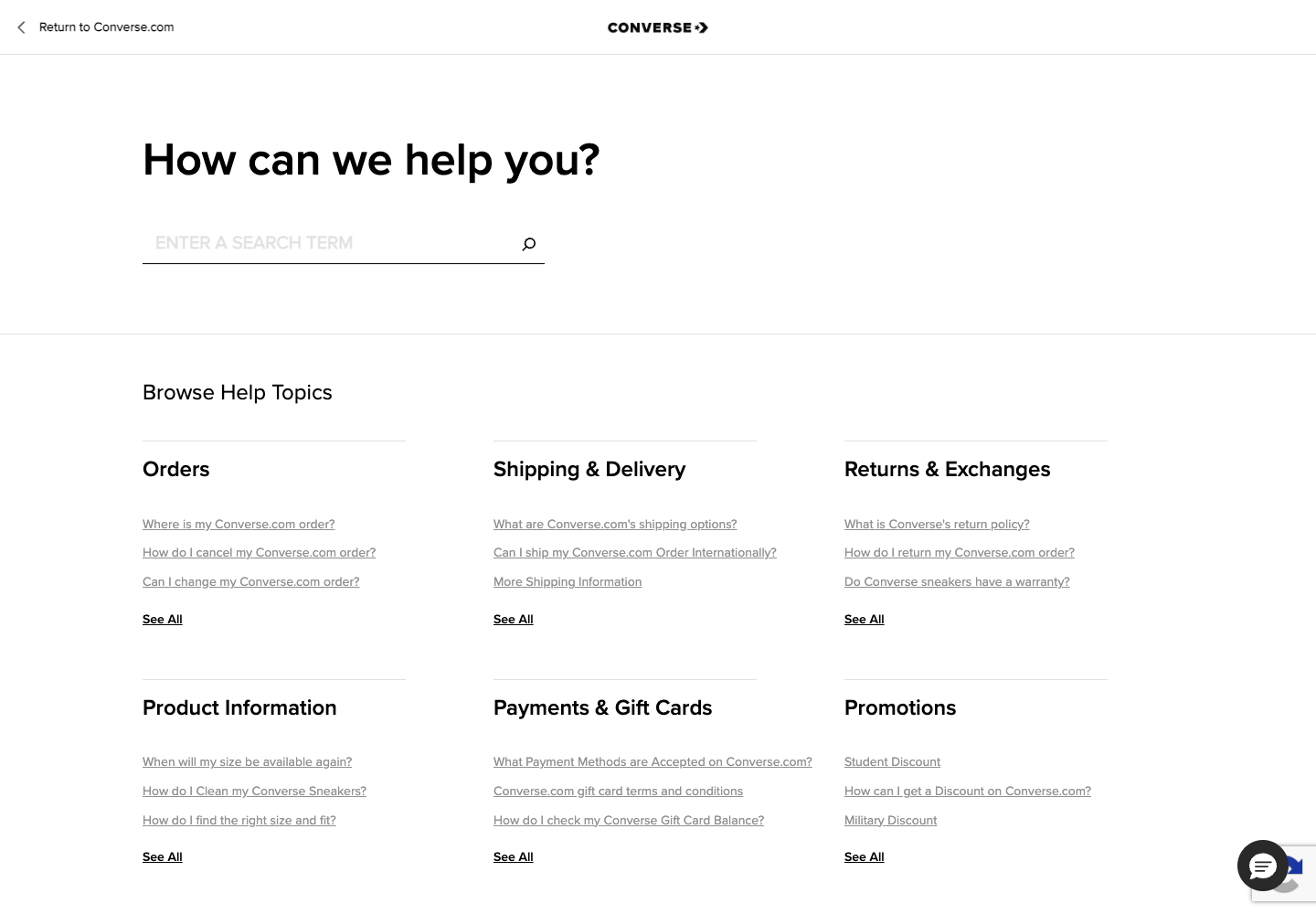
The US Help Center scored the lowest single-page G-score in this audit (0.25) — a plain search box and a topic grid (Orders, Shipping & Delivery, Returns & Exchanges, Product Information, Payments & Gift Cards, Promotions) with almost no body text, dates, or structured content for an AI engine to extract. Like every other converse.com URL in this audit, it returned HTTP 403 to a plain, non-browser request and was only reachable through a full browser session.
US help center: a search box and six static topic categories, no visible dates or structured FAQ content.
Product schema: the gap, in exact numbers
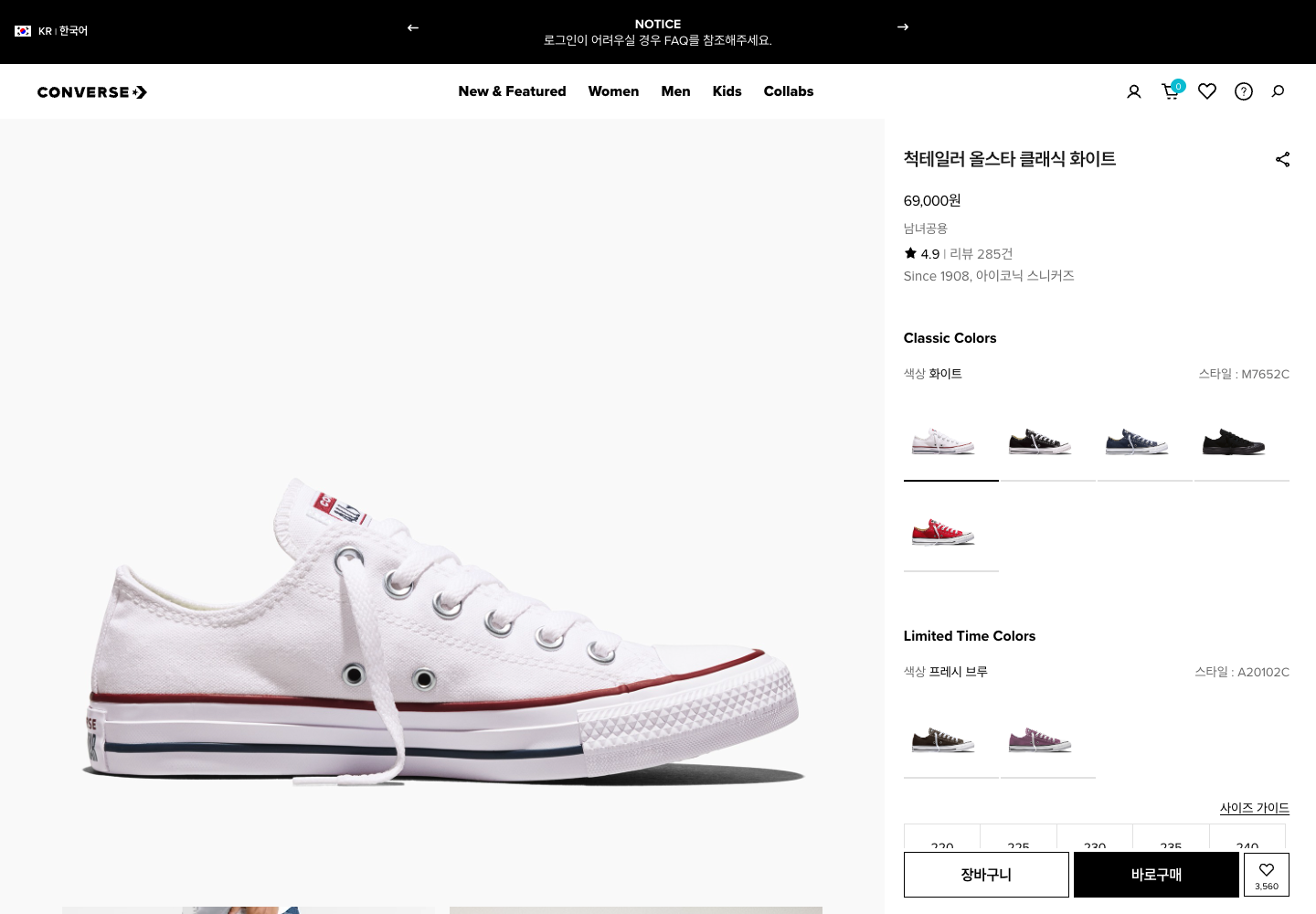
The contrast is as close to a controlled comparison as this series gets, because both pages describe the same product line. US converse.com’s Chuck Taylor All Star Canvas PDP, rendered fully in a real browser with a 6-second settle: zeroapplication/ld+json script tags, confirmed twice across separate runs. Korea’s converse.co.kr Chuck Taylor All Star Classic White PDP, fetched as plain HTML with no JavaScript required: one ProductGroup block (@id, productGroupID: cafe24_conversekorea_1_6528) with a hasVariant array — one entry per shoe size — and each variant carrying its own Offer (price 69,000 KRW, availability: InStock) and its own AggregateRating (4.9, 286 reviews at the size level we sampled).
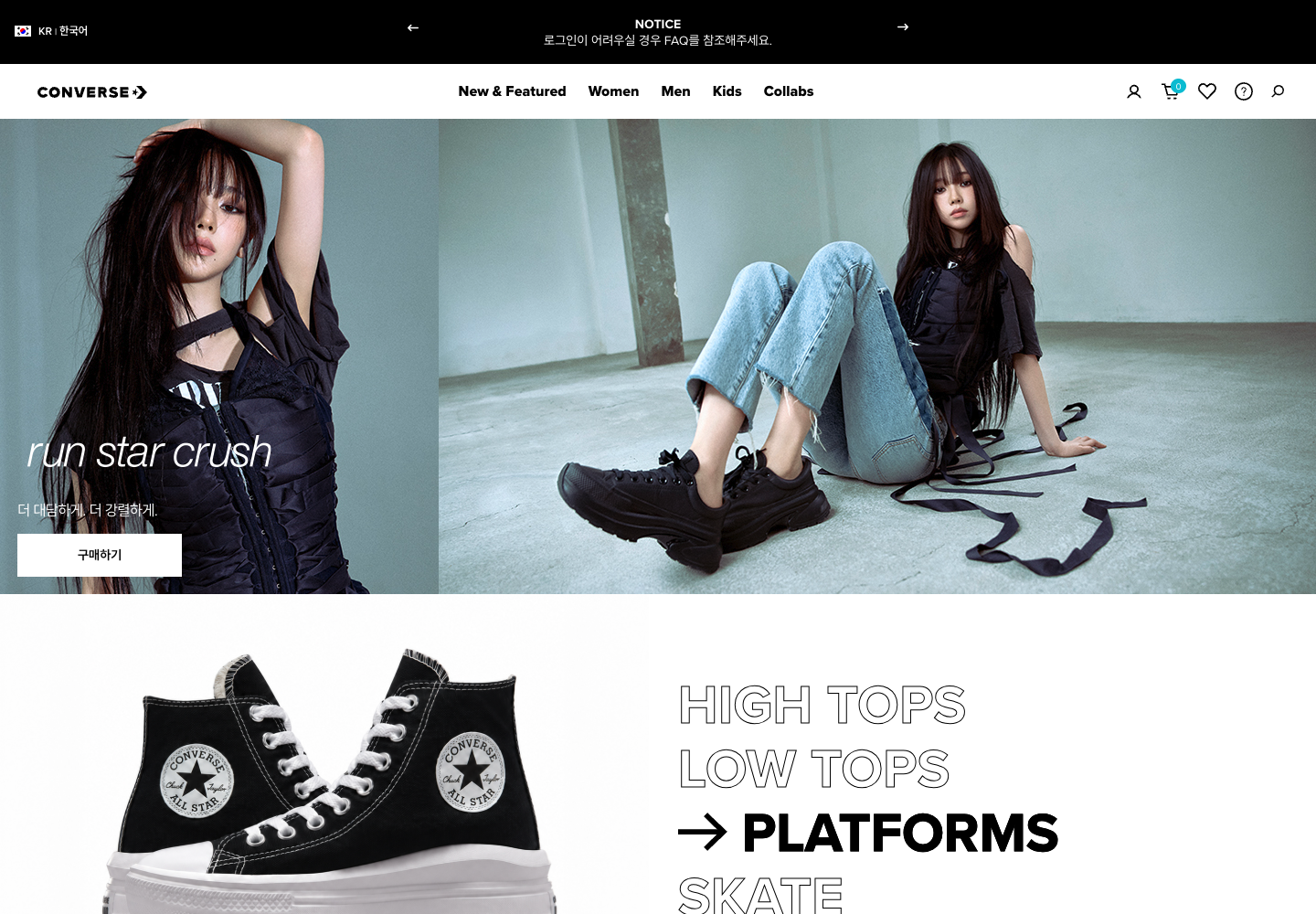
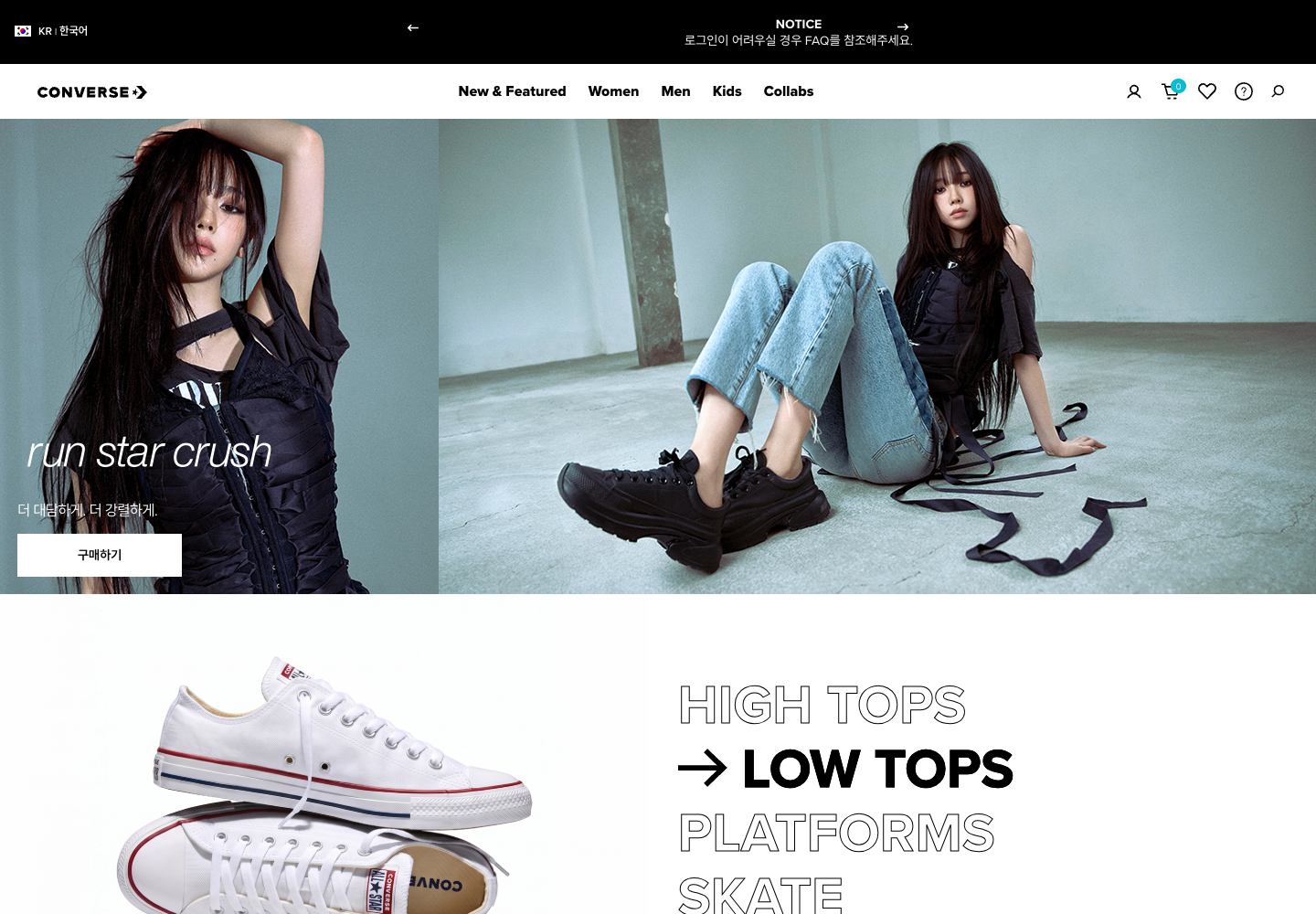
Korea homepage on converse.co.kr — visually similar campaign creative to the US site, built on an entirely different platform (Cafe24, a Korean e-commerce SaaS) underneath.The Chuck Taylor All Star hero module on the Korea homepage, the entry point we used to reach the product catalogue.
Korea Chuck Taylor All Star Classic White (style M7652C — note this is the low-top silhouette, where the US page we tracked, M7650, is the high-top): 69,000원, 4.9 stars from 285-286 reviews depending on size, “Since 1908, 아이코닉 스니커즈” (iconic sneakers) as the on-page tagline.
Honesty note on the product match: the US PDP we tracked throughout this audit (M7650, high-top) and the KR PDP (M7652C, low-top) are the same product line in the same colorway but different silhouettes — we picked the closest match each storefront’s own on-site search surfaced for “chuck taylor all star,” rather than forcing an exact style-number match that neither search actually returned. The schema gap itself doesn’t depend on this distinction: both are flagship Chuck Taylor products, and only one of the two carries any Product-level structured data.
Who actually runs converse.co.kr?
Unlike several brands earlier in this series — Reebok’s Korea site run by LF Corporation, New Balance’s run by E-Land — Converse Korea is not an external licensee. The site’s company-information page discloses the operating entity as (유)컨버스코리아 (Converse Korea LLC, a “yuhan-hoesa” / limited-liability company, the structure commonly used for Korean subsidiaries of foreign multinationals), business registration number 220-88-74818, representative 이명재 (Lee Myung-jae). The same footer lists its “FAMILY SITES” as NIKE and Jordan — an explicit, on-page acknowledgment that this storefront sits inside Nike’s own corporate family in Korea, not a third-party license. It’s the first brand in this series where the Korea operator is confirmed to be the parent company’s own entity rather than an independent licensee.
robots.txt (US) — inaccessible, by two different mechanisms — A plain curl request returns an Akamai edge-block page (“Access Denied,” referencing errors.edgesuite.net). A full real-browser request to the same URL returns a different 403 page entirely — a CloudFront/S3-style XML “AccessDenied” document with a RequestId/HostId. We could not read converse.com’s robots.txt by any method available to us from a Korea-based IP. We can’t confirm whether this is a geo-block, a bot-management rule, or both — only that it’s genuinely blocked, by more than one layer of infrastructure.
llms.txt and agents.md (US) — HTTP 200, but no real content — Both paths return a clean HTTP 200, which would normally suggest the file exists. In fact both serve the exact same page: a generic “Select Location & Language” country picker (the same page shown when navigating to a dead URL on this site). This is a new variant on the “soft-200” pattern we first saw on ASICS’s Korea llms.txt (which returned 200 with a homepage-shell body) — here it’s not a shell of the homepage, but a shell of the locale-chooser, and it affects both AI-agent-facing filenames identically. See our explainer on what llms.txt actually does before treating a 200 status code here as meaningful; Google Search doesn’t read llms.txt regardless.
sitemap.xml (US) — A genuine, clean HTTP 404 (confirmed via a network-response listener in a real browser session, since a direct page load fails before rendering). No sitemap is being served at this path.
robots.txt (Korea) — Loads cleanly over plain HTTP. A standard Cafe24-platform disallow list (admin, API, member, board-reply paths) repeated identically for User-agent: *, Googlebot and bingbot, with a Crawl-delay: 10. No AI crawler (GPTBot, ClaudeBot, PerplexityBot, Google-Extended) is named anywhere, positive or negative — matching the majority pattern in this series. Points to Sitemap: https://converse.co.kr/sitemap.xml.
llms.txt (Korea) — A clean HTTP 404, served by the Cafe24 platform’s own styled error page (its <title> literally reads “카페24”). No file exists.
Sitemap (Korea) — Loads over plain HTTP, 1,997 <loc> entries, including individual product URLs with Korean-script slugs (e.g. /product/척테일러-올스타-클래식-화이트/6518/) alongside static legal and notice-board pages — a real, maintained sitemap, unlike the US domain’s flat 404.
Plain-HTTP access, more broadly (US) — This isn’t limited to robots.txt: a plain curl request to converse.com’s homepage and to the Chuck Taylor PDP both return HTTP 403 as well. Every US page in this audit was only reachable through a full browser session. Any AI crawler that sends simple, non-browser-fingerprinted HTTP requests — the default behavior for most bots — would be blocked from converse.com entirely, not just from reading its robots.txt.
What works / What to verify
WHAT WORKS
A 7/10 AI citation rate despite near-total absence of structured data, a maintained 1,997-URL Korea sitemap, and an unusually transparent Korea company-info page that discloses the exact corporate relationship to Nike rather than leaving it to guesswork.
WHAT TO VERIFY
Whether converse.com’s flagship PDP — with 7,752 reviews and counting — would benefit from even baseline Product schema, whether the llms.txt/agents.md 200-status “soft page” is an intentional design choice or an unnoticed routing default, and whether the broad plain-HTTP 403 block is filtering out legitimate AI crawlers along with whatever it’s actually trying to stop.
Target query check — reported honestly, not inflated
We have not re-measured “converse seo” or “converse geo audit” query volume this session. Per the pattern already confirmed across nine earlier subjects in this series on October 20, 2026 (Keyword Planner, US) — the large majority showed no measurable search volume at all for “[brand] SEO/GEO audit” phrasing — we’re not claiming this title drives ranking-based traffic. The distribution case for this series rests on internal links, our own index, and readers already following the GEO Lab arc, not on search demand for “[brand] SEO audit” as a query.
Frequently asked questions
Does Converse’s flagship product page really have zero structured data?
Yes, based on what we observed: a full browser render of the Chuck Taylor All Star Canvas PDP (6-second settle, repeated across two separate checks) produced zero application/ld+json script tags. The only machine-readable metadata present was two bare Open Graph tags — og:url and og:image — with no og:title, og:description or any product-specific fields. This is a plain absence, not a JavaScript-timing issue we could reproduce differently.
Why do converse.com’s llms.txt and agents.md return HTTP 200 if there’s no real content?
We can only report what we observed, not the underlying routing logic: both URLs resolve to the same generic ‘Select Location & Language’ country-picker page that this site also shows for other unrecognized paths. A 200 status code at these filenames would normally suggest a real document exists; here it doesn’t, and a crawler checking only the status code — rather than the content — would be misled. Google Search doesn’t read llms.txt regardless; see our explainer on what llms.txt actually does.
Why is Converse Korea’s operator disclosed as part of Nike’s corporate family rather than an independent licensee?
We can only report what the site itself discloses: its company-information page names the operator as (유)컨버스코리아 (Converse Korea LLC) and lists NIKE and Jordan as ‘Family Sites’ in the same footer block. Nike has owned Converse globally since 2003, so a wholly-owned Korean subsidiary operating the local storefront is a plausible and disclosed structure — different from the external-licensee pattern (LF Corporation for Reebok, E-Land for New Balance) seen elsewhere in this series.
Does a 7/10 AI citation rate mean Converse’s GEO setup is working despite the missing schema?
Not reliably — this audit is itself a data point against that conclusion, consistent with all nine prior brands. Our Week 17 experiment found hygiene/structure score was not a dependable predictor of AI citation, and here Converse matches Reebok’s and ASICS’s 7/10 rate while scoring a mid-pack 0.5208 G-score average and carrying zero schema on its single highest-traffic page. Our 10-query snapshot measures the domain family, not individual URL citation, so we can’t confirm which specific Converse page — if any — drove the 7 successful citations.
Audit evidence, scope and limits
Inspected: November 6, 2026, public logged-out access from a Korea-based IP (real browser session used throughout for screenshots and citation testing; plain HTTP fetches used urllib with a standard desktop user agent). Screens: US homepage, Men’s category (780 results), the Chuck Taylor All Star Canvas product page (top and scrolled), US help center, Korea homepage, and the resulting Chuck Taylor All Star Classic White PDP — plus robots.txt, sitemap and llms.txt/agents.md checks on both domains, a 10-query Google AI Mode citation snapshot, and an 8-pillar G-score scored on six pages (browser-rendered for all four US pages, since plain HTTP returned 403 on every US path we tried; plain-fetched for both Korea pages).
Not measured: rankings, Search Console performance, analytics, conversion, signed-in/member flows, ChatGPT citations (not attempted, given the composer failures flagged on earlier audits in this series), or the complete product/locale catalogue beyond the one shoe line and six-to-eight URLs sampled here. The US and Korea PDPs tracked are different silhouettes (high-top M7650 vs low-top M7652C) of the same product family, noted explicitly above. This is a public-signal snapshot, not a performance claim or a full-catalogue crawl.
This is part 10 of a daily series. Every day, GeoParrot runs this same evidence-first method — real screenshots, a 10-query AI citation snapshot, an 8-pillar G-score audit, and an honest target-query check — against one more major sports and athletic-wear brand. Next: On Running.



Leave a Reply