
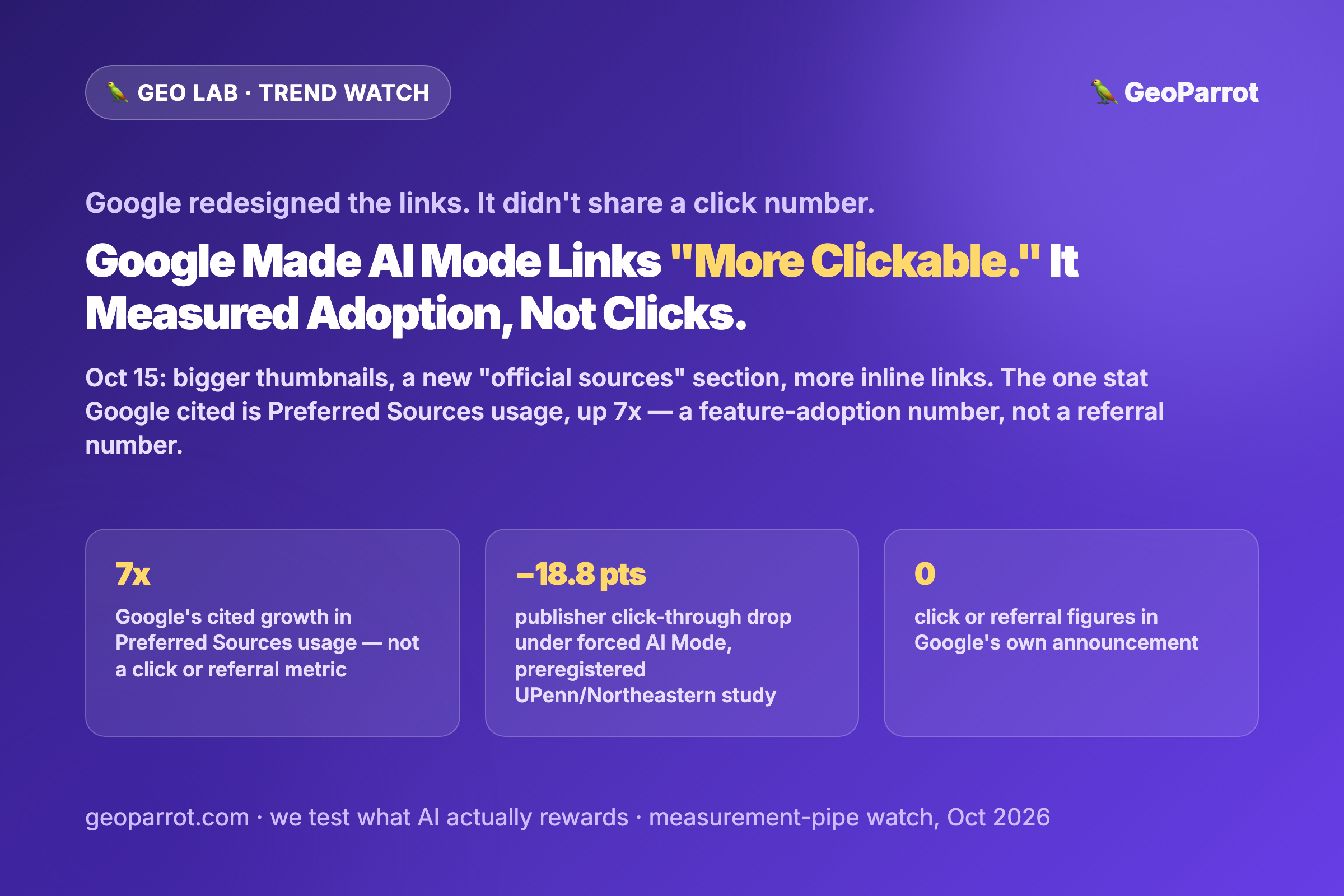
Quick answer: On October 15, 2026, Google’s Search blog announced a set of AI Mode and AI Overviews changes aimed at making links more visible: inline links placed higher and more often in answers, a redesigned “Dive Deeper” section with image thumbnails, a new section being tested at the top of some answers for “official” sources, expanding news carousels, and clickable creator names on video results. The post cites exactly one number to back the claim that this helps: usage of the Preferred Sources feature is “up more than 7x since the start of the year.” That is an adoption metric — how many people turned a setting on — not a click, referral, or traffic number. Meanwhile, the strongest independent evidence we have on the actual mechanism, a preregistered field experiment from UPenn and Northeastern (N=1,100), found forced AI Mode cut click-through to external sites by 18.8 percentage points. Redesigning what a link looks like doesn’t resolve that gap; it doesn’t even measure it.
Trend watch — published October 16, 2026. We read every AI-search interface announcement the way the GEO Lab reads any claim: what’s actually measured, what’s merely described, and whether the two line up.
What exactly did Google change on October 15?
Five specific changes, per Google’s own Search blog post and corroborated by 9to5Google’s same-day coverage. First, inline citation links inside AI Mode and AI Overview answers will appear “higher up in responses more frequently” — more links, placed earlier, rather than clustered at the end. Second, the “Dive Deeper” section at the end of some answers is being redesigned with image thumbnails and what Google calls “a more clickable design.” Third, Google is testing a new section at the top of some AI responses specifically for sites that are “the one or two official places on the web” to complete a task or find exact information, with added context explaining why each link is useful. Fourth, carousels for timely news articles — which surface a user’s Preferred Sources picks — are expanding to more locations and languages globally. Fifth, clickable creator and publisher names are being tested on video results, linking to Search profile pages. Three of the five (official sources section, creator profiles, parts of the link-placement change) are explicitly described as tests, not shipped features; the carousel expansion is the one piece Google calls a global rollout.
What’s the one number Google shared, and what does it actually measure?
Google’s post supports this entire bundle of changes with a single data point: “the number of people who now use our Preferred Sources feature has grown by more than 7x since the start of the year.” Preferred Sources lets a user pick publications they want prioritized in Top Stories and news carousels. A 7x jump in people turning that setting on is a real, checkable signal of feature adoption — but it answers a different question than the one this announcement is framed around. It does not tell you whether AI Mode answers are sending more clicks to the open web, whether citation links are getting clicked more often than they were before, or whether publishers are seeing more referral traffic from AI surfaces. Setting adoption and click-through are not interchangeable, and the post doesn’t offer a bridge between them — no before/after click-through rate, no referral traffic figure, no citation-to-click ratio. That’s a familiar pattern in GEO-adjacent announcements: a real, verifiable number is used to support a claim the number doesn’t directly measure.
What does independent data say about the actual click gap?
We’ve tracked this specific question — does a more visible AI answer translate into more clicks to the cited site — through three separate data points this quarter, and none of them point toward “redesigning the link” as the fix. The strongest is a preregistered, randomized field experiment from UPenn and Northeastern (N=1,100 real US Google users, browser-extension-logged real searches): forcing users into AI Mode cut click-through to external sites by 18.8 percentage points [95% CI −22.2, −15.3] versus normal search, with no corresponding gain in satisfaction or trust. That’s a controlled, causal result, not an inference from aggregate traffic. Second, Ahrefs’ panel of 963 French domains found AI Overviews cut CTR by a median of 5.7% across the full panel (23.1% for the most AI-exposed sites) — a drop measured on the same surface Google is now redesigning. Third, in September Google was separately caught testing AI Overview links that route users deeper into AI Mode instead of out to the cited publisher — the opposite direction from “more clickable links to external sites.” None of these three sources are reacting to the October 15 announcement; they’re independent measurements of the mechanism the announcement claims to be improving. A thumbnail redesign doesn’t contradict any of them, but it also doesn’t address what they measured.
Claim vs. measurement, side by side
| Source | What it reports | What it actually measures |
|---|---|---|
| Google, Oct 15 announcement | “More clickable” link design, official-sources section, bigger thumbnails | Preferred Sources feature adoption (+7x) — not clicks |
| UPenn / Northeastern, preregistered field experiment | Forced AI Mode vs. normal search, N=1,100 | Click-through to external sites: −18.8 percentage points |
| Ahrefs, 963-domain panel (France) | AI Overviews exposure vs. CTR | Median CTR −5.7%; most-exposed sites −23.1% |
| Google, Sept 22 test (reported by SE Roundtable) | AI Overview anchor links tested | Links routed to AI Mode follow-up, not to the cited site |
A checklist for what to actually do with this announcement
- Don’t treat “more clickable design” as a traffic forecast. Nothing in the announcement commits to a referral-traffic outcome, and the one metric it shares doesn’t measure one. Budget for no change until you see it in your own logs.
- Watch the “official sources” test specifically if you operate a single-authority page. Being one of “the one or two official places” for a task is a narrower, higher-value slot than a general citation — worth checking your Search Console AI-surface data if you plausibly qualify for a given query.
- Keep measuring citation and click separately. This announcement is further evidence the two have decoupled at the product level, not just the measurement level. A link redesign can raise one without moving the other.
- If you cite this announcement externally, cite the 7x number for what it is. Feature adoption, not traffic. Don’t let “more clickable” and “more clicks” blur into the same sentence in your own reporting.
- Re-test your own CTR after any of these features reach you. Carousels are rolling out globally now; the official-sources section and creator profiles are still test-stage and may never ship broadly. Don’t optimize for the test-stage features yet.
The honest caveats
Google’s announcement is a first-party source describing its own product changes, so the existence of the changes themselves is well-sourced; what we’re skeptical of is the implied causal claim (“more clickable” implying “more clicks”), which the post itself never explicitly states — we’re flagging a gap between framing and evidence, not catching Google in a false statement. The 18.8-point UPenn/Northeastern figure measures forced AI Mode against normal search broadly, not this specific redesign, which hadn’t shipped when that study ran; it’s the best available causal baseline for the mechanism, not a before/after test of October 15’s changes. Three of the five announced changes are explicitly test-stage and may be narrowed, changed, or cancelled before reaching most users. We have no independent click-through data on the redesigned “Dive Deeper” thumbnails or the official-sources section specifically, because neither has been live long enough to measure.
Frequently asked questions
Did Google say AI Mode links will drive more publisher traffic?
Not explicitly. The announcement describes link-visibility redesigns and cites one adoption metric (Preferred Sources usage up 7x) as evidence of engagement, but makes no specific claim or commitment about click-through rate or referral traffic.
What’s actually rolling out now versus still being tested?
The expanded news carousels and Preferred Sources surfacing are described as a global rollout. The top-of-answer “official sources” section and clickable creator profiles on video are explicitly test-stage, started this week per Google’s post, and could be narrowed or dropped.
Does this contradict the UPenn/Northeastern finding that AI Mode cuts clicks by 18.8 points?
No, but it doesn’t resolve it either. That study measured forced AI Mode against normal search before this redesign existed. Google’s changes could plausibly narrow that gap, widen it, or leave it unchanged — the announcement provides no data either way.
Should I change my GEO or SEO strategy because of this announcement?
Not based on the announcement alone. If you run a single-authority resource for a specific task, it’s worth watching the “official sources” test. Otherwise, the practical guidance is unchanged: keep optimizing for citation, and keep measuring clicks separately rather than assuming one implies the other.
GeoParrot is a GEO Lab: we run experiments to test what AI search engines actually reward, and we grade the industry’s claims — including Google’s own — against what was actually measured. See the running scoreboard at our 2026 GEO benchmark. Related: the preregistered experiment behind the 18.8-point click drop, why a 23.1% CTR headline isn’t your number, and Google’s earlier test of links that route to AI Mode instead of publishers.
Leave a Reply