
🎬 Watch the hands-on test on YouTube, then read the full data and method below.
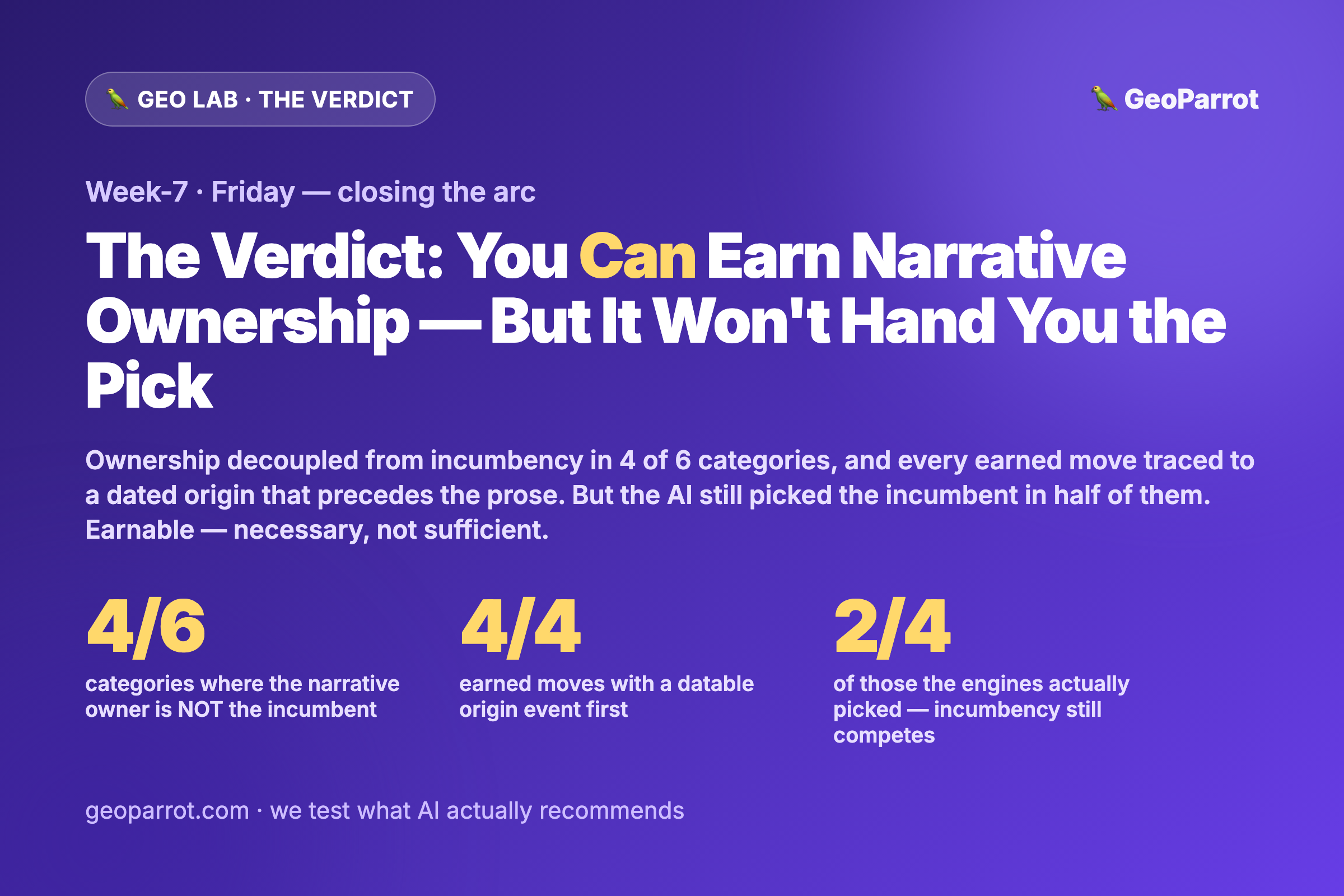
Quick answer: Yes — a challenger can deliberately earn ownership of its category’s narrative. It is authored, not inherited. But earning it is necessary, not sufficient: it won’t hand you the AI’s pick. On our frozen 18-brand roster, with zero engines re-queried, narrative ownership decoupled from incumbency (oldest + biggest brand) in 4 of 6 categories — including a clean Mullvad-type reversal where a small, young brand owns the defining attribute and is the AI’s #1. And every one of those four earned moves traced back to a concrete, datable origin event — an independent audit, a product launch, a founding-design bet — that precedes the shorthand spreading through third-party prose. So ownership is manufactured through dated proof, not born from category history. But our sharpest prediction failed: where the narrative owner and the incumbent disagreed, the AI’s pick followed the narrative owner in only 2 of 4 — in help desk and accounting the engines kept the deep incumbent (Zendesk, QuickBooks) over the narrative owner (Freshdesk, Xero). And in the two categories that never decoupled (live chat, survey), the defining attribute is a diffuse baseline with no concrete origin to seize — so there was nothing to earn. Verdict: earnable, slow, and a strong lever — not a guaranteed win against a heavy incumbent. Below: the ruling, the scorecard, a per-platform checklist, and next week’s question.
This is Friday’s verdict, closing this week’s GEO Lab arc. Monday we fact-checked the market’s “85% of AI citations are earned media” story and drew the line between earned = the channel and narrative = the payload. Tuesday we pre-registered a causal test — three sub-tests and four predictions locked before we dated a single article. Wednesday we collected: founding years, size proxies, and an origin trace for all six categories, without asking a single engine a new question. Today we rule.
What exactly were we ruling on?
One question, threaded through four posts: is “narrative ownership” — owning the language of your category’s one defining attribute in independent prose — something a challenger can deliberately earn, or is it just a byproduct of being old, big, and already the incumbent (i.e. locked in category history)?
That distinction decides whether GEO is a lever you can pull or a lottery you already lost. So we designed the test to be falsifiable in the challenger’s favour and against it:
- If ownership is locked in category history, the narrative owner should just be the incumbent everywhere, with no datable moment it was earned.
- If ownership is earnable, it should decouple from incumbency, and each decoupling should leave a fingerprint: a concrete dated event that precedes the language spreading.
We couldn’t run a true A/B intervention — you can’t randomize which brand “owns privacy” and wait three years. So this is a natural experiment: same corpus, add a time-and-incumbency lens, trace origins. Observational, with all the limits that carries (spelled out at the end). Here’s how the four pre-registered predictions landed.
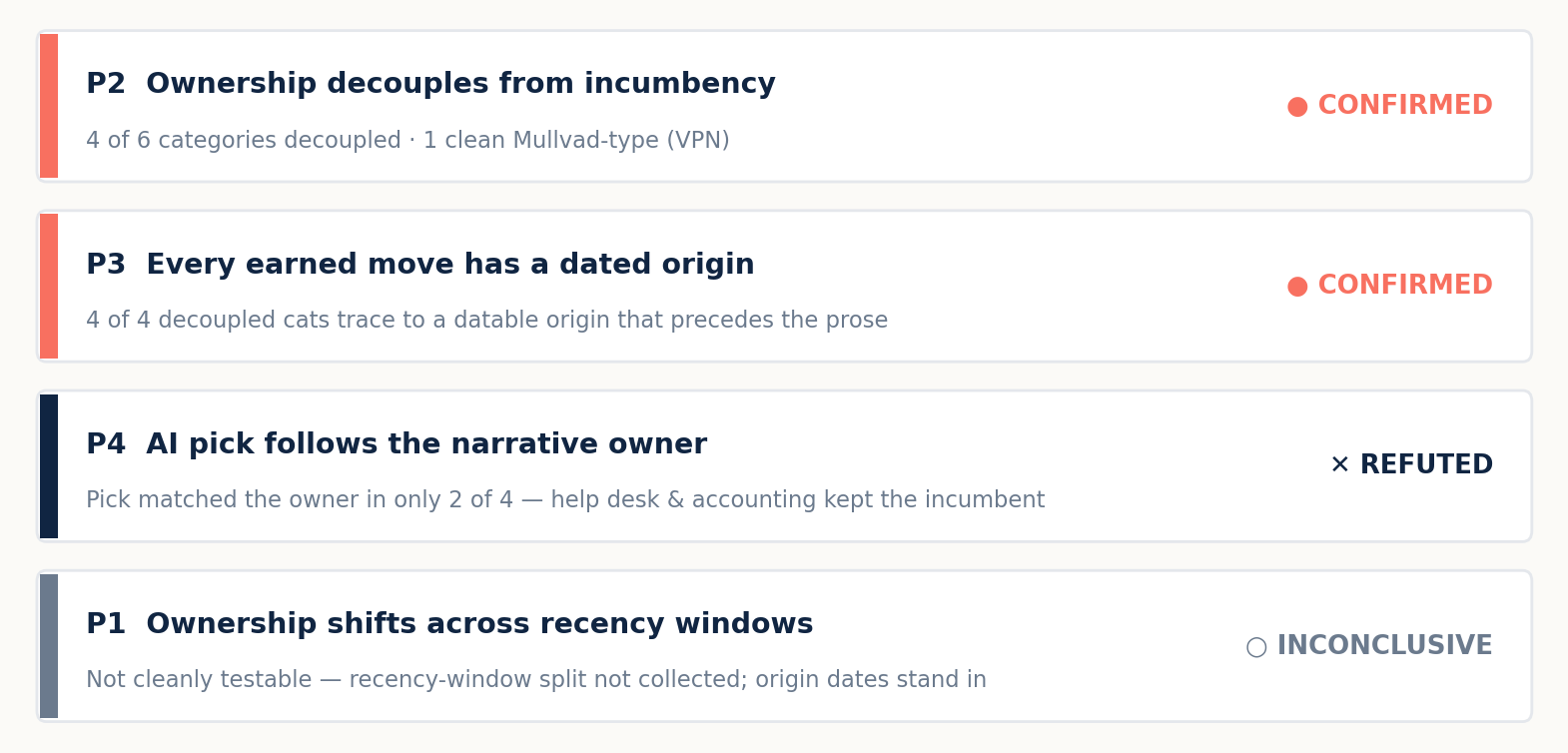
Verdict on the core question: ✅ Ownership is earnable, not locked
Confirmed. The clearest evidence is that narrative ownership decoupled from incumbency in 4 of 6 categories (our pre-registered bar was ≥3). In each of those, the brand that owns the defining-attribute language is not the oldest-and-biggest brand in the category:
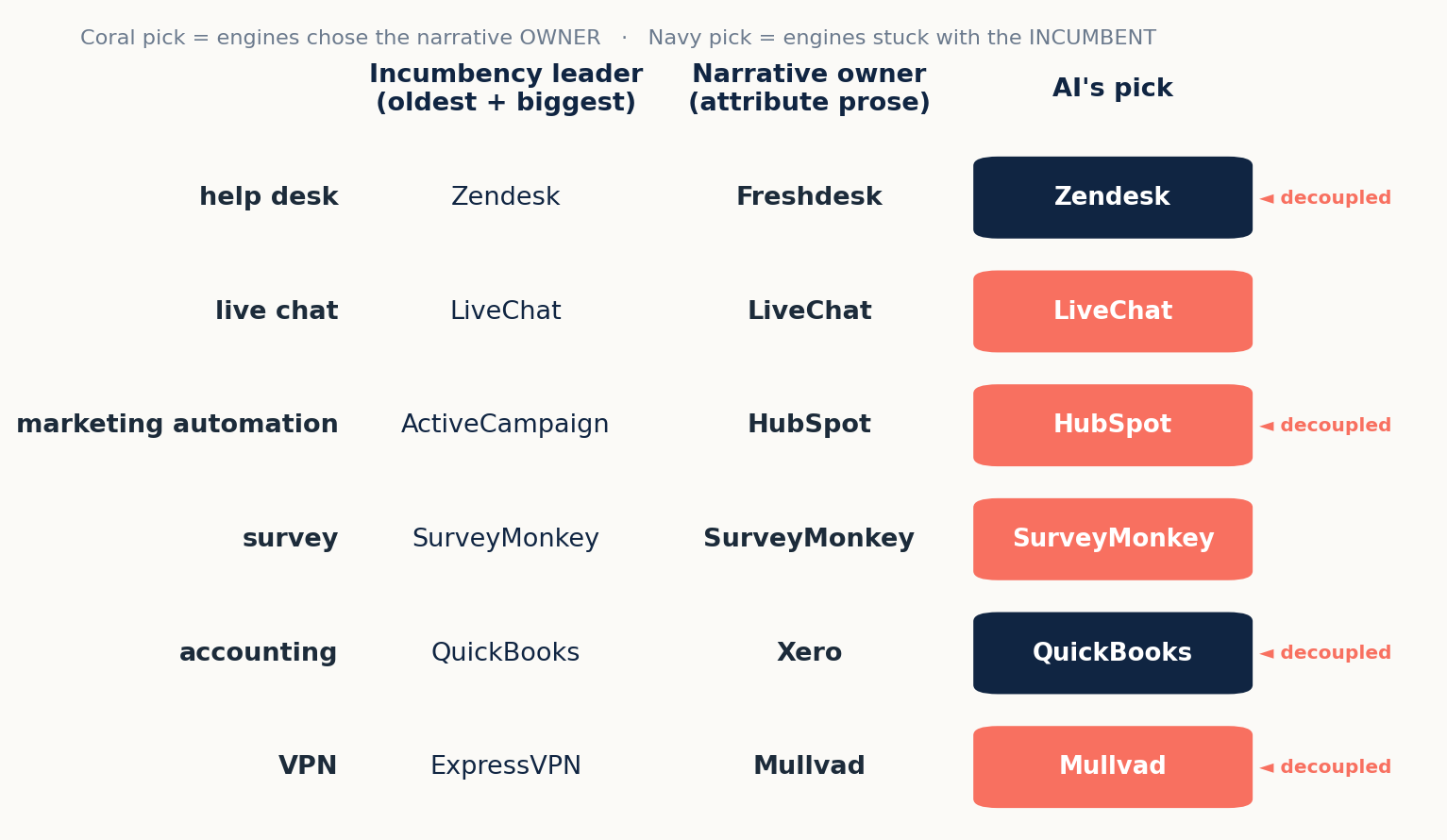
| Category | Incumbency leader (oldest + biggest) | Narrative owner (attribute prose) | Decoupled? |
|---|---|---|---|
| Help desk — omnichannel | Zendesk (2007, 6,949 reviews) | Freshdesk (2010) | ✅ Yes |
| Marketing automation — integration | ActiveCampaign (2003, 14,647) | HubSpot (2006) | ✅ Yes |
| Accounting — reporting/visibility | QuickBooks (1992, largest) | Xero (2006) | ✅ Yes |
| VPN — privacy/no-logs | ExpressVPN (2009, 28,215) | Mullvad (2009, 176) | ✅ Yes — Mullvad-type |
| Live chat — ease of use | LiveChat | LiveChat | ❌ No |
| Survey — distribution | SurveyMonkey | SurveyMonkey | ❌ No |
The VPN row is the proof-of-concept for earnability: Mullvad has 176 Trustpilot reviews against ExpressVPN’s 28,215 and Surfshark’s 30,780 — roughly 0.6% of the incumbent’s review volume — yet it owns 43% of the category’s “privacy” prose and is the engines’ #1 privacy VPN. A brand that small can only own that narrative if narrative ownership is earnable independently of scale. It is.
Did the earned moves leave a datable fingerprint? ✅ 4 of 4
This was the test that separates “earned” from “coincidence.” If ownership were just a vibe, decoupled categories would have no traceable origin. Instead, every one of the four decoupled categories traced back to a concrete, dated origin event that precedes the shorthand spreading in independent prose:
| Category | Owner | The dated origin — how it was earned |
|---|---|---|
| VPN | Mullvad | Baked in at founding (2009-03): anonymous numbered accounts, cash-by-mail payment, no-logs-by-design. Then proven by dated events — first Cure53 audit (2018), and the 2023-04 Swedish police raid that seized no customer data. Founding-design → audit → raid. |
| Marketing automation | HubSpot | A dated launch chain: free CRM at INBOUND 2014 → HubSpot Connect partner program (2015) → App Marketplace redesign at INBOUND 2019 (300+ integrations). “Integrates with your whole stack” became boilerplate after those launches. |
| Help desk | Freshdesk | A product launch: Freshdesk Omniroute omnichannel routing (2019-02), after Zendesk staked the same ground with Zendesk Suite (2018-05). “Omnichannel” shorthand spread in roundups from ~2020 — after the launches. |
| Accounting | Xero | A founding bet: cloud-native, real-time financial visibility written into Xero’s 2006 vision, reinforced by automated bank feeds (2009). The “visibility” framing predates the 2010s–2020s best-of listicles. |
The contrast with the two non-decoupled categories is the tell. Live chat’s “ease of use” and survey’s “distribution flexibility” have no single concentrated origin — they’re diffuse baseline properties of the product, repeated across reviews with no dated author. And those are exactly the two categories where ownership stayed locked to the incumbent. You can earn a narrative when there’s a concrete thing to earn; when the attribute is generic table-stakes, there’s nothing to seize and incumbency keeps it by default.
So can you just PR your way to it? ❌ No — and that’s the important correction
Monday’s post pushed back on the market’s “just earn media and volume will follow” story. The origin traces confirm the pushback from the other direction: every earned narrative was manufactured over years through concrete, verifiable events — a 2018 audit and a 2023 raid, a five-year launch cadence from 2014 to 2019 — not a press-release burst. Mullvad didn’t win “privacy” with a campaign; it won it with a product design in 2009 and a decade of dated proof that made the claim un-fakeable. Earned media was the channel that carried each origin event into third-party prose. The origin event itself was the payload. You can author the payload — but on a multi-year clock, and only if you actually did the thing.
The prediction that failed: does owning the narrative win the pick? ❌ Only half the time
Our sharpest, most self-falsifying prediction was P4: where the narrative owner and the incumbent disagree, the AI’s pick should follow the narrative owner. It failed. Among the four decoupled categories, the pick matched the narrative owner in only 2 of 4:
| Category | Narrative owner | Incumbency leader | The AI picked… |
|---|---|---|---|
| Marketing automation | HubSpot | ActiveCampaign | HubSpot — the owner ✅ |
| VPN | Mullvad | ExpressVPN | Mullvad — the owner ✅ |
| Help desk | Freshdesk | Zendesk | Zendesk — the incumbent ❌ |
| Accounting | Xero | QuickBooks | QuickBooks — the incumbent ❌ |
This is the honest limit of narrative ownership as a lever. In HubSpot and Mullvad, an earned narrative beat the incumbent. In Freshdesk and Xero, an equally-earned narrative lost to a deeper incumbent — the engines named Zendesk and QuickBooks anyway. Owning the language of the defining attribute is clearly a signal the engines weigh — but it competes with raw incumbency, and doesn’t automatically outrank it. Necessary lever, not a sufficient one. That’s the failed prediction that makes the verdict trustworthy: if we’d only reported the two wins, we’d be selling you a guarantee the data doesn’t support.
The final ruling
Threading all four predictions back to the week’s question — can a challenger deliberately earn narrative ownership, or is it locked in category history?
Verdict: Conditionally yes. Narrative ownership is earnable and authored, not locked — but it’s a slow, strong lever, not a guaranteed pick.
- ✅ It decouples from incumbency (4 of 6) — small, young brands can own the narrative (Mullvad on 0.6% of the incumbent’s reviews).
- ✅ It’s authored via dated proof (4 of 4 moves) — audits, launches, founding bets that precede the prose. Earned, over years, not PR’d overnight.
- ❌ It doesn’t buy the pick (owner won only 2 of 4 head-to-heads) — incumbency still competes and sometimes wins.
- ⚠️ It requires something concrete to seize — diffuse baseline attributes (ease-of-use, generic distribution) never decoupled; those stay locked to the incumbent.
The per-platform checklist: how to actually earn narrative ownership
Turn the ruling into moves. First the platform-agnostic play — because the origin traces say the same thing across every category — then the per-engine nuance.
The core play (works everywhere)
- Pick the one attribute your category is bought for — and make sure it’s concrete. “Privacy,” “integration,” “real-time visibility” won narratives. “Easy to use,” “flexible” did not — they’re too diffuse to own. If your category’s defining attribute is generic table-stakes, you can’t earn it; find a sharper sub-attribute you can author.
- Manufacture a datable origin event. Every earned narrative had one: an independent audit, a named product launch, a public test under pressure. Ship a thing on a date, with a name. Diffuse “we’re just good at X” never traced to ownership.
- Get the origin into independent prose, not just your blog. Earned media is the channel that moved each origin from a press release into third-party roundups. (This is the true half of Monday’s “earned media” story.)
- Then flood the attribute language, not the list count. Ownership is share of the defining-attribute prose, not how many best-of lists name you — last week’s verdict showed list breadth predicted the pick only 1 of 6 times.
- Don’t expect it to beat a deep incumbent on its own. Where you face a Zendesk or a QuickBooks, an earned narrative narrows the gap but may not close it — pair it with the presence floor and category-specific signals below.
Per-engine nuance
| Engine | What to prioritise when earning your narrative |
|---|---|
| ChatGPT (with search) | Leans on a small set of high-authority roundups and Wikipedia-grade consensus. Get your dated origin cited in the independent best-of lists it re-reads; a Wikipedia-referenceable event (an audit, a public incident) carries weight. |
| Perplexity | Most literal about attribute-tied prose and freshest sources. This is where owning the language pays fastest — repeat the exact attribute phrasing across recent independent pages. Recency and community mentions matter more here. |
| Google AI Mode / Gemini | Most incumbency-biased — the two categories that kept the incumbent (help desk, accounting) look most like Google’s depth-and-authority preference. Here narrative ownership needs the most reinforcement: depth, schema, and a long independent trail, not one event. |
| Copilot (Bing) / Grok | Bing-indexed sources and, for Grok, real-time social. A dated origin that gets discussed (Mullvad’s raid) travels well; make sure the event is indexable and talked about, not just published. |
The per-engine split is a reminder, not a spec — it’s consistent with our earlier finding that there is no single universal GEO strategy across engines. Earn the narrative once; adapt where you plant the proof.
Limitations (so you can weigh the verdict honestly)
- P1 was inconclusive, not tested. Our pre-registered recency-window split (does the top attribute-owner change across time windows?) required a per-window corpus split we didn’t collect this week. The origin dates (P3) stand in as temporal evidence, but the clean window comparison remains open — a genuine gap, disclosed.
- Observational, not causal. Temporal precedence (origin before prose) is the strongest inference an observational design supports — but precedence is not proof of causation. Reverse causation (a brand became prominent, then the event got attention) can’t be fully ruled out.
- Small n. Six categories, 18 brands, one pick each. Patterns are directional; treat “4 of 6” as a signal, not a population estimate.
- Date noise. Founding years and origin dates carry ±6-month uncertainty (rebrands, product-vs-company dates — e.g. QuickBooks 1992 vs Intuit 1983). We used the more defensible date and flagged medium-confidence calls.
- Single-snapshot pick. The AI pick comes from our frozen exp6–7 corpus. Engines drift; a re-run in three months could move a head-to-head.
Next week’s question
P4 is the cliffhanger. An earned narrative beat the incumbent in HubSpot and Mullvad but lost in Freshdesk and Xero — so when does an earned narrative actually beat incumbency, and when does incumbency win? Next week we test the tie-breaker: is there an incumbency “moat” threshold — a review-count or age gap beyond which no narrative can flip the pick — and what does a challenger need to add to an owned narrative to cross it? Same Lab discipline: hypothesis, method, data, verdict.
Frequently asked questions
Can a small brand really out-own a giant on narrative?
Yes — Mullvad owns 43% of “privacy” prose with ~0.6% of the incumbent’s review volume, and is the engines’ #1 privacy VPN. Narrative ownership decoupled from size in 4 of 6 categories. It’s earnable independently of scale.
If I own the narrative, will AI recommend me?
Not guaranteed. In our data the narrative owner won the AI’s pick in only 2 of 4 head-to-heads against the incumbent. Owning the narrative is a strong signal the engines weigh, but it competes with incumbency and doesn’t automatically outrank it.
How long does it take to earn narrative ownership?
Years, not a campaign. Every earned narrative traced to a multi-year chain of dated events — a 2009 founding design plus a 2018 audit and a 2023 raid, or a 2014–2019 product-launch cadence. There’s no PR shortcut; the origin event has to be real and datable.
What if my category’s defining attribute is just “easy to use”?
Then it’s probably too diffuse to own — the two categories whose attributes were generic baselines (ease of use, distribution) never decoupled from the incumbent. Find a sharper, concrete sub-attribute you can author with a dated event.
What’s the single most important move?
Manufacture a concrete, datable origin event tied to your category’s defining attribute — an audit, a named launch, a public proof — and get it into independent prose. That fingerprint preceded ownership in every earned case we traced.
Sources
- GeoParrot GEO Lab, exp8 (this week): natural experiment on the frozen exp6–7 18-brand roster — incumbency decoupling (founding year + review-count proxies) and origin trace across 6 buyer-intent categories; zero engines re-queried. First-party data.
- Cure53, independent security audits of Mullvad VPN (2018, 2020, 2022–2025).
- Public reporting on the 2023-04 Swedish police search of Mullvad’s Gothenburg office (no customer data seized).
- Vendor launch records: Zendesk Suite (2018-05), Freshdesk Omniroute (2019-02), HubSpot App Marketplace / INBOUND (2014–2019).
- G2 and Trustpilot review counts (carried from exp6); founding years via Wikipedia / company records.
Leave a Reply