
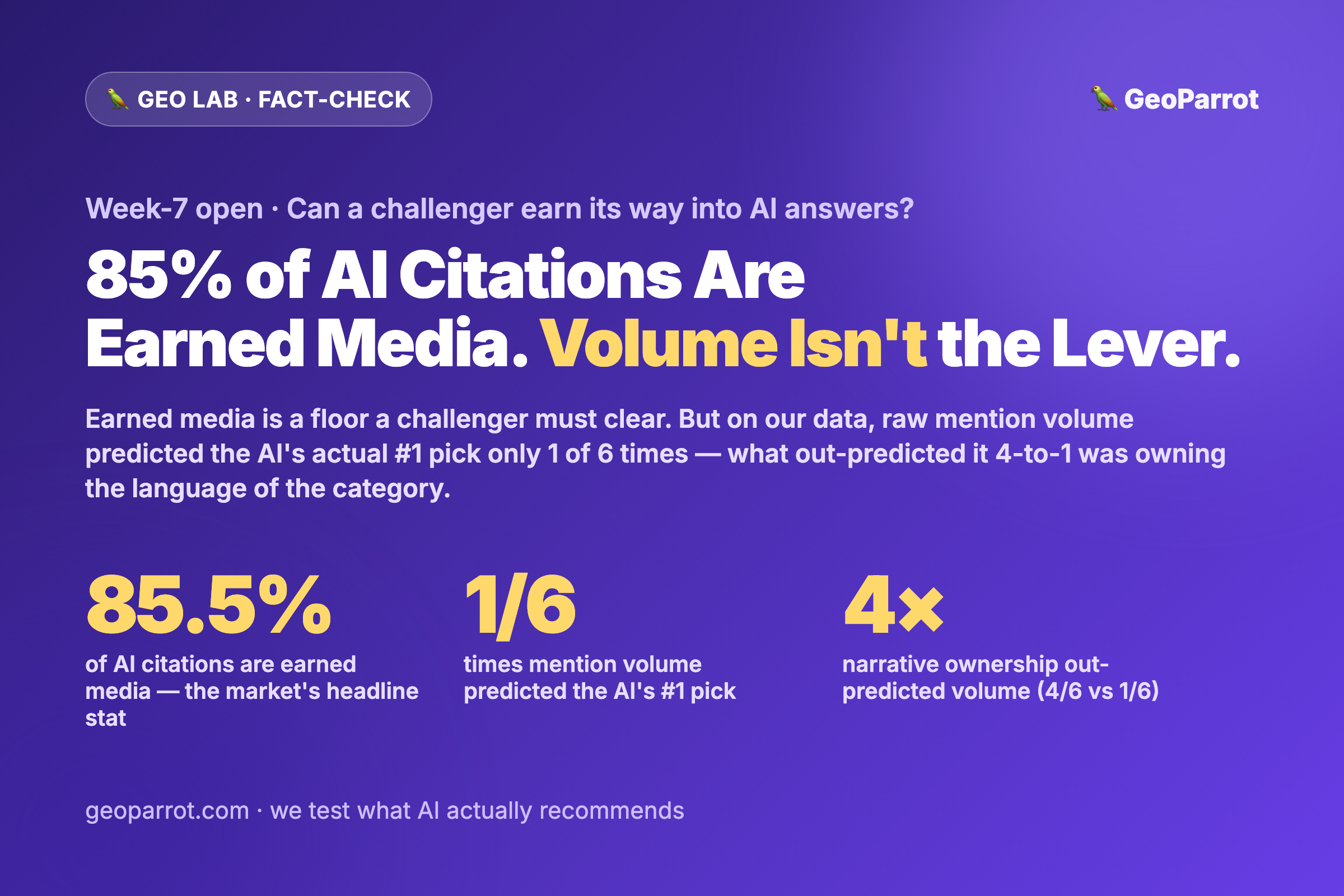
Quick answer: Half true, and the wrong half is the one everyone’s acting on. Yes — earned media dominates AI citations: Muck Rack puts 85.5% of AI citations on earned sources, the University of Toronto measured earned cited roughly 5x more than owned, and a Stacker/Scrunch study lifted one article’s citation rate from 8% to 34% just by distributing it to third-party sites. So a challenger with zero earned coverage really is invisible — earned media is a floor you must clear. But the market translates “earned media wins” into “maximize mention volume,” and on our first-party data volume is not the lever. Raw best-of-list breadth predicted the AI’s actual #1 pick only 1 of 6 times — the consensus pick sat on fewer lists (82.6% vs 93.2%), with fewer reviews and a lower rating, than the runner-up it beat. What out-predicted mention count 4-to-1 was narrative ownership: owning the language of the category. Mullvad is the AI’s #1 VPN on just 1 of 8 lists with 176 reviews. So a challenger can’t PR its way in on volume — the open question, which we test all week, is whether it can deliberately earn the narrative.
This is Monday’s fact-check, and it opens this week’s GEO Lab question: can a challenger deliberately earn its way to becoming the AI consensus pick — or is that status locked in category history? Last week we finished proving which metric actually predicts the pick (narrative ownership, not Share of Voice). This week we push from correlation to causation: if narrative ownership is what wins, can you build it on purpose? We start where every founder’s feed is pointing them right now — the “earn media, get cited” wave.
What is the market actually claiming this month?
The single loudest GEO message of 2026 is that AI visibility is won off your own site, in earned media. The stat sheet is genuinely striking, and it’s worth stating at full strength before we complicate it:
- 85.5% of AI citations come from earned media, not brand websites. That’s Muck Rack’s read across more than a million AI prompts, echoed by a 5W analysis landing on the same 85.5% figure. Owned pages barely register in the answer layer.
- Earned is cited roughly 5x more than owned. University of Toronto research found AI engines lean on third-party sources about five times as often as brand-controlled ones — because an independent source is easier to trust, retrieve and cite than a self-serving claim.
- Distribution alone multiplies citations. A December 2025 Stacker/Scrunch study of 944 prompt–platform combinations across five AI platforms took the same article and pushed it out to third-party news sites — citation rate jumped from 8% to 34%, a 4.4x lift, with no change to the content itself.
- Web-mention volume tracks citations. Brands in the top quartile for web mentions earn 10x+ more AI citations than the bottom quartile; Contently frames earned media as outperforming owned on citation rate by 325%.
The direction is real and, frankly, we’ve found the same thing from the other side: engines cite almost entirely different source URLs (0.5% overlap across four engines), and those sources are overwhelmingly third-party, not brand-owned. So we’re not here to debunk the earned-media stat. We’re here to check the instruction the market derives from it — because that translation is where challengers get sent down the wrong road.
Is “earned beats owned” true? (Yes — and it matters most for challengers.)
Take the strongest version of the claim seriously first. For an incumbent with a huge site, some owned pages still leak into answers. For a challenger, owned content is nearly worthless in the AI layer: a new brand’s own “why we’re the best” page is exactly the unverifiable, self-serving source engines discount. The 5x and 85.5% figures land hardest precisely on the small brand — which is why the honest version of this fact-check is not “ignore earned media.”
Earned media behaves like a floor. A brand generally needs some independent presence to be in the running at all — to be a candidate the engine can retrieve and cite. We’ve seen this floor directly: a brand with no third-party footprint doesn’t show up in the consideration set, full stop. And we’ve seen its inverse — you can’t self-publish your way to the pick: brands that cited their own best-of listicles got named #1 only 4.2% of the time. Earned, third-party, independent — the market is right about the channel. The question is what you have to do inside that channel.
So can a challenger just buy volume to win? (No — mention count predicted the pick 1 of 6 times.)
Here’s where “earn media, get cited” quietly becomes “earn more media, get cited more” — and the volume assumption fails our data. In last month’s experiment we froze the AI consensus picks for 6 buyer-intent categories — the brands two engines independently crowned #1 — and measured the earned-media signals a Share-of-Voice tool would count, for the pick versus the runner-up it beat. If volume won, the pick should out-count the runner-up. It did the opposite:
| What the market tells a challenger to maximize | The market’s claim | What our first-party data found |
|---|---|---|
| Earned coverage vs owned pages | 85.5% of citations are earned; ~5x owned | Confirmed as a floor. A challenger with zero earned coverage is invisible; you can’t self-publish your way in (4.2% pick rate) |
| Breadth of best-of-list mentions | Top-quartile mentions → 10x citations | Predicted the pick only 1 of 6 times. The consensus pick sat on fewer lists — 82.6% vs the runner-up’s 93.2% |
| Review volume & ratings | More social proof → more visibility | The pick had fewer reviews (~8,088 vs ~8,861) and a lower rating (4.18★ vs 4.42★) |
| Narrative ownership (how you’re described) | — not on the market’s scorecard — | Out-predicted mention count 4-to-1 (4 of 6 vs 1 of 6) on the same frozen roster |
Read the middle rows together: on every earned-media count the market tells a challenger to grow, the brand the engines actually recommend is behind the brand they don’t. Fewer lists, fewer reviews, lower rating — and it still wins. A challenger that spent its whole budget closing that volume gap would be optimizing toward the runner-up. The lever the market doesn’t put on its scorecard — narrative ownership — is the one that out-predicted volume 4-to-1.
The cleanest proof is the category where volume fails hardest. The AI’s #1 “best VPN” pick across engines is Mullvad — on just 1 of 8 independent lists (the lowest breadth in the entire study), 176 reviews, 3.5★. Its runner-up sits on 7 of 8 lists with ~28,000 reviews. Every earned-media count says the runner-up should win by a mile. The engines pick Mullvad anyway — because in the prose writers reach for it as the shorthand for “no-logs, anonymous, audited privacy.” It doesn’t have the volume. It has the narrative.
Then what does a challenger actually need to earn — reach, or narrative?
This reframes the earned-media playbook without contradicting the stats. Earned media is the channel — the 85.5% is right, and a challenger absolutely has to be in third-party text to exist. But the payload that wins isn’t “one more mention.” It’s whether the coverage you earn makes you the brand independent writers use as the shorthand for the attribute that defines the query. Mullvad earned relatively little coverage but earned the right coverage: privacy writers converged on describing it one way. That’s why we found engines can draw on totally different source pages yet converge on the same pick — the language survives across pages even when the URLs don’t overlap. Volume is countable and easy to sell; narrative ownership is what actually crosses the finish line.
So the practical challenger question is sharper than “how do I get more press?” It’s: can I deliberately author the category’s defining narrative into the coverage I earn — and will engines move because of it? That’s no longer a correlation question. It’s a causal one.
Can narrative ownership be earned on purpose — or is it locked in category history?
Here’s the thread we pull all week. Everything above is correlational: brands that own the narrative tend to be the pick. That’s consistent with two very different worlds, and a challenger’s entire strategy depends on which one is real:
- Earnable (causal). Narrative ownership is a lever a challenger can deliberately build — seed the right attribute language into the right independent sources, and the AI’s read of you shifts. If so, the earned-media budget should be pointed at owning an attribute, not at maximizing mention count.
- Locked (historical asset). Narrative ownership is a slow byproduct of years of category history — Mullvad earned its privacy reputation over a decade, and no amount of deliberate PR shortcuts it. If so, a challenger’s realistic play is to define a new attribute it can own rather than fight for one already claimed.
Both are plausible, and the market’s “just earn more media” advice quietly assumes the first without ever testing it. So this week we test it. Tuesday we pre-register a method to tell earned-on-purpose narrative ownership apart from history-locked ownership on our frozen roster; midweek we run it; Thursday we publish the results; Friday we rule — and turn it into a per-engine playbook for challengers. The stakes are concrete: founders are being told to buy their way into AI answers with volume. If narrative ownership is earnable, we can say what to earn. If it’s locked, we can say to stop paying for coverage that will never move the pick — and where to aim instead.
FAQ
Is it true that 85% of AI citations come from earned media?
Yes — Muck Rack’s analysis of over a million AI prompts puts 85.5% of AI citations on earned sources rather than brand-owned pages, and a separate 5W study landed on the same figure. University of Toronto research found earned media cited roughly 5x more than owned. The stat is real, and it matters most for small brands, whose own pages barely get cited at all.
So should a challenger just do more PR to get cited by AI?
Earned media is necessary but volume is not the lever. On our first-party data, breadth of best-of-list mentions predicted the AI’s actual #1 pick only 1 of 6 times — the consensus pick appeared on fewer lists, with fewer reviews and a lower rating, than the runner-up it beat. What out-predicted mention count 4-to-1 was narrative ownership: how the brand is described, not how often.
How can a brand with almost no coverage be the AI’s top pick?
Because recommendation tracks the language, not the count. The AI’s #1 VPN pick, Mullvad, sits on just 1 of 8 independent best-of lists with 176 reviews, yet wins — because independent writers use it as the shorthand for “private, no-logs, audited” VPNs. That attribute language survives across the many different pages engines read, even though the individual source URLs barely overlap (0.5% across four engines).
What’s the difference between Share of Voice and narrative ownership?
Share of Voice counts how often you’re mentioned. Narrative ownership measures how much you own the language of your category — how often independent writers reach for you as the shorthand for its defining attribute. In our tests the first ranked the runner-up above the winner; the second out-predicted it 4-to-1.
What is this week’s experiment testing?
Whether narrative ownership is earnable — something a challenger can build on purpose — or a locked asset accrued over years of category history. That’s the shift from correlation (owners tend to be picks) to causation (can you become an owner). We pre-register the method Tuesday, run it midweek, publish results Thursday, and rule Friday.
Sources
- Muck Rack / 5W — analysis putting 85.5% of AI citations on earned media, not brand websites
- Machine Relations — Earned Media vs. Owned Content: AI Citation Rates Compared (University of Toronto ~5x figure; Stacker/Scrunch 8%→34% distribution lift; top-quartile 10x)
- Contently — How to Get Your Brand Cited in ChatGPT (earned media outperforming owned by 325% on citation rate; 30-day freshness 3.2x; schema 2.8x)
- GeoParrot GEO Lab — first-party data on the AI consensus pick: the frozen-roster reputation signals, narrative ownership out-predicting mention count 4-to-1, and the Share-of-Voice verdict
Leave a Reply