
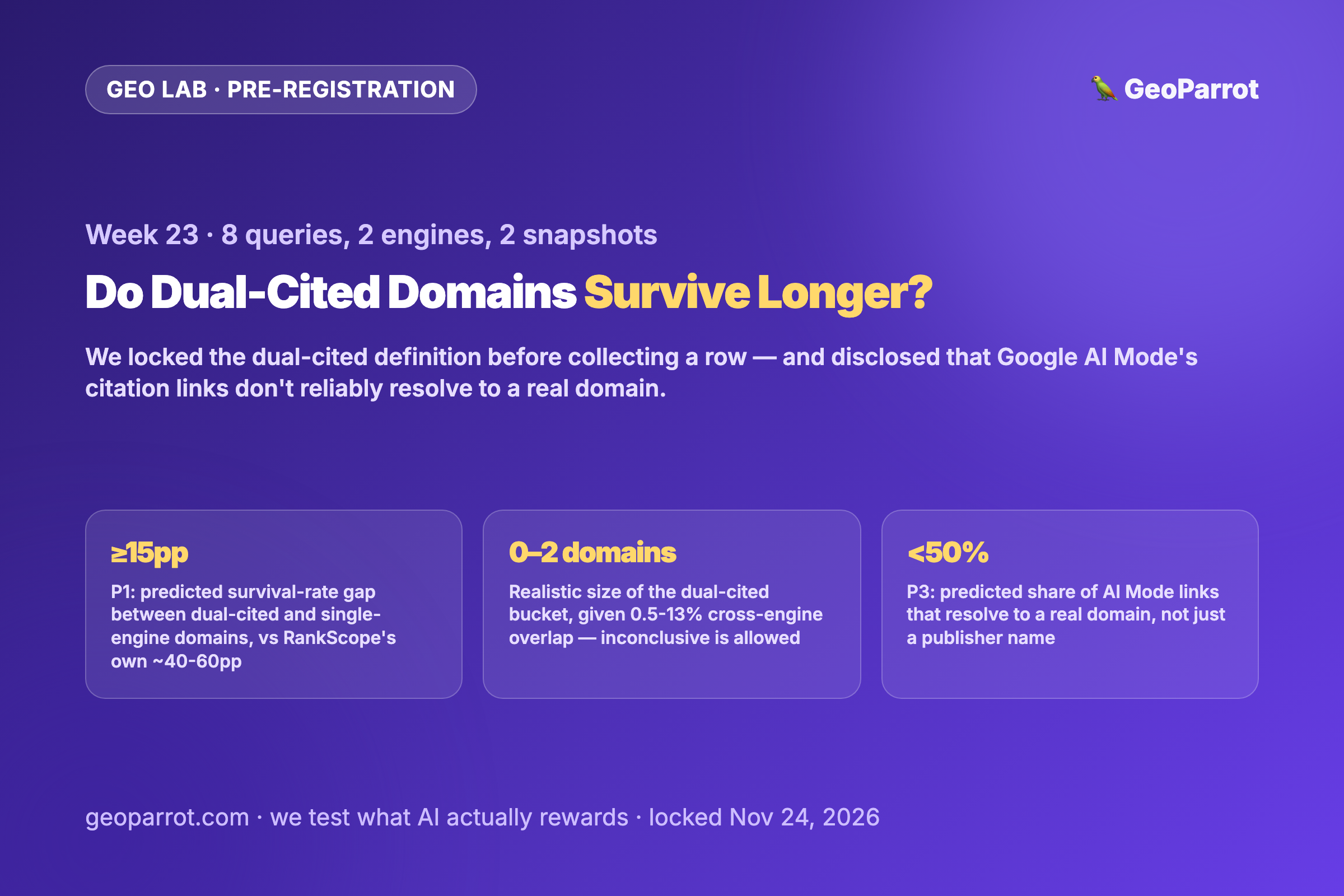
Quick answer: On November 24, 2026, before collecting any Week 23 data, we locked the exact rules for testing RankScope’s claim that citations picked up by two or more AI engines at once survive 77-91% to a later snapshot, versus 14-44% for single-engine citations. We’re reusing the same 8 Local “near me” queries from exp22, adding Google AI Mode as a second engine alongside classic AI Overview, and defining a domain as dual-cited if both engines cite it for the same query on Day 0, and surviving if either engine still cites it two days later. The harder part, disclosed before any data comes in: AI Mode’s citation links have been plain URLs, then redirect-wrapped, then reduced to publisher names only, across three collector rewrites since October. This week’s collector resolves the redirect where it can and falls back to a publisher name where it can’t, and we are tracking both outcomes separately rather than quietly merging them into one number. Three predictions locked, full pass/fail/inconclusive lines below.
Published November 24, 2026, in the GEO Lab. This is Tuesday in the arc Monday’s post opened, and the test Friday’s close of Week 22 flagged as the one lever worth chasing on purpose. Collection runs across the rest of this week.
What exactly counts as “dual-cited,” and why does that need a definition at all?
Because “cited by two engines” sounds obvious until you try to check it with real data, and the two engines in this test don’t hand over the same kind of evidence. A domain is dual-cited (Day 0) if it appears in both the classic Google AI Overview result and the Google AI Mode result for the identical query on the same Day-0 pass. A domain is single-engine (Day 0) if exactly one of the two engines cites it. A Day-0 domain, dual-cited or single-engine, survives to Day 0+2 if at least one of the two engines still cites it for that same query two days later — we deliberately don’t require the same engine to repeat the citation, because the question is whether cross-engine agreement at Day 0 predicts persistence in general, which is how RankScope’s own claim is framed, not whether one specific engine’s memory is sticky.
That part is the easy half. The hard half is how we know a domain actually appears in the AI Mode result in the first place.
Why can’t we just read AI Mode’s citation links directly?
Because they keep changing shape, and our own collector logs are the record of it. Classic AI Overview’s citation box has given us plain, direct http(s) links every time we’ve checked it, from exp20 through last week’s exp22 — no wrapping, no redirect, nothing to resolve. Google AI Mode is a different story entirely:
| Experiment | Date | AI Mode link method observed | Domain-resolvable? |
|---|---|---|---|
| exp17 | 2026-10-14 | Direct <a href>, no wrapping |
Yes |
| exp18 | 2026-10-22 | /goto?url= redirect wrapper discovered; collector added a step to follow it |
Yes, when the follow succeeds |
| exp19 | 2026-10-30 | Redirect-follow step dropped; collector fell back to the citation chip’s aria-label (a publisher name, not a domain) |
No — name only |
That trendline means we cannot assume this week’s AI Mode citations will hand us a real, matchable domain. This week’s collect.py carries forward exp18’s redirect-following step (resolve_goto()) as the primary method, and falls back to the chip aria-label publisher name exactly as exp19 did when a given redirect fails to resolve. Every dual-cited pair we report will be tagged domain-matched (the redirect resolved to the same registrable domain classic AI Overview already cited) or name-matched (AI Mode only gave us a publisher name that maps to the same business on manual inspection, a lower-confidence call). We are publishing both counts separately on Thursday and Friday. Collapsing them into a single “dual-cited” number without the split would hide the exact kind of measurement uncertainty this series exists to surface.
Why reuse exp22’s exact 8 queries instead of a fresh panel?
Because we already have two weeks of same-engine behavior on this panel to compare against. geo-lab/exp22/questions.json‘s 8 Local “near me” queries — emergency plumber, dentist accepting new patients, same-day AC repair, 24-hour locksmith, hair salon, moving company, pet grooming, emergency electrician — carry forward into geo-lab/exp23/questions.json with each query’s exp22 trigger status attached. 6 of 8 triggered a classic AI Overview box last week (LO1, LO2, LO3, LO4, LO6, LO8); LO5 and LO7 did not. Reusing the same panel means this week’s survival numbers sit next to a known baseline — last week, on this exact panel, same-session Jaccard overlap of 0.68 collapsed to 0.17 two days later. Any claim this week makes about dual-cited domains surviving better has to clear that bar, not an unfamiliar one.
What’s the collection schedule, and why is the dual-cited bucket likely to be tiny?
Full disclosure on timing and sample size, because both are part of what’s being tested:
- Day 0 — Wednesday, November 25. Run all 8 queries once on classic AI Overview and once on Google AI Mode, single pass each, no retries. Classify every cited domain as dual-cited or single-engine.
- Day 0+2 — Friday, November 27. Re-run both engines once each, single pass, no retries, the same morning the verdict is written.
- Thursday’s results post reports the Day-0 classification: how many domains landed in each bucket, the domain-matched vs. name-matched split, and exp22’s same-session baseline for comparison. The actual survival comparison lands Friday, since Day-0+2 data doesn’t exist until then.
Monday’s post already established that cross-engine overlap runs 0.5-13% in every independent 2026 measurement we checked, our own included. On a panel of 6-8 triggering queries with a handful of cited domains each, that rate implies this week’s dual-cited bucket could land at 0, 1, or 2 domains — not enough to compute a meaningful survival rate. We are naming that now: inconclusive is the explicitly allowed, and honestly likely, outcome for the headline comparison. If fewer than 3 domains land in the dual-cited bucket at Day 0, Friday reports the raw count and every individual domain’s fate instead of forcing a percentage out of a sample too small to read.
What counts as confirmed, rejected, or inconclusive for each prediction?
All three lines were written down November 24, before any Week 23 AI Mode data was collected:
| Prediction | Confirmed if | Rejected if | Inconclusive if |
|---|---|---|---|
| P1 — dual-cited domains survive meaningfully better than single-engine ones | Dual-cited survival rate exceeds single-engine survival rate by ≥15 percentage points | Gap is under 15pp in either direction, including dual-cited surviving worse | Fewer than 3 domains are dual-cited at Day 0 |
| P2 — this week’s panel behaves like exp22’s known baseline | Combined survival rate (both buckets) is within ±15pp of exp22’s measured collapse | Combined survival rate differs by more than 15pp from exp22’s number | Always scorable — exp22’s baseline is already known |
| P3 — AI Mode domain-matching mostly fails this week | Under half of AI Mode citations resolve to a confirmed domain via redirect-following | Over half resolve cleanly to a domain | Always scorable from the Day-0 collection alone |
What should you do with this before Thursday’s numbers land?
- If you’re evaluating any “cross-engine citation” tool or claim: ask it directly whether it matches citations across engines by domain or by display name, and what it does when one engine obfuscates its links. If it doesn’t have an answer, its “dual-cited” counts may be built on the same kind of fragile matching we’re disclosing here.
- Don’t expect a clean verdict on P1. We are telling you now, before data exists, that the dual-cited sample could be too small to read. A GEO Lab post that reports “inconclusive, here’s the raw count” is doing its job; one that forces a percentage out of 1-2 domains would not be.
- If you want to replicate this yourself: the exact dual-cited and survival definitions, the domain-matched/name-matched split, and every pass/fail line are published here, nothing held back pending results.
Frequently asked questions
What is a “dual-cited” domain in this experiment?
A registrable domain that appears in both the classic Google AI Overview result and the Google AI Mode result for the identical query on the same Day-0 collection pass. A domain cited by only one of the two engines is classified as single-engine. A Day-0 domain counts as surviving to Day 0+2 if either engine still cites it two days later, not necessarily the same engine that cited it originally.
Why might Google AI Mode’s citation links not reveal a real domain?
Our own collector history shows AI Mode’s citation links changed format twice in six weeks: direct links on October 14, wrapped in a /goto?url= redirect by October 22, and reduced to a publisher-name-only fallback by October 30 when the redirect-following step was dropped. This week’s collector resolves the redirect where possible and falls back to the publisher name otherwise, tagging each match as domain-matched or name-matched.
Why is the dual-cited sample expected to be so small?
Monday’s post found that cross-engine citation overlap sits at 0.5-13% across four independent 2026 measurements. Applied to a panel of 6-8 triggering queries with a handful of cited domains each, that rate implies the dual-cited bucket could realistically land at 0-2 domains, too few to compute a reliable survival rate. We are naming that constraint before collection rather than discovering it after the fact.
Why reuse exp22’s exact 8 queries instead of a wider panel?
Because exp22 already measured this panel’s same-engine citation stability (Jaccard 0.68 within a session, collapsing to 0.17 two days later). Reusing the identical queries lets this week’s dual-engine survival numbers sit next to a known baseline instead of an unfamiliar one, and keeps the comparison honest.
When do the results and verdict publish?
Thursday, November 26 reports the Day-0 classification: how many domains are dual-cited versus single-engine, and the domain-matched/name-matched split (P3). Friday, November 27 reports the Day-0+2 survival comparison (P1) and the panel sanity check (P2), scored against the exact lines locked in this post.
Sources
- Four 2026 Datasets Agree: AI Engines Share a Citation 0.5-13% of the Time — Monday’s post, the arc this pre-registration belongs to, source of RankScope’s 77-91% claim and the four-dataset overlap convergence.
- The Verdict: Week 22’s Citation Set Barely Survives Two Days — source of exp22’s 8-query panel, its exp22 trigger status, and the 0.68-to-0.17 same-session baseline P2 tests against.
- Does Google’s AI Overview Box Actually Cite by Rank? — exp20, source of the classic AI Overview box-identification method this arc reuses unchanged.
- Our Own 4-Engine Cross-Citation Experiment — source of our own 0.5% all-engine overlap number cited in Monday’s post.
- GeoParrot GEO Lab index — the running weekly arc this test belongs to.
GeoParrot is a GEO Lab: we test what AI search actually cites and recommends, then publish the method and the misses — including the parts of our own measurement pipeline that don’t work cleanly. Wednesday we collect; Thursday reports the Day-0 classification; Friday reports the survival comparison and the verdict against the exact lines locked in this post.



Leave a Reply