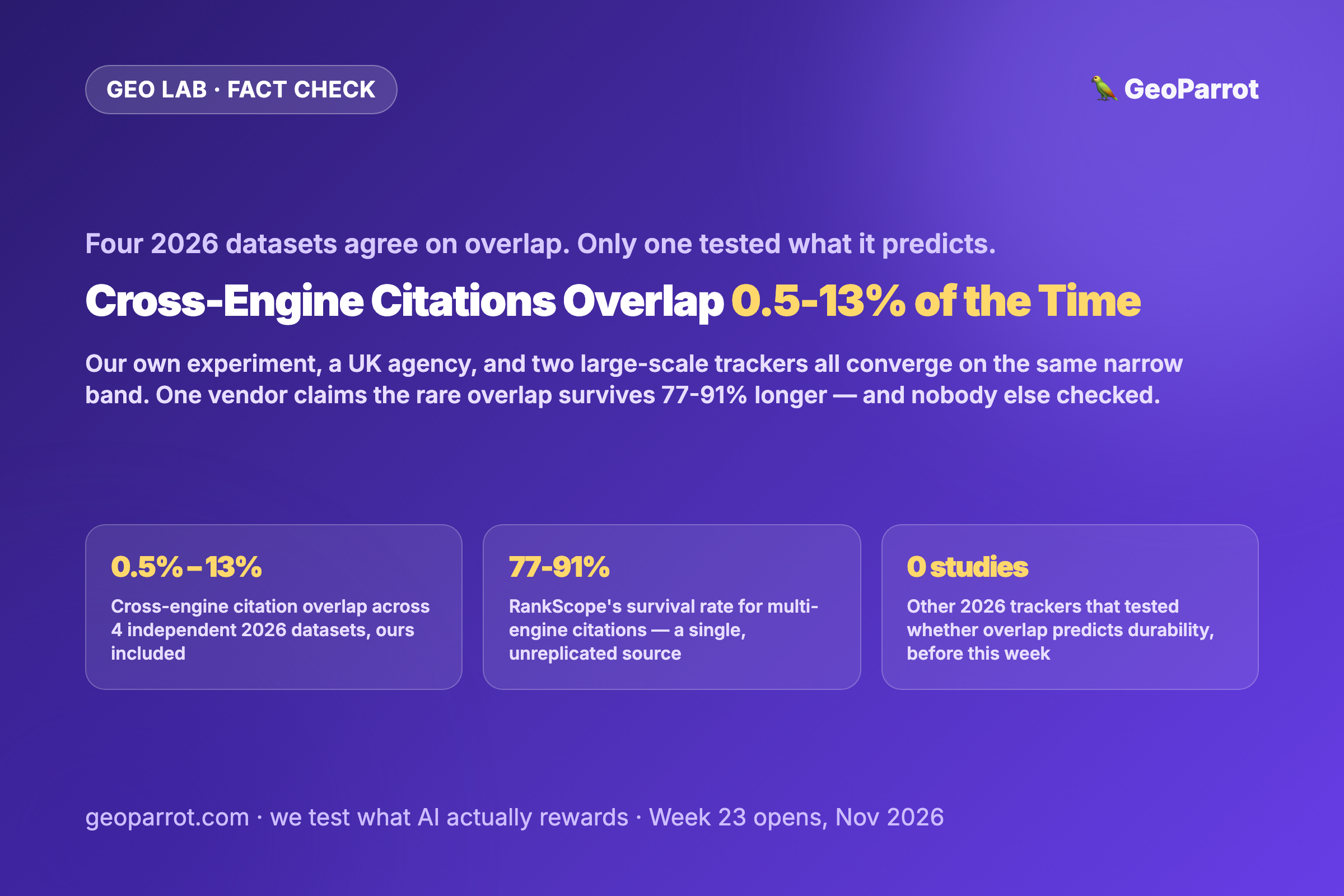
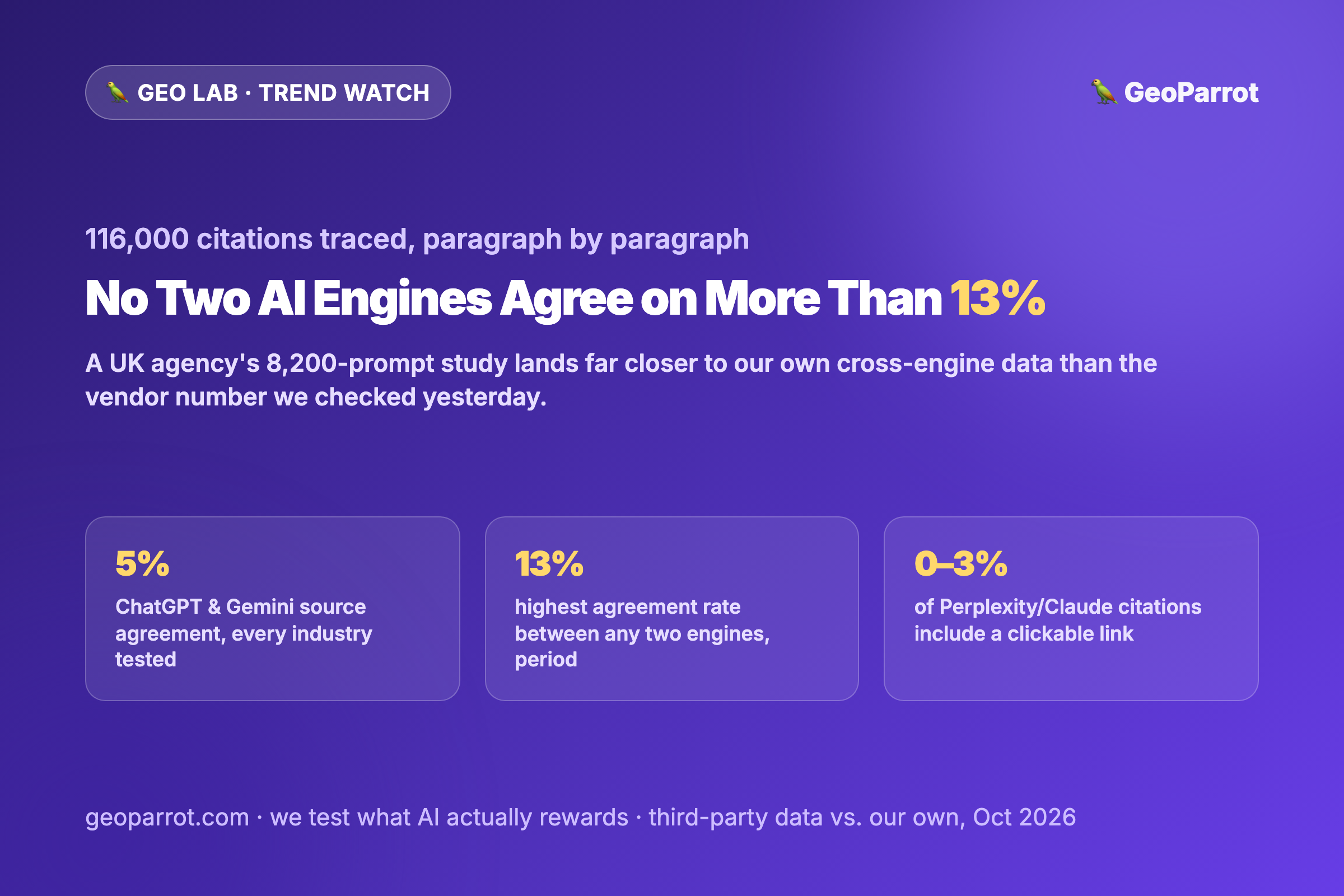
Quick answer: Four independent 2026 measurements, two of them our own, all land in the same narrow band when they ask how often different AI engines cite the exact same source for the exact same question: our own 4-engine experiment found 0.5% all-engine overlap, a UK agency’s 116,000-citation study found 5% between ChatGPT and Gemini and never more than 13% between any pair, a vendor tracking 22.7 million citations (Wellows) put ChatGPT-Perplexity overlap near 10-11%, and a separate aggregation of 6.8 million citations (5W and Profound) also landed on 11%. That convergence is the easy part of this story. The harder claim comes from a fifth source, RankScope, which we covered last week: pages cited by two or more engines at once survive 77-91% to a later snapshot, versus just 14-44% for pages cited by only one engine. We went back through every other 2026 citation-tracking dataset we could find, including two that measure citation survival over time, and none of them tested whether cross-engine overlap predicts durability. RankScope’s claim is standing alone. This week we test it on our own panel.
Week 23 opens, published November 23, 2026, in the GEO Lab. Last Friday’s Week 22 verdict confirmed that a citation set barely survives two days on our own panel (Jaccard 0.68 within a session collapsing to 0.17 two days later) and flagged RankScope’s 77-91% multi-engine persistence number as the one lever in that entire arc that looked worth chasing on purpose. This week we chase it.
How rare is cross-engine citation overlap, really?
Rare enough that four separate attempts to measure it, run by four different parties with four different sample sizes, all come back inside the same narrow band.
Source
Sample
What it measured
Overlap found
GeoParrot (our own)
15 buyer-intent questions, 4 engines (ChatGPT, Gemini, Perplexity, Google AI Mode), 386 cited domains
Share of domains cited by all four engines on the same question
~10-11% pairwise; 0.19% to 0.59% across the half-year for all five at once
5W + Profound (PR firm + GEO vendor, aggregated)
6.8M+ citations, 12 studies pooled, Aug 2024-early 2026
ChatGPT-Perplexity domain overlap
11%
Wellows and Profound both sell AI-visibility tracking, a disclosed conflict of interest in their own writeups. The UK agency study and our own experiment have no commercial stake in the number.
Four parties, four different sample sizes (386 domains up to 22.7 million citations), four different time windows, and the numbers still cluster: pairwise overlap somewhere around 5-13%, all-engine overlap closer to zero. That is about as strong a replication as a single claim gets in this space. We are confident in the headline: AI engines pull from almost entirely separate reference lists, even when asked the identical question.
Does the rare overlap that does happen survive longer?
This is where the agreement stops. Last week we covered RankScope’s 2026 three-run tracker: 50 questions across 10 brands and 4 engines, re-asked at 0 hours, +3 hours, and roughly +2.7 days. Its page-level survival numbers were already unimpressive on their own, 14-16% for classic AI Overview, 15-18% for AI Mode, 40-44% for ChatGPT, 66% for Perplexity, but it reported one number that looked like an actual lever: pages cited by two or more engines at the same time survived at 77-91%, far above any single-engine rate.
We went looking for a second dataset to confirm it and came up empty. Foglift’s September 2026 quarter-over-quarter tracker (75 buyer-intent questions re-run across Q2 and Q3, five engines) measures same-question citation-set turnover per engine, 77.0% for ChatGPT up to 86.7% for the Google AI Overview lane, but it never segments by whether a citation was also picked up by a second engine. Wellows’ 22.7-million-citation dataset reports the overlap rate itself growing from 0.19% to 0.59% across six months, a real trend, but says nothing about whether the domains inside that shrinking overlap are more likely to still be cited later. Neither study was designed to answer the question RankScope answered. They were measuring a different axis entirely, same as four other 2026 volatility studies we compared two weeks ago.
Why should you be skeptical of a 77-91% number before testing it?
Because the group it describes is tiny by construction. If cross-engine overlap sits at 5-13% of all citations, as four independent 2026 datasets agree it does, then RankScope’s “multi-engine” survival bucket is drawn from a thin slice of its own 50-question panel. A persistence rate built on a small subset can swing wide on a handful of individual results, and RankScope’s own write-up does not publish the raw count of multi-engine citations behind the 77-91% figure. We are not saying the number is wrong. We are saying it has exactly one source, it has never been independently replicated, and the two time-decay studies that could have checked it (Foglift and Wellows) did not ask the question. That is precisely the gap a GEO Lab experiment with a known, fixed query panel is built to close.
What are we testing this week?
We are reusing the same 8 Local-intent queries from Week 22’s exp22 panel, but adding Google AI Mode as a second engine alongside classic AI Overview. On day 0 we collect citations from both engines for all 8 queries and mark which domains were cited by both engines versus only one. Two days later we re-collect and check which of those domains are still cited. The theme question for the week: on our own panel, do the dual-cited domains from day 0 survive to day 0+2 at a meaningfully higher rate than the single-engine-only domains, the way RankScope found at a much larger scale? Tuesday’s post locks the exact overlap definition, the survival threshold, and falsifiable predictions before we collect a single snapshot, following the same one-attempt, no-retry collection discipline that kept our own cross-engine experiment and last week’s panel both clean of Google’s bot defenses.
What should you do with a cross-engine overlap number right now?
Stop optimizing for one engine’s citation count in isolation. Four 2026 datasets agree that a citation on ChatGPT tells you almost nothing about whether Perplexity, Gemini, or Google AI Mode will also cite you, overlap sits at 5-13% even in the best-replicated numbers.
Treat “cross-engine overlap predicts durability” as an unreplicated claim, not a settled fact. It comes from one source (RankScope), on a small implied sample, and the two other 2026 trackers built to measure citation stability over time never tested it.
Watch for vendor COI on either side of this debate. Wellows and Profound both sell AI-visibility tracking; that does not make their 10-11% overlap numbers wrong, since independent parties (our own experiment, the UK agency study) landed in the same range, but it is a reason to weight the agreement across sources over any single vendor’s number.
Expect our own verdict Friday. If dual-engine citations on our 8-query Local panel survive meaningfully better than single-engine ones, that is the first actionable GEO lever to come out of six weeks of citation-stability testing. If they don’t, that is worth knowing too.
Frequently asked questions
How often do different AI engines cite the same source for the same question?
Rarely. Four independent 2026 measurements agree on a narrow band: our own 4-engine experiment found 0.5% all-engine overlap across 386 cited domains, a UK agency’s 116,000-citation study found 5% between ChatGPT and Gemini and never above 13% for any engine pair, and two separate large-scale trackers (Wellows at 22.7 million citations, and a 5W/Profound aggregation of 6.8 million citations) both put ChatGPT-Perplexity overlap around 10-11%.
Does being cited by two or more AI engines at once make a citation last longer?
RankScope’s November 2026 tracker says yes: pages cited by two or more engines simultaneously persisted at 77-91% on a later run, versus 14-44% for single-engine citations. No other 2026 citation-stability study we reviewed, including Foglift’s quarter-over-quarter tracker and Wellows’ six-month overlap trend, tested this specific question, so it currently rests on one source.
Because the other 2026 datasets built to measure citation durability over time, like Foglift’s per-engine turnover tracker and Wellows’ overlap-trend dataset, were designed to answer a different question and never segmented their results by whether a citation was also picked up by a second engine. Cross-engine overlap itself is also rare (5-13% in every independent measurement), so any study attempting this test is working with a small subset of its own data.
Are the vendors reporting low cross-engine overlap numbers trustworthy?
Two of the four sources in this comparison, Wellows and Profound, sell AI-visibility tracking and disclose that conflict of interest themselves. Their 10-11% overlap figures are still credible because two independent, non-commercial measurements, our own 4-engine experiment and a UK agency’s 116,000-citation study, landed in the same range without any sales incentive attached.
What is GeoParrot testing this week on cross-engine citation survival?
We are adding Google AI Mode as a second engine to the same 8 Local-intent queries used in last week’s reproducibility panel, collecting on day 0 and again two days later, and checking whether domains cited by both engines at once survive to the second collection at a higher rate than domains cited by only one engine. Tuesday’s post locks the exact definitions and falsifiable predictions before any data is collected.


Leave a Reply