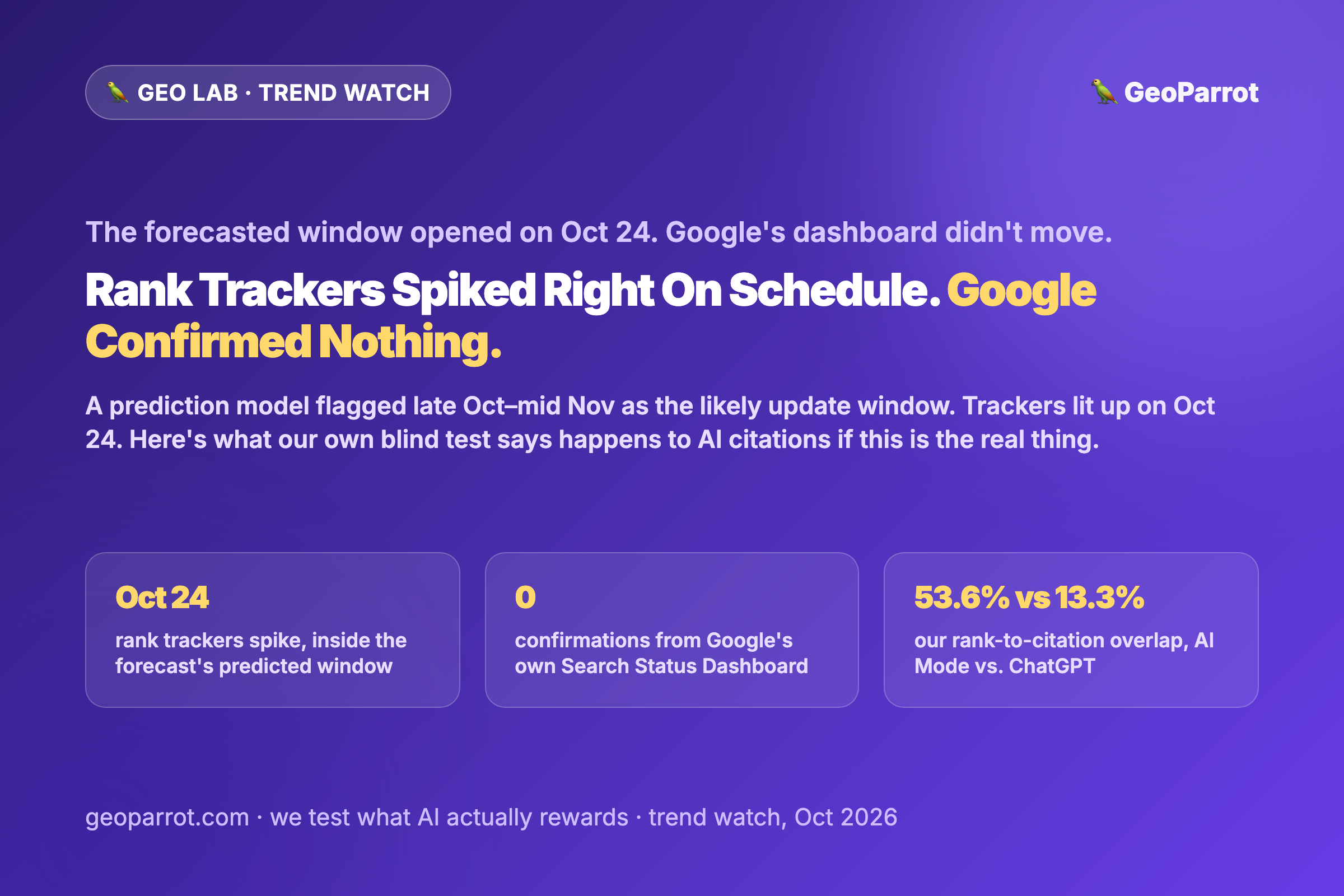
Quick answer: On October 24, 2026, third-party rank trackers — Mozcast, Wincher, CognitiveSEO, Semrush, AWR, Serpstat, DataForSEO and others — all showed elevated volatility at once, and Search Engine Roundtable’s reader reports described “very very depressing” traffic and rankings “bouncing all over the place.” That lands squarely inside the late-October-to-mid-November window a gradient-boosted prediction model flagged on October 13 with 96.8% odds of some Google update arriving within 30 days. But as of the October 26 recap, Google’s own Search Status Dashboard still shows no confirmed update — the identical forecast-versus-confirmation gap we flagged five days ago, just one week closer to the predicted window. Even if this turns out to be the update landing, our own September blind test already tells you the AI-citation fallout won’t be uniform: 53.6% rank-to-citation overlap on Google AI Mode, versus 13.3% on ChatGPT. A red rank tracker this week is not, by itself, evidence your AI visibility moved.
Trend watch — published October 27, 2026, in the GEO Lab. Five days ago we covered a prediction model putting 96.8% odds on a Google update landing between late October and mid-November 2026. This week the volatility it predicted actually showed up on schedule — which makes this less a new story than a checkpoint: did the forecast start coming true, and if it has, what does our own prior data say happens to AI citations next?
What actually happened to Google rankings on October 24?
Multiple third-party rank-tracking tools — Mozcast, Wincher, CognitiveSEO, Semrush, AWR, Serpstat and DataForSEO among them — all registered elevated volatility starting Friday, October 23, continuing heavily into Saturday, October 24. Search Engine Roundtable’s coverage collected reader reports rather than guessing at a cause: one webmaster wrote “Traffic is again very very depressing. Looks like a bleak weekend ahead.” Another reported unusual crawl activity — “I’ve been getting heavy bot traffic from Singapore the last couple of days. This usually happens before a Google update” — and a third described the ranking shuffle itself: “rankings are bouncing all over the place. Right now, it feels like Google is heavily favoring public broadcasters.” That’s three independent, qualitative signals (traffic, crawl behavior, result composition) all pointing the same direction in the same 48 hours. It follows earlier unconfirmed chatter on October 16, 20 and 21, so this isn’t an isolated blip — it’s the fourth distinct volatility window logged this month.
Does this count as the update the prediction model called?
Not yet, and that distinction matters more than it sounds like it should. The Dan Taylor model we covered on October 22 forecast a timing window — late October through mid-November — not a specific date or a confirmed mechanism. October 24 sits inside that window, which is consistent with the model, but “consistent with” isn’t “confirmed by.” As of the October 26 Search Engine Roundtable recap, Google’s Search Status Dashboard showed nothing: no live update, no recently completed rollout, no acknowledgment of the October 24 volatility at all. That’s the same gap we described five days ago — forums and trackers reporting movement while Google’s own status page says nothing happened — just now sitting directly inside the predicted window instead of ahead of it. If Google confirms a broad core update in the next few weeks, October 24 will likely get cited as the start of its rollout. If Google never confirms anything, this was unconfirmed noise that happened to land during a statistically likely window — which, per the model’s own logic, was always going to have some volatility in it regardless of cause.
If this is the update, what happens to AI citations? We already measured this once.
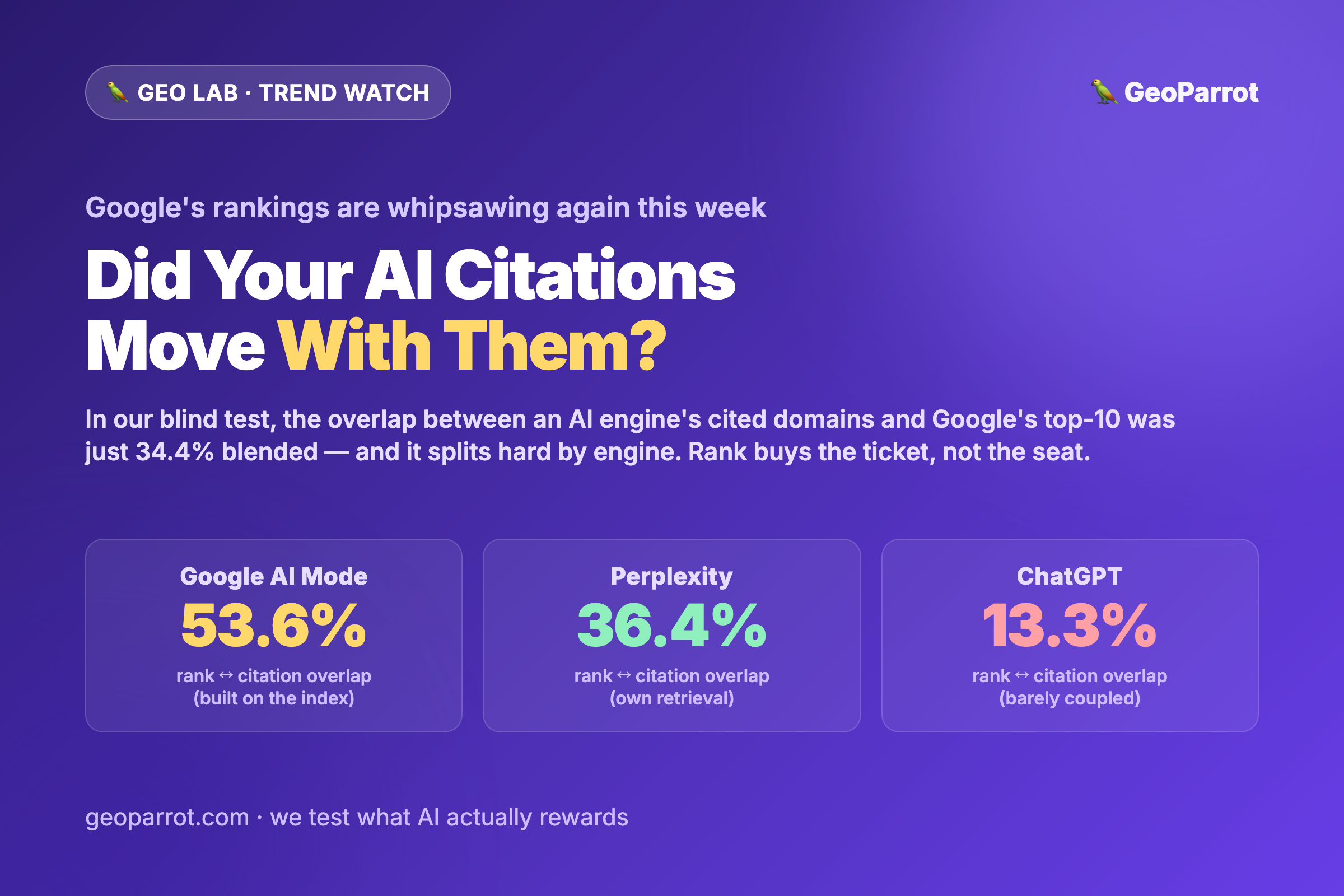
This is the part we don’t have to guess at, because we ran a pre-registered blind test on exactly this question in September, during the last round of unconfirmed volatility. We pulled Google’s top-10 organic domains against the domains actually cited by Google AI Mode, Perplexity and ChatGPT across 8 high-commercial-intent queries, and measured how much they overlapped.
Engine
Rank-to-citation overlap
What that means if rankings move
Google AI Mode
53.6%
Built on Google’s own index — a ranking swing has the most realistic path to touching it, though ~47% of its citations already come from outside the top-10
Perplexity
36.4%
Runs its own retrieval, moderately coupled to rank
ChatGPT
13.3%
Independent retrieval, barely coupled — a Google ranking event has almost no mechanical path to it
Source: GeoParrot’s own blind test, published September 19, 2026, re-cited October 22 and again here as the baseline for what a confirmed ranking event would plausibly do to AI citations.
Note what this table is and isn’t. It’s our measured relationship between ordinary rank movement and AI citation presence, from one prior event. It is not a live before/after reading of this specific October 24 volatility — we haven’t run that test on this window, and a scaled-content “Panda-style” update (if that’s what this turns out to be) could behave differently from the ordinary jitter we measured in September. But it’s the only real evidence either of us has right now, and it argues against the reflex that a red rank tracker this week automatically means your AI Overviews or ChatGPT citations are in trouble. The August and September spam updates we tracked separately support the same split: AI Mode and AI Overviews share real risk with a Google demotion because they run on the same index; ChatGPT and Perplexity, built on independent retrieval, mostly didn’t move with it.
Is this just another measurement artifact, like the ones we’ve logged all quarter?
Worth asking, because this quarter we’ve already logged five cases where a “the metric moved” story turned out to be a broken measurement pipe rather than a real change in AI behavior. This one is different in kind, not just degree: the October 24 signal is multiple independent rank trackers agreeing on real ranking movement, corroborated by first-party reader reports of traffic and crawl-pattern changes — not a single dashboard misreading a label or a tag. The open question isn’t whether something moved in the rankings (several tools agree something did); it’s whether Google will ever call it an update, and separately, whether that movement reaches AI citations at all. Those are three different questions — did rank move, will Google confirm it, did AI citations move with it — and the counted-vs-inferred distinction applies to the third one specifically: your own AI-referred sessions and GSC Generative AI impressions are counted; a rank tracker’s volatility score is inferred evidence about rank, and tells you nothing directly about citations.
What to actually do while this is still unconfirmed
Don’t treat October 24 as a confirmed update. Multiple rank trackers agreeing on volatility is real signal that something moved in the rankings — it is not the same as Google confirming a core update, and the two have diverged before this year.
If you saw a rank drop this week, check your AI citation surfaces separately before reacting. Pull your Search Console Generative AI report and your GA4 AI-referred traffic. Based on our prior data, a Google Mode citation drop is plausible if your rank fell hard; a ChatGPT citation drop from this alone is unlikely.
Don’t rewrite pages reactively. The standard advice for unconfirmed volatility — wait for either a sustained multi-week trend or an official confirmation — applies here, and applies harder to AI citations specifically, since rank predicts them weakly even when rank movement is real.
Keep your own snapshot now. If a core update is confirmed in the coming weeks, you’ll want a rank and AI-citation baseline from before it landed. Log both today rather than reconstructing them after the fact.
Frequently asked questions
Did Google confirm a core update on October 24, 2026?
No. Multiple third-party rank trackers showed elevated volatility starting October 23–24, and SEOs reported real traffic and ranking changes, but as of the October 26 recap, Google’s Search Status Dashboard showed no confirmed broad core update and Google made no public statement about the dates.
Is this the update the 96.8%-odds prediction model forecast?
Possibly, but it’s not confirmed either way. The model, published October 13, flagged late October through mid-November as the likely window for a Google update to land within 30 days at 96.8% odds. October 24 falls inside that window, which is consistent with the forecast, but consistency isn’t confirmation — the model predicted a timing range, not this specific date or cause.
If my rankings dropped this week, did my AI Overview or ChatGPT citations drop too?
Not necessarily, and it depends heavily on the engine. In our own blind test, rank-to-citation overlap was 53.6% on Google AI Mode, 36.4% on Perplexity, and just 13.3% on ChatGPT. A rank drop has a real, though partial, path to hurting your AI Mode citations; it has almost no mechanical path to your ChatGPT citations.
Should I change my content because of this week’s ranking volatility?
Generally no, while it remains unconfirmed. Reactive rewrites during an unconfirmed volatility window risk “fixing” a problem that may not exist, especially on the AI-citation side, where rank is a weak predictor even during confirmed ranking events. Wait for either a sustained trend or an official Google confirmation before making structural changes.
How is this different from the AI Overview label bug or other measurement artifacts this quarter?
Those five incidents were cases where the underlying AI behavior hadn’t changed at all — only the measurement tool had broken. This case is different: multiple independent rank trackers and first-party reader reports agree real ranking movement happened. What’s still unresolved is whether Google will confirm it as an update, and separately, whether that rank movement reaches AI citations at all — those are open questions, not a measurement bug.


Leave a Reply