
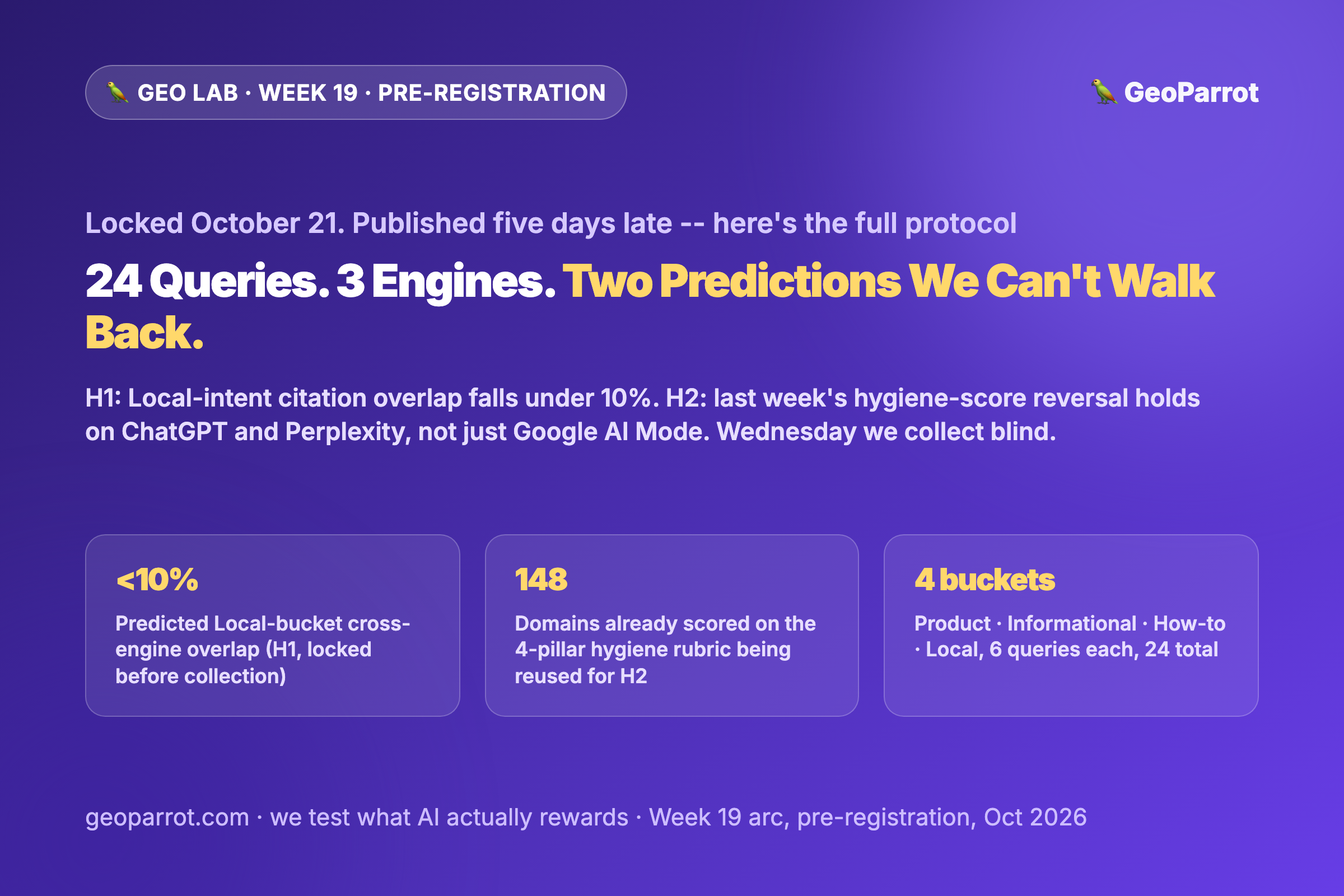
Quick answer: On October 21, 2026, before collecting any data, we locked two hypotheses for this arc. H1: cross-engine citation overlap (ChatGPT, Perplexity, Google AI Mode) for Local-intent queries will come in under 10%, sharply lower than Product, Informational, and How-to queries in the same 24-query set. H2: last week’s hygiene-score reversal — cited pages scoring lower on our content-hygiene rubric than uncited ones, the opposite of a widely repeated “4.2x more citations” claim — holds on ChatGPT and Perplexity too, not just Google AI Mode. This post is the full protocol: all 24 queries, the 4-pillar domain-scoring rubric we’re reusing from 148 already-scored domains, and the exact numbers that would prove either prediction wrong. We wrote it five days before publishing it, which is itself part of the story.
Published October 27, 2026, in the GEO Lab. This is Tuesday in the arc Monday’s post reopened. The gap between “locked” and “published” is the dogfooding point: a pre-registration that sits in a folder for five days before anyone can read it is barely different from no pre-registration at all, because nobody outside the lab can check that the numbers weren’t adjusted after the fact. Today closes that gap.
What exactly did we lock on October 21, and why two hypotheses instead of one?
Weeks 13 through 18 each reported a single aggregate number — “overlap = 34%,” “hygiene gap = negative,” “Reddit citation share = 21%.” Averages like that hide where a pattern actually comes from. This arc doesn’t collect a new one-number verdict; it slices one 24-query dataset three ways at once — by engine, by search intent, and by domain hygiene tier — and checks two specific, falsifiable claims against those slices rather than against the whole blended set.
- H1 (new claim, about intent): Local-intent queries — the kind backed by Google Business Profile, Yelp, and Maps listings rather than editorial web pages — will show cross-engine citation overlap under 10%. That’s a much sharper claim than our own 34% blended baseline from September, and sharper than the 26-33% figure Searchable published for a related but different statistic (business-name agreement, not source-citation overlap).
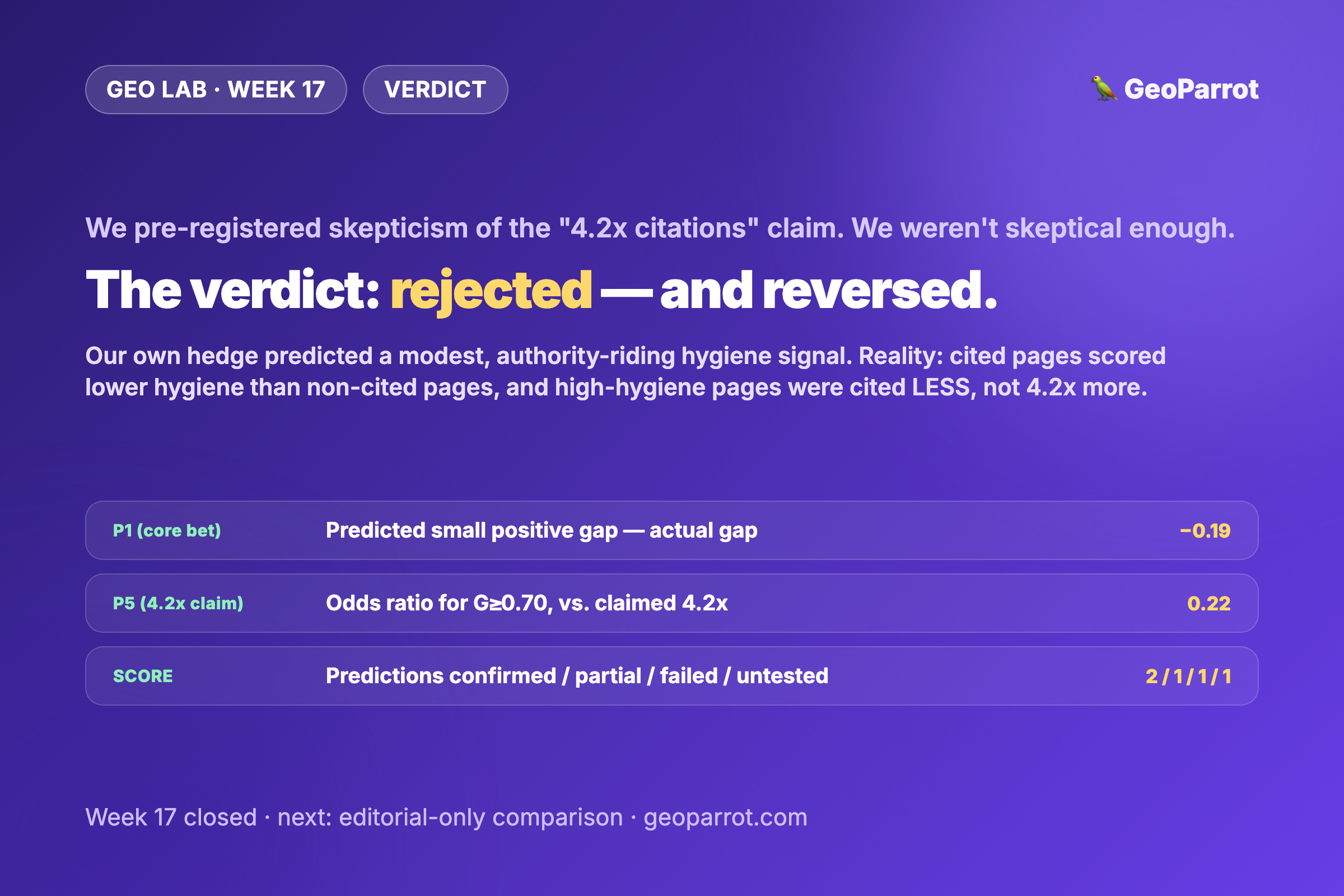
- H2 (replication claim, about engine universality): last week’s result that cited pages score lower on a 4-pillar hygiene rubric than uncited pages — the reverse of the “4.2x more citations” claim we audited and rejected in September — was measured only on Google AI Mode. H2 asks whether that reversal is a property of AI citation behavior generally, or just how Google AI Mode specifically ranks sources.
Two hypotheses instead of one because they test different axes of the same worry: that our prior single-engine, single-intent numbers might be flukes of which engine or which kind of query we happened to measure. If both hold, this arc’s slicing was worth doing. If either fails, that’s useful too — it narrows where the earlier result actually applies.
Why these 24 queries, and why is this the first arc with a standalone Local bucket?
Every prior overlap arc (exp13, exp14) mixed a handful of local queries into a general commercial set — exp13 had 3, buried inside 12, too few to analyze as their own slice. This is the first GeoParrot arc sized to look at Local on its own: 6 queries per intent, 24 total, evenly split across Product, Informational, How-to, and Local.
| Intent bucket | n | Example query | Why this bucket |
|---|---|---|---|
| Product | 6 | “best crm for small business” | Buyer-intent, affiliate-listicle-heavy SERPs — the baseline we’ve tested before (exp12, exp14) |
| Informational | 6 | “what are the signs of vitamin D deficiency” | Editorial consensus content; predicted to show the highest cross-engine overlap of the four buckets |
| How-to | 6 | “how to train for a first marathon” | Procedural, also editorial-source-heavy; predicted to pattern with Informational |
| Local | 6 | “emergency plumber near me”, “dentist accepting new patients near me” | GBP/Maps/Yelp-backed answers — structurally different source pool; the bucket H1 is about |
exp19/questions.json in our lab repo.The Local queries are deliberately generic (“near me” service searches: plumber, dentist, personal injury lawyer, HVAC, movers, emergency vet) rather than branded or city-specific, because the question is whether the category of intent breaks cross-engine agreement, not whether one particular city’s results are noisy.
How are we scoring domain hygiene for H2 — and why reuse old scores instead of re-scoring everything?
H2 reuses the exact 4-pillar rubric from last week’s hygiene-score experiment (exp14’s scoring pass, originally built to test the “4.2x” claim): each domain gets 0-2 points on four pillars — test_data (original testing/measurement vs. none), schema (structured markup present), brand_demand (independent brand search signal), and freshness (dated/updated content). 148 domains were already scored this way as of last week’s collection. This week, any domain we’ve already scored keeps its existing score untouched — we only score domains newly seen in this week’s citations. That’s a deliberate shortcut: re-scoring 148 domains from scratch would eat most of a collection day, and the rubric doesn’t change week to week, so re-running it would just reproduce the same numbers with extra steps.
The honest caveat: reusing old scores means any domain whose content changed materially since last week’s scoring pass carries a stale score into this week’s H2 check. For a single-week replication test, we’re accepting that risk rather than re-auditing; a persistent drift in either direction would be worth flagging in a future arc, not this one.
What counts as a pass, a fail, or inconclusive for each hypothesis?
Both lines were written down October 21, before any of this week’s queries were run:
| Hypothesis | Confirmed if | Rejected if |
|---|---|---|
| H1 (Local overlap) | Local-bucket cross-engine citation overlap < 10%, and visibly lower than the other three buckets in the same 24-query run | Local overlap ≥ 10%, or Local sits within range of Product/Informational/How-to rather than standing apart |
| H2 (hygiene reversal holds across engines) | Cited domains score lower (or no higher) on the 4-pillar rubric than uncited domains, on ChatGPT and Perplexity as well as Google AI Mode | ChatGPT or Perplexity shows cited domains scoring meaningfully higher on hygiene than uncited ones — i.e. the original “higher quality, more citations” direction holds on at least one of the two non-Google engines |
A result can also land as inconclusive — for instance, if the Informational and How-to buckets don’t separate cleanly from Product, or if hygiene direction is mixed (one non-Google engine replicates, the other doesn’t). We’ll report that plainly rather than rounding it into a clean pass.
What does a five-day gap between “locked” and “published” actually cost?
This is the part worth being blunt about, because it’s a methodology failure on our end, not a finding. A pre-registration only does its job — removing our freedom to reinterpret a result after it lands — if it’s visible to someone other than us before the result exists. Writing the prediction down in a private file and running the test a week later, with nobody having seen the prediction in between, is functionally close to not pre-registering at all: we’d be the only witness to our own timestamp. Monday’s post already owned this gap once; this post is where the fix actually happens, by putting the full protocol — queries, rubric, pass lines — somewhere public and dated before Wednesday’s collection runs.
What should you do with this right now?
- If you’re tracking AI citations for a local business: don’t wait for Friday’s verdict to act on the direction. Every prior data point we have — our own 34% general baseline, Searchable’s 26-33% recommendation-agreement figure — already points toward local intent being where cross-engine AI search agrees least. Treat “optimize for one AI engine” as a weaker strategy for local categories specifically.
- If you publish product comparison or review content: H2’s result (due Thursday/Friday) will tell you whether chasing a generic “content quality” score is worth it across AI search broadly, or whether it was always a Google-AI-Mode-specific artifact. Hold off on rubric-driven content rewrites until that lands.
- If you want to replicate this yourself: the full query list and rubric are in this post — nothing is withheld pending publication. Run your own version with your own category’s “near me” queries and see if Local breaks agreement for you too.
Frequently asked questions
What are the two hypotheses GeoParrot locked for this arc?
H1: cross-engine citation overlap for Local-intent queries (ChatGPT, Perplexity, Google AI Mode) will be under 10%, well below Product, Informational, and How-to queries in the same 24-query set. H2: last week’s finding that cited pages score lower on a content-hygiene rubric than uncited pages replicates on ChatGPT and Perplexity, not just the Google AI Mode data it was originally measured on.
Why publish the protocol five days after it was written?
The October 21 pre-registration was locked as part of a broader lab-methodology upgrade and queued behind that upgrade’s other work — it existed in a file but was never made public. A pre-registration nobody can see before the result lands doesn’t fully do its job of preventing after-the-fact reinterpretation, so this post closes that gap before Wednesday’s data collection.
How many queries, and how are they split?
24 total: 6 Product (e.g. “best crm for small business”), 6 Informational (e.g. “what are the signs of vitamin D deficiency”), 6 How-to (e.g. “how to train for a first marathon”), and 6 Local (e.g. “emergency plumber near me”). This is the first GeoParrot arc with a Local bucket large enough to analyze on its own.
What is the hygiene-score rubric being reused for H2?
A 4-pillar scale (0-2 points each) scoring whether a domain shows original test_data, structured schema markup, independent brand_demand, and content freshness. It was built for last week’s experiment and already covers 148 domains; this week reuses those scores unchanged and only scores newly-seen domains.
When do results publish?
Collection runs midweek (Wednesday). Thursday reports the raw numbers for both hypotheses. Friday is the verdict, scored against the pass/fail lines locked in this post — not adjusted after seeing the data.
Sources
- ChatGPT and Gemini Agree on Local Business Picks ~30% of the Time. We Predicted Under 10% for Citations and Never Ran the Test. — Monday’s post, the arc this pre-registration belongs to.
- We Built the Missing Control Group. Hygiene Score Predicted Who AI Does NOT Cite. — source of the 4-pillar rubric and the original hygiene reversal this arc’s H2 retests.
- The Verdict: A “4.2x More AI Citations” Quality-Score Claim Didn’t Just Overshoot. It Pointed Backwards. — the original industry claim the reversal responds to.
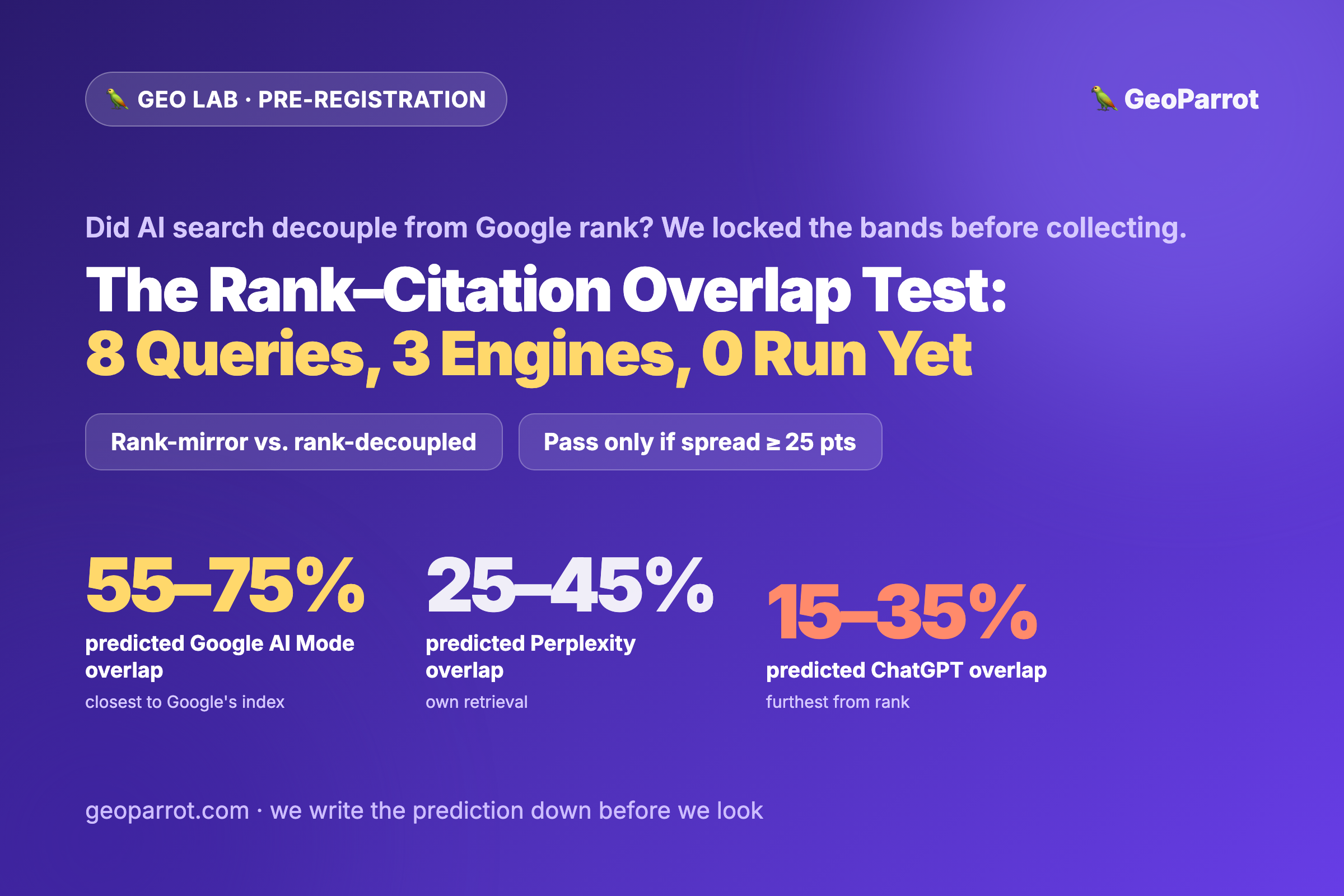
- Verdict: The Rank-to-AI-Citation Decoupling Passed Our Blind Test — source of our 34% blended cross-engine citation overlap baseline, the general number H1 predicts Local falls sharply below.
- last week’s — and this arc’s — pre-registration discipline — the earlier protocol post this one follows the same format as.
- 2026 GEO Benchmark — the full first-party scorecard this arc feeds into.
GeoParrot is a GEO Lab: we test what AI search actually cites and recommends, then publish the method and the misses — including our own. Wednesday we collect; Thursday reports the raw numbers; Friday is the verdict against the exact lines locked in this post.
Leave a Reply