
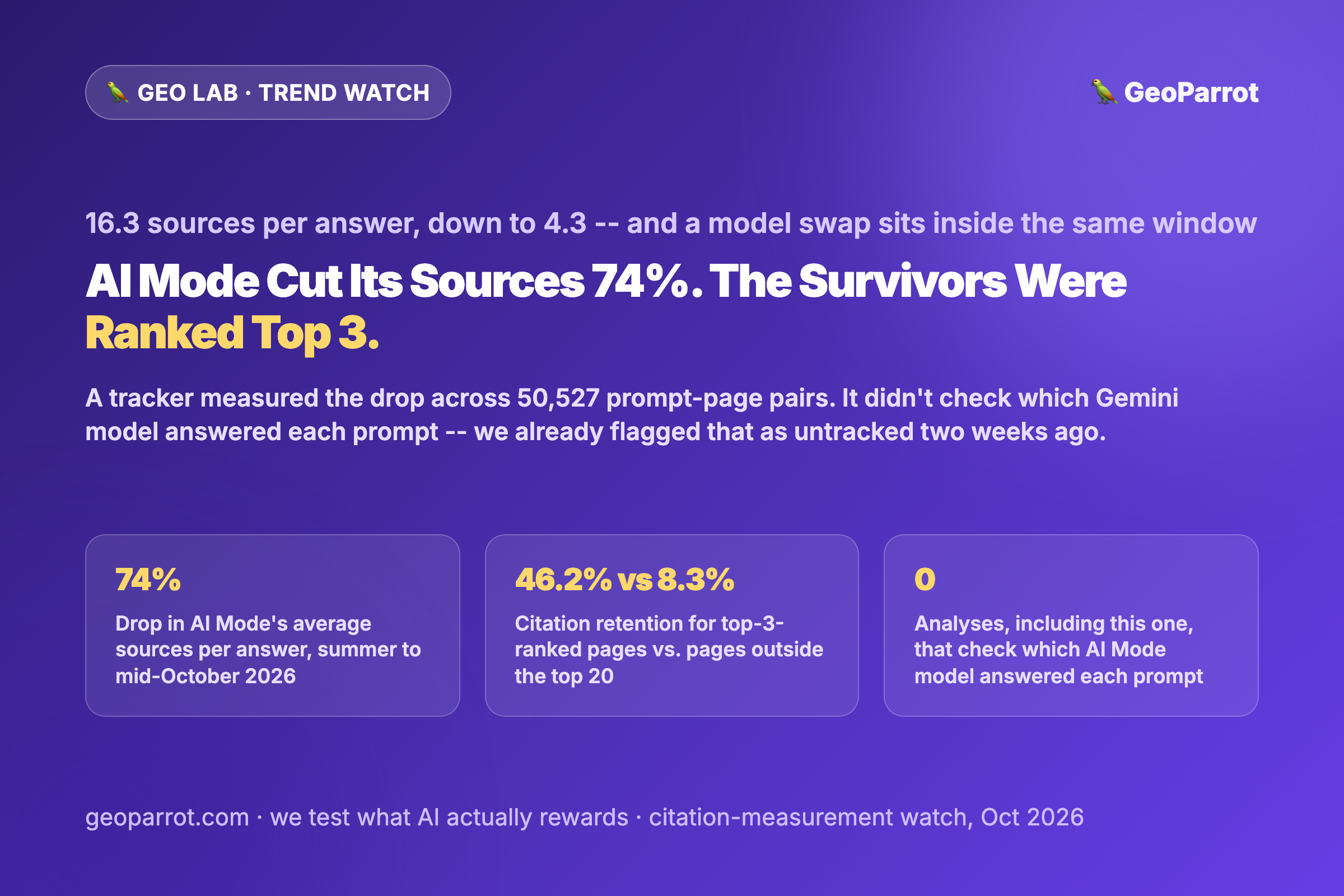
Quick answer: A tracking vendor analysis published October 23, 2026 by Maeva Cifuentes, pulling 50,527 prompt-page pairs from citation tool Scrunch across 407 tracked prompts, found Google AI Mode’s average sources per answer fell from 16.3 in summer (July 15–Aug 26) to 4.3 in the week of October 14–20 — a 74% drop. Only 9.3% of pages cited over the summer still held a citation after the cut, but survival wasn’t random: pages ranked top 3 on Google kept their citation 46.2% of the time versus 8.3% for pages ranked outside the top 20, and Reddit/forum and YouTube pages also over-performed. One thing the report doesn’t control for: its measurement window exactly straddles a Gemini model swap in AI Mode that we already flagged as invisible to every tracker we could find — so some of this “cut” could be a side effect of which model answered, not a deliberate pruning decision.
Trend watch — published October 26, 2026, in the GEO Lab. This is the second time in two weeks we’ve had to ask whether a reported shift in AI Mode’s citation behavior is a real policy change or an artifact of something else entirely — last time it was a model swap no tracker accounts for; this time the two stories turn out to overlap.
What exactly did the data find, and who collected it?
The analysis, published on Maeva Cifuentes’s newsletter The Search Spot on October 23, 2026, combined citation logs from Scrunch, Google rankings from DataForSEO, and page-content characteristics from 497 pages scraped via Olostep — 50,527 prompt-page pairs across 407 prompts and 8 B2B SaaS brands, with one brand alone supplying 42% of the pairs. Two windows were compared: a summer baseline (July 15–Aug 26) against a post-cut period (Aug 30–Oct 19), with the sharpest single-week read at Oct 14–20: 4.3 average sources per AI Mode answer, down from 16.3. A parallel, faster cut showed up in Google AI Overviews — 8.0 sources (Oct 10–16) to 3.7 (Oct 17–20), a 54% drop in days rather than months.
Is this a deliberate Google policy change, or could it be the model swap we already flagged?
This is the part worth slowing down on. The post-cut window in this report — Aug 30 to Oct 19 — fully contains two events we’ve separately documented this quarter: Gemini 3.8 Flash joining AI Mode’s model picker on September 2 with a bug that dropped source links entirely for roughly 48 hours, and Gemini 4 Argon joining the same menu on October 13 — one day before the sharpest 4.3-source reading in this report. Neither Cifuentes’s piece nor other coverage we found checks which model answered each sampled prompt, which is exactly the gap we flagged two weeks ago: AI Mode can answer the same query with at least four different models, one of which already broke citations once, and no AI-visibility tool we could identify logs which model generated a given answer. That doesn’t mean this drop is the Argon rollout — a four-month decline line doesn’t look like a single 48-hour bug. But a report measuring “how many sources AI Mode shows” across a window with an unlogged model variable can’t fully rule it out, and doesn’t try to.
If it’s not random, what predicted which citations survived?
Two variables stood out. First, frequency: pages that had been cited often before the cut kept their citation 61.6% of the time, versus 3.1% for pages cited only once or twice — a strong “rich get richer” pattern. Second, Google rank: pages holding a top-3 organic position kept their AI Mode citation 46.2% of the time, more than 5x the 8.3% retention rate for pages ranked outside the top 20. By content format, homepages (28.7% retention), Reddit/forum threads (25.0%), YouTube pages (23.1%), and review sites (16.3%) all outperformed the sample average. Cifuentes is explicit about the limits of this: “everything here is correlation,” and the piece notes rank, citation consistency, and page format “travel together” in ways the data can’t cleanly separate — a page that’s ranked top 3, cited often, and a Reddit thread is three correlated things, not three independent proofs.
| What’s reasonably well-supported | What’s still unresolved |
|---|---|
| Average AI Mode sources per answer fell from 16.3 to 4.3 across this sample’s two time windows | Whether the drop is a deliberate Google policy change, a side effect of a model swap, or some mix of both |
| Citation survival correlates with Google top-3 rank, prior citation frequency, and certain formats (homepage, Reddit, YouTube) | Which of those correlated factors, if any, is actually causal |
| AI Overviews showed a similar, faster-moving source-count drop in the same general period | Whether that’s the same mechanism as the AI Mode drop or an unrelated coincidence |
| The underlying sample skews heavily to one B2B SaaS brand (42% of pairs) and 8 brands total | Whether this pattern holds outside B2B SaaS, or at the scale most sites operate at |
How does this square with our own rank-vs-citation data?
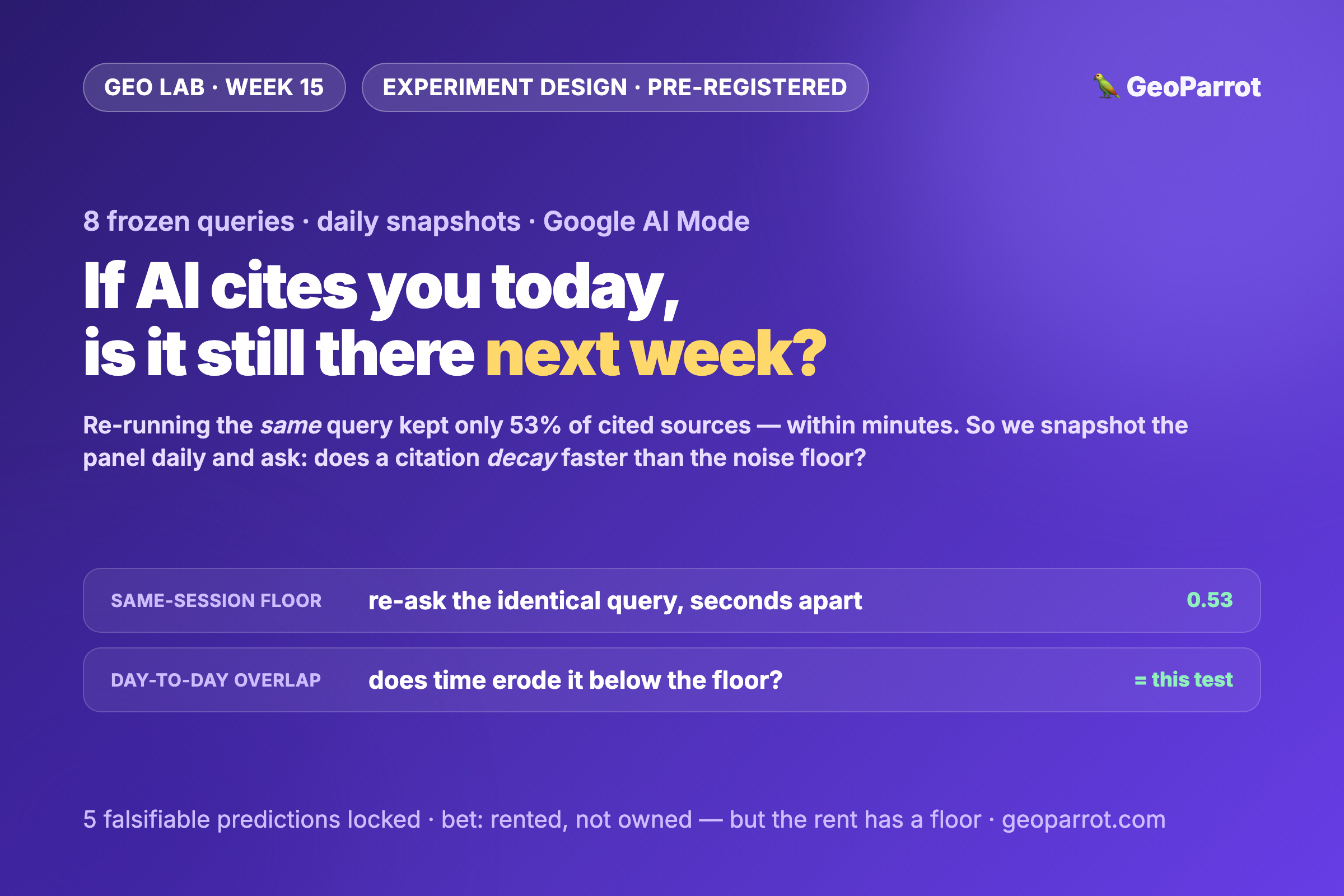
It sharpens a distinction we’d only measured loosely before. Our own blind test of rank-to-citation overlap found just 34% blended overlap between a page’s Google rank and whether it got cited at all — rank was a weak predictor of initial selection. This new data measures something different: not selection, but survival once the citation pool shrinks. Both can be true at once — rank barely moving whether you get picked, while mattering a great deal on whether you keep getting picked once Google starts citing fewer pages. It also complicates our hygiene-score finding that on-page polish was a weak-to-negative predictor of citation (0.22 odds ratio): rank may matter more for holding a citation than hygiene ever did for winning one. And it’s a reminder of how volatile the pool already was before any “cut” — our own query-rewording test swapped roughly 86% of AI Mode’s sources from phrasing alone, months before this report’s window starts.
What to actually do about this right now
- Don’t treat “average sources per AI Mode answer” as a stable, policy-confirmed number. This report’s own window contains at least one documented model swap; re-measure over several more weeks before concluding Google made a permanent change.
- If a page lost a citation it used to hold, check its current Google rank for that query first. In this sample, pages outside the top 20 lost citations at more than 5x the rate of top-3 pages — rank is a cheaper first check than rewriting content.
- Don’t read the Reddit/YouTube retention bump as “go post there” advice on its own. The report itself says format, rank, and consistency are entangled in this data; treat it as a correlation to watch, not a channel strategy to fund.
- Weight this less if you’re not a B2B SaaS brand. One brand supplied 42% of the sample and the full set covers only 8 brands — a real result, but not yet a broad one.
The honest caveats
We did not collect this data ourselves; we’re relying on one vendor’s tracking data (Scrunch), one ranking source (DataForSEO), and one scraper (Olostep), interpreted by a single author whose own piece calls the findings correlational. The brand sample is small (8, one supplying 42%) and apparently all B2B SaaS. Our contribution is the model-swap confound — flagging that it exists and that nobody checked for it, not proving it explains the drop. The cut could be real, deliberate, and unrelated to which Gemini model answered; we can’t rule that out from the outside, and neither, it appears, can the report’s own author.
Frequently asked questions
How much did AI Mode’s source count actually drop?
Per a third-party analysis published October 23, 2026, average sources per AI Mode answer fell from 16.3 in summer (July 15–Aug 26, 2026) to 4.3 in the week of October 14–20, 2026 — a 74% drop. A similar, faster 54% drop showed up separately in Google AI Overviews between October 10–16 and October 17–20.
Has Google confirmed it deliberately reduced AI Mode’s citation count?
No. This is third-party tracking data, not a Google statement. The measurement window also overlaps at least one known AI Mode model change (Gemini 4 Argon, added October 13, 2026), and neither this report nor other coverage we found controls for which model answered each sampled prompt.
Does ranking in the top 3 on Google guarantee my AI Mode citation survives?
No, but it correlates strongly with it in this sample: top-3 pages kept their citation 46.2% of the time versus 8.3% for pages outside the top 20. The report’s own author describes this as correlational, since rank, citation frequency, and content format moved together in the data.
Should I change my content strategy because of this one report?
Not based on this alone. The sample is small (8 brands, one supplying 42% of the data, all apparently B2B SaaS) and the author calls the findings correlational. Treat it as a signal worth re-checking against your own citation history, not a rule to build a strategy around yet.
GeoParrot is a GEO Lab: we run experiments to test what AI search engines actually reward, and we grade the industry’s claims — including our own — against what was actually measured. See the running scoreboard at our 2026 GEO benchmark. Related: why no tracker accounts for which AI Mode model answered your query, our blind test of rank-to-citation overlap, why hygiene score was a weak-to-negative predictor of citation, and how much query rewording alone swapped AI Mode’s sources.

Leave a Reply