
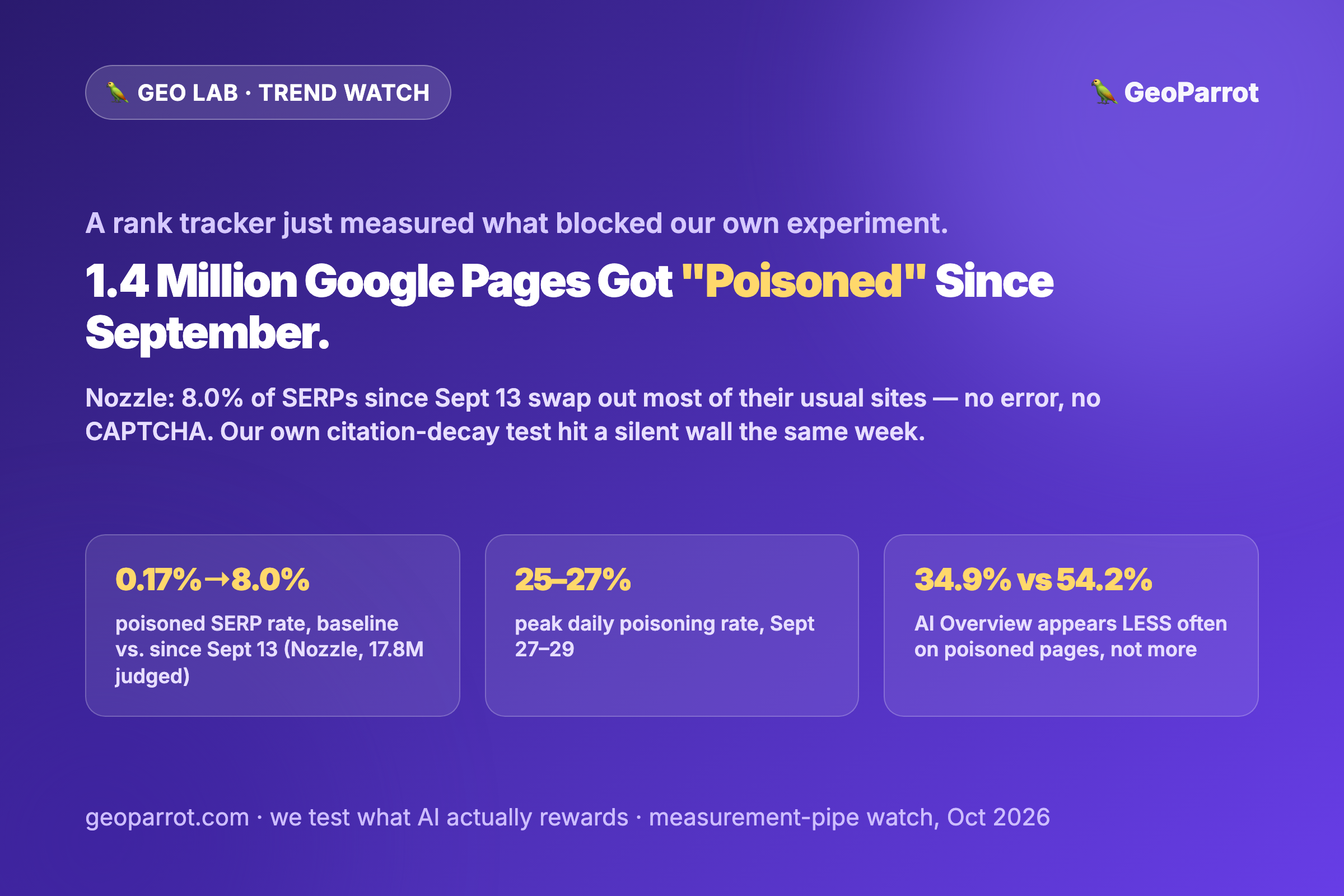
Quick answer: Rank-tracking company Nozzle published a study (October 10) showing that since September 13, 2026, a measurable share of the Google SERPs it collects come back “poisoned” — complete, error-free pages where most of a keyword’s usual sites have been swapped out. Baseline rate before mid-September: 0.17%. Since September 13, across 17.8 million judged SERPs: 8.0% poisoned, peaking at 25–27% on September 27–29, running 4–11% daily through early October. Nozzle’s theory — stated as inference, not confirmed fact — is that this is collateral damage from Google’s defenses against AI-scraping bots, catching legitimate rank trackers in the same net. We can’t confirm the mechanism either, but the timing lines up almost exactly with our own citation-decay experiment getting silently blocked in the same window. The twist worth knowing: poisoned pages actually show AI Overviews less often than normal, not more — which complicates the simple “Google is protecting its AI answers” story.
Trend watch — published October 19, 2026. This extends a thread we’ve tracked since September: Google’s anti-scraping defenses cut rank-tracker data by ~80% starting around September 13, and two weeks later our own pre-registered AI-citation experiment hit a silent wall we couldn’t fully explain at the time. This week’s vendor data is the closest thing we’ve seen to an explanation.
What exactly did Nozzle measure?
Nozzle collected 63.1 million SERPs between August 20 and October 9, judging 43.9 million of them against a per-keyword baseline (sites appearing in the top 10 on at least 60% of that keyword’s SERPs during a clean August 20–September 9 window). A SERP counts as “poisoned” when fewer than half of its keyword’s usual sites show up anywhere on the page — no error, no CAPTCHA, a completely normal-looking result. Before September 13, that happened to 0.17% of SERPs. Since then, across 17.8 million judged SERPs, it’s happened to 8.0% — 1.42 million pages. The worst stretch was September 27–29, when 25–27% of daily SERPs came back poisoned; the rate has settled to a 4.2–11.4% daily range since October 1. On a poisoned page, organic results keep only 20.7% of the sites that normally appear there, versus 88.5% on a clean one — and a site that would usually rank top 10 misses the top 10 entirely 58.6% of the time, versus 2.7% normally. Most recover fast: 77.9% of affected sites were back within three days. Nozzle’s own line for it: “The page looks normal. The results don’t.”
Is this Google deliberately defending its AI Overviews from scrapers?
That’s Nozzle’s working theory, and it’s a reasonable one: the timing lines up with the broader anti-scraping crackdown that started around the same date, and bulk SERP collection for rank tracking is mechanically identical to bulk SERP collection for AI-visibility monitoring. But Nozzle is explicit that this is inference from timing, not a confirmed mechanism — there’s no statement from Google, and the report doesn’t claim one. One detail in Nozzle’s own data pushes back on the tidiest version of that theory: AI Overviews show up on only 34.9% of poisoned SERPs, versus 54.2% on clean ones — a drop, not a boost. If this were Google specifically shielding AI Overview content from automated collection, you’d expect AI Overview visibility to hold steady or increase on flagged traffic, not fall. What does increase on poisoned pages is image packs (44.2% versus 23.0% baseline), and ads hold up far better than organic results (83.7% retention versus 70.6%). The shape of the data reads less like “protect the AI answer” and more like “something blunter is scrambling the whole non-paid surface for traffic Google suspects isn’t a normal searcher” — AI Overviews included, not exempted.
| What’s confirmed | What’s not confirmed / not the claim |
|---|---|
| 8.0% of 17.8M judged SERPs were poisoned since Sept 13, vs. 0.17% baseline (Nozzle, Oct 10) | That Google has stated this is intentional, or explained the mechanism |
| Peak rate 25–27% on Sept 27–29; 4.2–11.4% daily since Oct 1 | That this is specifically targeting AI-visibility scrapers rather than rank trackers, bots in general, or something else |
| AI Overview appearance falls to 34.9% on poisoned pages vs. 54.2% baseline | That Google is “protecting” AI Overviews from scraping — the data points the other way |
| 77.9% of affected sites recovered within 3 days | Whether our own early-October experiment block and Nozzle’s poisoning are literally the same mechanism (they’re different symptoms: a blank, non-loading page vs. a complete page with swapped results) |
Why are we treating this as our own story, not just someone else’s data?
Because we lived a version of it. On September 30, our pre-registered AI-citation decay experiment queried Google AI Mode and got a page that never finished loading — readyState stuck on “loading,” an empty document, no error, while the same browser rendered every other site normally in the same session. We reported the honest verdict: no data collected, no decay result, and a standing block confirmed again on a retry October 2. At the time we could only connect it loosely to the crackdown we’d covered two weeks earlier. Nozzle’s numbers don’t prove our block and their “poisoning” are the identical mechanism — a frozen blank page and a complete page with swapped results are different failure modes — but the timing is hard to ignore: our block landed one day after Nozzle’s worst measured stretch (September 27–29), inside a window their data shows running elevated through early October across 49 countries. Whatever is degrading Google’s results page for automated traffic right now, it’s broad enough that an independent, pre-registered research script hit it the same week a large-scale commercial rank tracker was measuring it at full scale.
A checklist if you track rankings or AI citations with any automated tool
- Don’t react to a single-day ranking or citation drop between late September and now without cross-checking a first-party source. Search Console’s position data, or your own server logs, don’t depend on scraping Google’s results page and can’t be “poisoned” the same way.
- Give a sudden drop three business days before treating it as real. Nozzle found 77.9% of affected sites recovered within that window — a drop that’s still there after three days is more likely genuine than one that vanished.
- If you build or buy an AI-visibility or rank-tracking tool, ask directly whether it detects this pattern. Nozzle’s detection method (comparing each SERP against a 60%-of-baseline-SERPs threshold for “usual sites”) is published; ask vendors if they’ve implemented something equivalent, or if their “0 citations today” could just be a poisoned page.
- Log raw evidence, not just parsed numbers, if you run your own collector. A screenshot or saved DOM lets you tell “normal-looking page, different results” (poisoning) apart from “blank, non-loading page” (our failure mode) apart from “genuinely different ranking” — three different things that all show up as a number changing in a dashboard.
- Resist the “Google is protecting AI Overviews” shortcut. The data available right now shows AI Overview appearance falling, not rising, on affected pages. Attribute cause cautiously until Google says something directly.
The honest caveats
Our figures come from Nozzle’s own published methodology and report; we haven’t independently reproduced their collection or judging process. Nozzle is a rank-tracking vendor with a direct commercial interest in this story being read as “trust your numbers less without checking us” — that doesn’t make the data wrong, but it’s worth naming. The causal theory (AI-scraping defenses catching rank trackers as collateral) is explicitly Nozzle’s inference from date correlation, not something Google has confirmed, and we’re repeating that caveat rather than smoothing it into a certainty. And the connection we’re drawing to our own blocked experiment is a timing and plausibility argument, not a proof — we observed a different failure signature (page never loads) than Nozzle’s “poisoned” definition (page loads completely, with different results), and we don’t have the technical access to confirm both come from the same underlying system.
Frequently asked questions
What is a “poisoned” Google SERP?
Per Nozzle’s definition, it’s a Google results page that loads completely and shows no error, but where fewer than half of a keyword’s usual sites (based on a clean baseline period) appear anywhere on the page. The sites are swapped, not missing due to a crash or block message — which is what makes it hard for an automated tool to detect.
Has Google confirmed this is intentional?
No. Nozzle’s report frames the likely cause — Google’s defenses against bulk AI-scraping and grounding collection catching rank trackers in the same net — as informed speculation based on timing, not a confirmed statement from Google. No Google statement on this specific pattern is on record as of this writing.
Does this mean my rankings or AI citations actually changed?
Not necessarily, and that’s the point. A poisoned SERP looks, to a scraping tool, exactly like a real ranking or citation change. The only way to tell the difference is to cross-check against a first-party signal — Search Console position data, your own analytics — or wait a few days, since Nozzle found 77.9% of affected sites recovered within three days.
Is this the same thing that blocked GeoParrot’s own experiment in early October?
We don’t know for certain, and we’re not claiming it is. Our block was a page that never finished loading at all; Nozzle’s “poisoning” is a page that loads fully but with swapped results — different symptoms. What we can say is the timing overlaps closely (our block landed the day after Nozzle’s worst measured stretch) and both point to the same broader period of intensified, largely unexplained defenses on Google’s results page against automated collection.
Does Google show AI Overviews more often to protect them from scrapers?
The available data says the opposite: AI Overviews appear on 34.9% of poisoned SERPs versus 54.2% of clean ones, a drop. That undercuts the simple theory that Google is specifically shielding AI Overview content from automated traffic — whatever is happening appears to degrade the whole non-paid surface, AI Overviews included, rather than carving them out for special protection.
GeoParrot is a GEO Lab: we run experiments to test what AI search engines actually reward, and we grade the industry’s claims — including our own — against what was actually measured. See the running scoreboard at our 2026 GEO benchmark. Related: the September crackdown that started this thread, our own blocked citation-decay experiment, and why inferred metrics break quietly instead of loudly.
Leave a Reply