
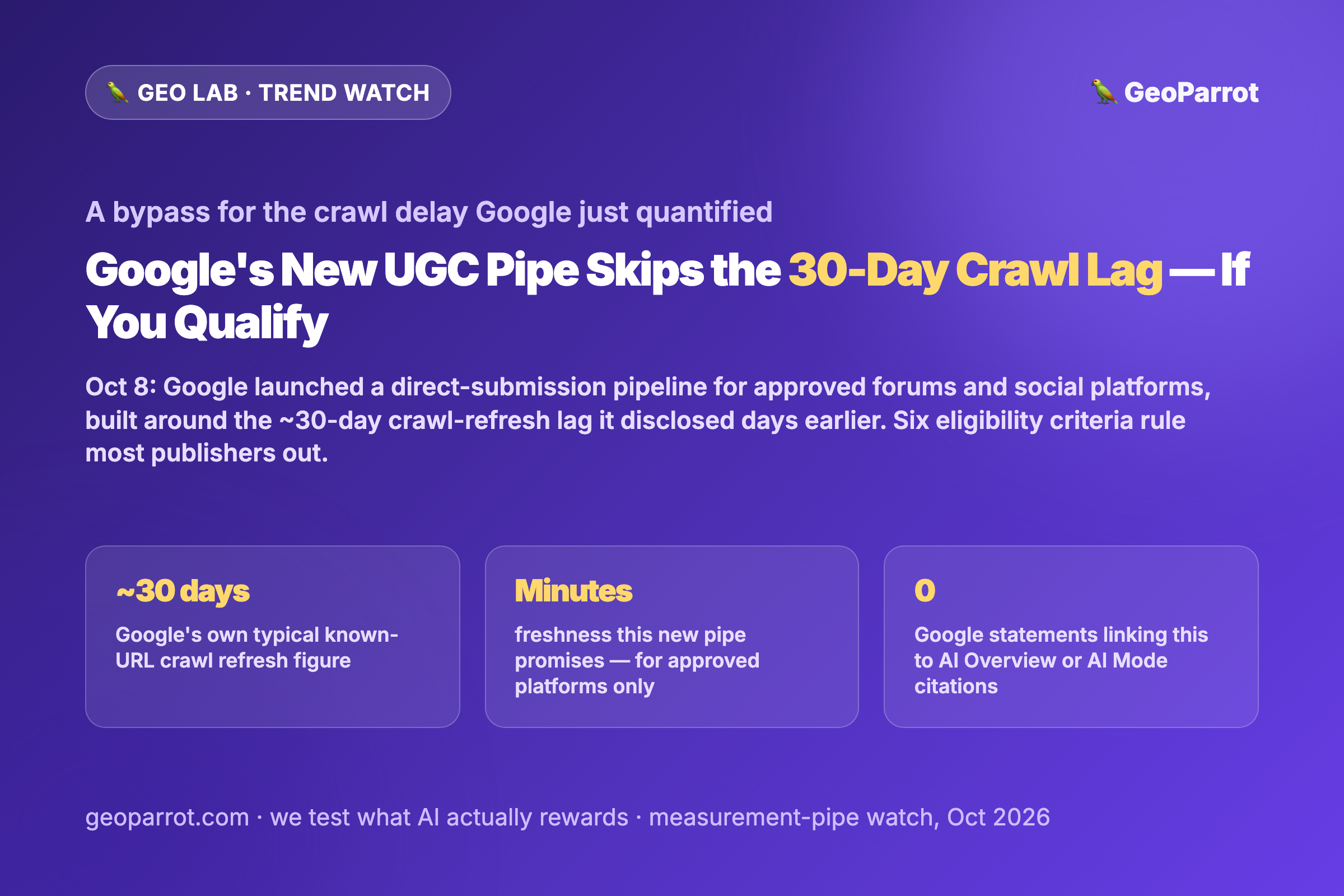
Quick answer: On October 8, 2026, Google launched the UGC Fresh Data Program, a direct-submission pipeline that lets approved forums and social platforms push trending posts and engagement data straight to Google, “within minutes” of publication. It exists because Google’s own normal crawl cycle refreshes known URLs roughly every 30 days — too slow for content that’s only relevant for hours. Eligibility requires high UGC volume, a large audience, OAuth 2.0 and schema.org technical capacity, and active moderation; Google explicitly states the program “doesn’t guarantee that content will appear in Search.” The six-criteria bar effectively excludes individual sites and small publishers.
Trend watch — published October 13, 2026. We read every “Google opens a new pipeline” story the way the GEO Lab reads any claim: what Google actually documented, what reporters inferred on top of it, and where the gap between those two is.
What exactly did Google launch, and when?
Google’s own developer documentation describes the UGC Fresh Data Program as a dedicated ingestion pipeline to help approved platforms “display fresh, high-quality, authentic user-generated content” across Search features. It launched October 8, 2026 — the same day Google’s September 2026 spam update finished its 13-day, 16-hour rollout, a timing overlap multiple outlets noted but Google did not explain. The program sits outside the Indexing API and outside normal crawling entirely: approved platforms submit content and engagement-counter updates directly, rather than waiting for Googlebot to find and recrawl a URL.
Six eligibility criteria gate entry. A platform must (1) primarily host UGC, social posts, or forum discussions on stable, dedicated URLs — not profile or feed pages; (2) show high content volume and a significant user base; (3) keep that content fully public, with no login or paywall gates, and attributable to creators with public profiles; (4) implement OAuth 2.0 authentication and emit validated JSON-LD using schema.org types like SocialMediaPosting or DiscussionForumPosting; (5) run active moderation with user-reporting tools; and (6) submit new content within minutes and refresh engagement counters within 72 hours. Sites apply through a form; Google replies in six to eight weeks, and — in its own words — “submitting an application doesn’t guarantee participation in the program,” nor does participation “guarantee that content will appear in Search.”
Why does this matter for GEO specifically?
Because the number this program is built around is one we already flagged. Days earlier, at Search Central Live Deep Dive Europe, Google’s Gary Illyes put a figure on how long normal crawling takes to refresh a known URL: roughly 30 days typical, weeks to never in the slowest cases. A forum thread or trending post is often only relevant for hours. Thirty days of crawl lag against an hours-long relevance window isn’t a rounding error — it’s a structural miss, and Google just admitted it by building an entirely separate pipe around it rather than trying to make the normal pipe faster.
That lines up with something we’ve already measured, not just inferred. Across our own cross-engine citation experiments, Reddit and forum-style UGC showed up disproportionately in what AI systems cite — a pattern two independent follow-up studies replicated after we first flagged it. Until now the likeliest explanation was training-data skew. This program adds a second, concrete mechanism: Google is now willing to pipe qualifying UGC platforms into its index fast enough to matter for trending topics — through a door that requires OAuth infrastructure, schema.org engineering, and “significant” scale to even knock on. A single-author blog can’t apply. A platform the size of a major forum network plausibly can.
| What’s confirmed | What we’re inferring, not Google |
|---|---|
| Program launched Oct 8, 2026, with six published eligibility criteria and a live application form | That this pipeline specifically feeds AI Overviews or AI Mode citations, rather than only classic Search UGC features |
| Google states explicitly: no guarantee of Search appearance, no guarantee of program acceptance | Any numeric minimum for “high volume” or “significant user base” — Google discloses none |
| The program is separate from the Indexing API and normal crawling | That the Oct 8 launch date relates causally to the spam update ending the same day, beyond coincidence of timing |
| Google’s own Oct 2 data put typical known-URL crawl refresh at ~30 days | Whether the “minutes” freshness this program promises actually compounds with ranking or citation likelihood, versus just appearing sooner at the same eventual rate |
What does this change about the “just publish fresh content” GEO pitch?
Part of the common GEO pitch is that freshness and schema are things any publisher controls, and controlling them is how you compete for AI citations on timely topics. That’s still true at the page level. But Google is also building freshness infrastructure only a narrow set of platforms can plug into — and those platforms already happen to be the ones our own data shows AI systems cite disproportionately. If Reddit-scale UGC platforms get a minutes-fast lane while your blog sits on a ~30-day crawl cycle by default, “publish faster” doesn’t close that gap. It was never a gap faster publishing alone could close.
A checklist for what to actually do about this
- If you operate a comments section, forum, or community feature at real scale, check the six eligibility criteria against your platform before dismissing this — it’s a real option, not just enterprise-only in principle.
- If you don’t operate at that scale, don’t read this as “I need faster crawling.” The lesson is about where to put earned-mention effort: a well-timed post on a forum platform that already has (or can get) fast ingestion plausibly reaches AI surfaces sooner than the same content on your own domain.
- Don’t assume this feeds AI Overviews or AI Mode specifically. Google’s documentation says “Search features” broadly. Treat any claim that this program is “how to get cited by AI fast” as inference until Google says otherwise.
- Re-check the 30-day crawl figure before citing it as universal. Illyes presented it as an unofficial, methodology-undisclosed “typical” number from a conference slide, not a guaranteed SLA for every site.
The honest caveats
Our primary source for the program’s mechanics is Google’s own developer documentation, which we treat as authoritative for eligibility criteria and the guarantee language. The claim that this program meaningfully explains forum/UGC over-representation in AI citations is our inference, built by connecting three separately-confirmed facts (the program, the 30-day crawl figure, and our own prior citation data) — Google has not stated this program targets AI-surface citations, and we have no first-party data showing a participating platform’s citation rate before and after approval. We also haven’t independently verified whether any platform has been accepted into the program yet; as of publication, the six-to-eight-week response window from the Oct 8 launch hasn’t fully elapsed.
Frequently asked questions
What is Google’s UGC Fresh Data Program?
A direct-submission pipeline, launched October 8, 2026, that lets approved forums and social platforms send Google trending user-generated content and engagement data within minutes of publication, bypassing normal crawling.
Who can apply?
Platforms that primarily host UGC on stable public URLs, show high volume and a significant user base, can implement OAuth 2.0 and schema.org JSON-LD, and run active moderation. Google discloses no numeric size threshold, but the technical and scale bar functionally excludes individual sites and small publishers.
Does joining the program guarantee content appears in Search or gets cited by AI?
No. Google explicitly states the program “doesn’t guarantee that content will appear in Search,” and does not mention AI Overviews or AI Mode citations in its documentation at all — any link between this program and AI citations is our inference, not a Google claim.
How is this related to the “30-day crawl delay” Google mentioned?
Days before this launch, Google’s Gary Illyes shared unofficial internal data putting typical known-URL crawl refresh at roughly 30 days. This program exists specifically to route around that lag for approved UGC platforms, since forum content is often relevant only for hours.
What should a small publisher take away from this?
That some of the freshness advantage going to Reddit-style platforms in AI citations may be structural and Google-granted, not just something your own publishing cadence can out-compete. Earned mentions on platforms with this kind of access may matter more than previously assumed.
GeoParrot is a GEO Lab: we run experiments to test what AI search engines actually reward, and we grade the industry’s claims — including our own — against what was actually measured. See the running scoreboard at our 2026 GEO benchmark. Related: the ~30-day crawl figure this program routes around, why earned UGC beats owned content for AI citations in our data, what raw AI-crawler logs show about fetch behavior, and what you’ll still be able to count in 2027.
Leave a Reply