
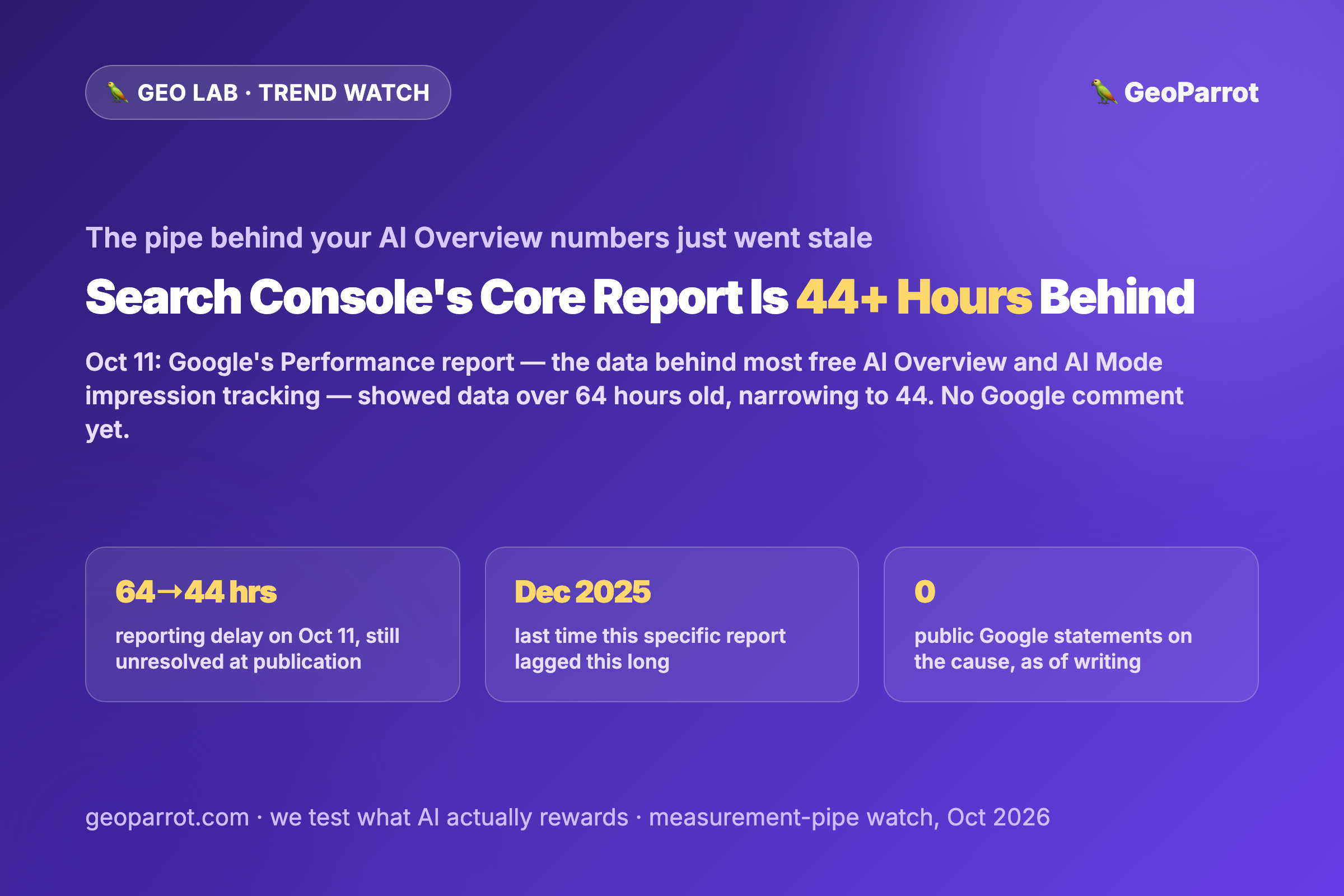
Quick answer: On October 11, 2026, Search Engine Roundtable reported that Google Search Console’s Performance report — the report almost everyone uses to see clicks, impressions, and the Search Appearance breakdown that includes AI Overviews and AI Mode — was showing data over 64 hours stale. By mid-morning that delay had narrowed to roughly 44 hours, still far outside the report’s normal few-hour lag. Google had not publicly commented as of this writing. The confirmed fact is the delay itself, timed to land during the tail of the September 2026 spam update rollout. What’s not confirmed is any causal statement from Google, or how long it lasts.
Trend watch — published October 12, 2026. We read every AI-search measurement change the way the GEO Lab reads any claim: what’s actually confirmed, what’s inferred, and what it changes about whether your numbers mean what you think they mean.
What exactly happened, and how do we know?
Search Console’s Performance report is the one report in the product that’s supposed to stay close to real-time — usually a lag of a few hours, sometimes a day. Other reports (indexing, Core Web Vitals) have a looser, well-known lag; this one doesn’t, which is why site owners lean on it for day-to-day monitoring. On the morning of October 11, Barry Schwartz at Search Engine Roundtable flagged that the report’s most recent available date was over 64 hours old. By around 11am ET the same day, that gap had narrowed to roughly 44 hours — still multiples of the normal lag, and still unresolved at publication, with no Google statement yet. The timing overlaps with the tail end of the September 2026 spam update, though “overlaps with” and “caused by” are different claims Google hasn’t confirmed either way. The last comparably long delay to this report was in December 2025.
Why does a Search Console outage matter for GEO specifically?
Because the Performance report’s Search Appearance filter — the free, first-party way most sites try to see “how often did Google show an AI Overview or AI Mode result featuring my URL” — runs on exactly this pipe. For a lot of GEO practitioners without budget for a paid AI-visibility tool, it’s the primary instrument. We’ve already flagged a conceptual problem with it: Google itself admits the “position” field for AI appearances isn’t a rank in the normal sense. This delay adds a separate problem on top — not what the number means, but whether it’s even current. A dashboard that pulls GSC data on a daily cron and diffs “yesterday vs. today” for AI Overview impressions would, during a window like this, show a flat line or drop that has nothing to do with actual AI visibility and everything to do with the pipe being stale.
| What’s confirmed | What’s not confirmed |
|---|---|
| Performance report showed 64+ hours of staleness on Oct 11, narrowing to ~44 hours by late morning | Any Google statement on root cause |
| Only the Performance report is affected — not the usual indexing-report lag | Whether this is directly caused by the September 2026 spam update rollout, or just coincidental timing |
| Timing overlaps with the tail of the September spam update’s rollout window | A resolution timeline |
| A comparable delay to this report last occurred in December 2025 | Whether the AI Overview / AI Mode breakdown specifically is delayed by the same margin as overall clicks and impressions |
How does this compound a measurement problem GEO already has?
This is the third distinct crack we’ve documented this quarter in the free-tier instruments people use to measure AI visibility, and each is a different failure mode. First, Google’s anti-scraping defenses choked third-party rank-tracker data collection by roughly 80% — a collection failure for tools that scrape the SERP directly. Second, Search Console’s own AI “position” metric turned out not to behave like a rank — a definitional gap, not a collection failure. This is a third kind: the first-party pipe running stale, nothing wrong with the metric’s definition or anyone’s scraper — just an unexplained delay. Three mechanisms, same net effect: whatever chart you’re looking at for AI-surface visibility right now, there’s a real chance it isn’t showing current reality. That’s close to what Duane Forrester warned about when he said most 2027 GEO metrics won’t be independently checkable — except this is a live first-party product failing to stay current today, not a future problem.
A checklist for what to actually do about this right now
- Check the “Last updated” date before trusting a day-over-day comparison. The API response includes a date range — if the latest row is more than a day old, don’t treat today’s dashboard as today’s reality.
- Don’t react to a sudden AI Overview impression drop this week without first confirming the data isn’t simply stale. A delay-driven flatline looks identical, at a glance, to an actual visibility loss.
- If an automated GSC-API pull feeds a dashboard or alert, add a freshness check comparing the latest returned date to the query date, and suppress alerts when the gap exceeds the normal lag.
- Cross-check with a manual spot query on the AI surface itself if a number looks off — the one instrument that can’t be stale is you actually running the query.
- Don’t expect a postmortem when it’s fixed. Per the December 2025 precedent, these delays typically resolve without a detailed public explanation — just a return to normal lag times.
The honest caveats
Our source for the delay figures is Search Engine Roundtable’s same-day reporting, treated here as reliable first-hand observation, but we have not independently replicated it against our own Search Console property as of publication. We also haven’t confirmed whether the AI Overview / AI Mode portion of the Search Appearance breakdown lags by the same margin as overall clicks and impressions — it’s plausible the whole report is delayed uniformly, but that’s our inference, not something Google or Search Engine Roundtable stated explicitly. And we’re not claiming the spam update caused the delay; we’re only noting the two events overlap in time, which is weaker evidence than it might sound.
Frequently asked questions
Is Google Search Console’s Performance report down?
Not down, but stale. As of October 11, 2026, the most recent available data was 44 to 64+ hours old, well beyond its normal few-hour lag. The report is still functioning; it’s just showing older data than usual.
Does this affect AI Overview and AI Mode impression tracking specifically?
It affects the Performance report broadly, which includes the Search Appearance filter used to track AI Overview and AI Mode impressions. Whether that specific breakdown lags by the exact same margin as overall traffic data hasn’t been independently confirmed.
Did Google say what caused the delay?
No. As of publication, Google had not issued a public statement. The delay’s timing overlaps with the tail of the September 2026 spam update rollout, but that’s a correlation observers have noted, not a confirmed cause.
What should I do if my AI Overview numbers look like they dropped this week?
Check the report’s latest available date before concluding anything changed. If the data is stale by more than a day, treat the apparent drop as an artifact of the delay until the report catches up, then re-check.
Has this happened before?
Yes. A comparable extended delay to the same report occurred in December 2025. It was eventually resolved without a detailed public explanation of the root cause.
GeoParrot is a GEO Lab: we run experiments to test what AI search engines actually reward, and we grade the industry’s claims — including our own — against what was actually measured. See the running scoreboard at our 2026 GEO benchmark. Related: why Search Console’s AI “position” isn’t a rank, how Google’s anti-scraping defenses broke third-party AI visibility tools, what you’ll still be able to count in 2027, and what the September 2026 spam update actually does to AI citations.
Leave a Reply