
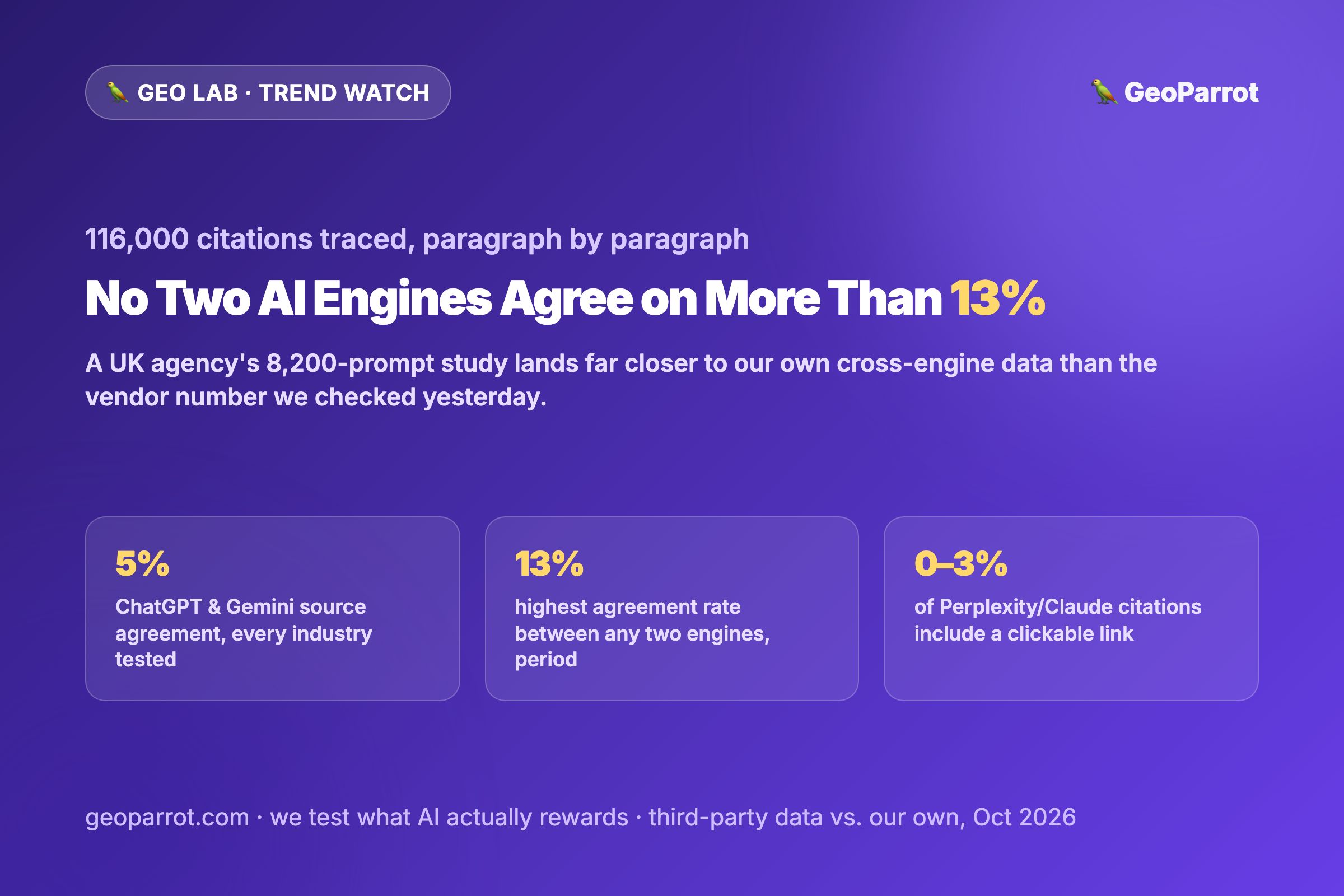
Quick answer: On October 7, 2026, UK agency Geeky Tech published an update to its AI citation study: 8,200+ prompts across the US and UK, five industries, and — the part that matters — every one of 116,000 citations traced back to the exact paragraph that earned it, not just the domain. The headline number: ChatGPT and Gemini agree on only 5% of their sources in any given industry, and across all five engines tested (ChatGPT, Perplexity, Claude, Gemini, Google AI Overviews), no two ever agree on more than 13%. That’s functionally the same story we told yesterday about a different vendor’s 27.2% figure — except this number is roughly double the fragmentation, comes from a far larger sample, and uses a method that scores noticeably better on the stat-auditing framework we built this week.
Trend watch — published October 10, 2026. We read every new AI-citation data point the way the GEO Lab reads any claim: what was actually measured, what methodology was disclosed, and how it holds up against the numbers we’ve already checked.
What did Geeky Tech actually measure, and why is this method stronger than yesterday’s?
The study ran in two phases. The first, published in July 2026, asked 1,126 questions across US and UK markets and traced every citation each engine produced back to the specific paragraph — not just the domain or page — that the engine appeared to quote or paraphrase. The second phase, run in August, repeated the exercise across five additional industries, pushing the total past 8,200 prompts and 116,000 traced citations. That paragraph-level tracing is the detail that separates this from most AI-visibility press releases: knowing which domain got cited is table stakes; knowing which 50 words on that domain the engine actually pulled is a much harder, much more useful thing to measure, and it’s closer to how our own experiments try to work.
Run this through the three-part scoring method we pre-registered this week to audit GEO stats — reachability, methodology disclosure, re-citation stability (R/M/S) — and it does better than the vendor number we covered yesterday. Reachability: high, the study and its methodology page are public. Methodology disclosure: high relative to the category — phase dates, prompt counts, industries, and the paragraph-tracing approach are all stated. Stability: this is the one real data point any of these stats have had so far — it’s Geeky Tech’s own second run, five months and five industries after the first, and the direction of their findings (ranking-to-citation correlation strengthening, agreement staying low) held rather than reversing. That’s not independent replication by someone else, but it’s more than a single snapshot.
How does this number stack up against the other two we’ve checked this week?
| Source | What it counted | Result | R/M/S read |
|---|---|---|---|
| LLM Scout (Oct 7 press release) | Binary: did engine mention one tracked brand, yes/no | 27.2% disagreement | Reachable, low methodology disclosure, stability untested |
| GeoParrot exp2 (our own data, June 2026) | Full domain-citation set per engine, 15 questions | ~0.5% full overlap, 85.1% single-engine-exclusive | Reachable, method published, small sample, no independent re-run yet |
| Geeky Tech (Oct 7, 2026) | Paragraph-level citation tracing, 8,200+ prompts, 5 industries | 5% ChatGPT/Gemini agreement; no pair above 13% | Reachable, methodology disclosed, one internal re-run holding direction |
No two engines agreeing on more than 13% of sources means at least 87% disagreement on any given pair — a number that lands much closer to our own 85.1% single-engine-exclusive finding than to the 27.2% figure we flagged yesterday. We’re not claiming vindication; our own sample was 15 questions, which we’ve said from the start is a pattern, not a census. But a 116,000-citation study landing within a few points of our 85% rather than near a vendor’s 27% is the kind of convergence across independent, differently-built methods that should move a prior — the same standard we applied to the crawler-log convergence we wrote up Wednesday.
What else did it find that’s actually actionable, beyond the overlap number?
- Google ranking’s pull on AI citation is getting stronger, not weaker. A top-3 Google ranking gave roughly a 33% chance of an AI citation in the July phase; by the August re-run that had risen to approximately 45%. Fragmentation across engines and ranking still mattering aren’t contradictory — Perplexity alone cited domains ranked in Google’s top 3 for 71% of its answers, even while disagreeing with ChatGPT on which sources to use.
- The sweet spot for a quoted passage is short and self-contained. Passages around 50 words that read as a complete answer on their own — and that sit high on the page — accounted for up to 48% of citations. That’s consistent with what we’ve found testing first-party substance against markup-only tactics: structure and position beat cleverness.
- Being cited by Perplexity or Claude rarely means a clickable link. The study found clickable source links present in only 0-3% of Perplexity and Claude answers. A citation without a link is a mention, not a referral — one more reason we keep telling people to stop treating “cited” and “clicked” as the same outcome.
- The median brand barely shows up on its own ground. Even a typical B2B brand got cited in only about 13% of AI answers to questions directly about its own topic area — a reminder that low visibility is the default, not an anomaly worth panicking over on its own.
A checklist for using this data point without overreading it
- Stop budgeting for a single “AI visibility” number. With no engine pair agreeing on more than 13% of sources, a per-engine strategy isn’t optional — see our earlier per-engine GEO checklist for what that actually looks like in practice.
- Keep ranking work in the plan. The ranking-to-citation lift strengthening to ~45% means top-3 Google placement is still one of the better-evidenced levers, not a relic.
- Write one self-contained, ~50-word answer near the top of the page for your most important question. That’s the shape this study (and our own passage-level work) keeps finding gets quoted.
- Measure citations and clicks as two separate metrics. A rising citation count on Perplexity or Claude, with clickable links at 0-3%, will not show up as referral traffic — don’t let a dashboard imply otherwise.
- Treat this number the way we’d want ours treated: directionally useful, not independently replicated yet. One agency, two self-run phases. Strong methodology, still a single source until someone else reruns it.
The honest caveats
Geeky Tech is a single marketing agency publishing its own proprietary study to promote its own citation-tracking service — the same commercial incentive we flagged in the vendor stat we covered yesterday, even though this one discloses far more about how it was built. “No two engines agree on more than 13%” is also still a same-agency, same-tooling measurement across all five engines; a methodological quirk in how they define a “source match” would bias all five numbers in the same direction rather than canceling out. And our own comparison point — 85.1% single-engine-exclusive — came from 15 questions in one month, a sample we’ve repeatedly said is too small to generalize from alone. Two imperfect, independently-built measurements landing in the same neighborhood is meaningfully better evidence than either alone, but it is not a census, and we’d update again if a fourth method landed somewhere else entirely.
Frequently asked questions
Does this study prove the 27.2% vendor number from yesterday was wrong?
No — it answers a different question at a much larger scale. The vendor measured binary brand-mention agreement on a tracked brand; Geeky Tech measured full source-agreement across paragraph-level citations for 8,200+ prompts. Both can be “correct” measurements of different things. What’s notable is that the larger, more disclosed study lands much closer to our own full-citation-overlap finding than the binary one did.
What does “no two engines agree on more than 13%” actually mean in practice?
For any pair of the five engines tested (ChatGPT, Perplexity, Claude, Gemini, Google AI Overviews), at least 87% of the sources they cite for the same questions are different. That supports building and tracking GEO work per engine rather than assuming one optimization approach covers all of them.
Is Google ranking still worth optimizing for if AI engines disagree this much?
Yes, based on this data. A top-3 Google ranking’s association with an AI citation grew from roughly 33% to about 45% between the study’s two phases. Cross-engine disagreement on which sources get cited doesn’t mean ranking stopped mattering to any individual engine’s odds.
Why do Perplexity and Claude citations rarely include a clickable link?
The study simply found that in practice, Perplexity and Claude present a clickable source link in only 0-3% of answers. The reasons aren’t disclosed in the release, but the practical effect is the same one we keep flagging: a citation in these engines is far more often a mention than a referral click.
How should I weigh this against GeoParrot’s own cross-engine data?
As a second, larger, independently-built data point pointing the same direction as ours, not as a replacement for it. We ran 15 questions once; Geeky Tech ran 8,200+ prompts twice. Theirs is the stronger single study. Both still need someone outside either organization to rerun them before either number should be treated as settled.
GeoParrot is a GEO Lab: we run experiments to test what AI search engines actually reward, and we grade the industry’s claims — including our own — against what was actually measured. See the running scoreboard at our 2026 GEO benchmark. Related: yesterday’s vendor-stat comparison, our own cross-engine citation experiment, per-engine GEO checklist, and our R/M/S method for auditing GEO stats.
Leave a Reply