
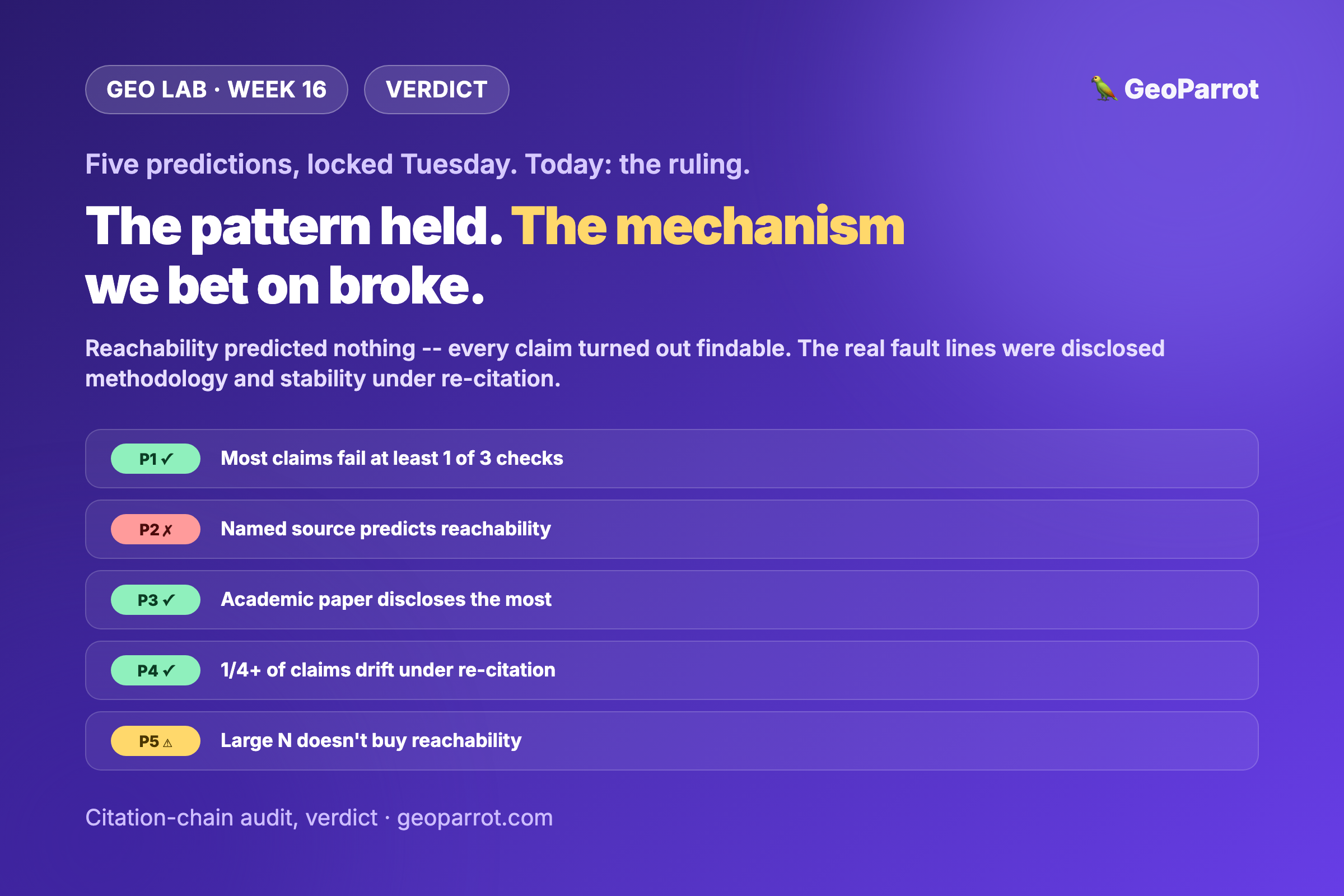
The verdict: ⚠️ Confirmed, but the mechanism we bet on is wrong. Monday’s fact-check traced 3 repeated GEO citation stats by hand and found the chain mostly didn’t hold. This week we turned that into a pre-registered method — three criteria (Reachable, Methodology-disclosed, Stable), five numbered predictions — and scored 8 fresh claims against it. The headline pattern held, harder than we predicted: only 3 of 8 scored a clean 3/3, and 5 of 8 failed at least one leg. But the load-bearing mechanism behind that pattern — that a visibly named source (vs. an aggregator round-up) predicts whether a checkable document exists — failed. Every single claim turned out reachable once we dug past the first search result. The real fault lines were disclosed methodology and stability under re-citation, not whether a source looked named up front. And for a third straight week, our own research tooling mangled a number mid-session while we were checking someone else’s. Full ruling, a checklist by where you actually encounter a stat, and next week’s test below.
Friday verdict — published October 9, 2026, closing this week’s GEO Lab arc. Monday we hand-traced three GEO citation stats and found a problem. Tuesday we locked a repeatable score and five predictions against 8 more. Wednesday we collected. Thursday we published the full score sheet. Today we rule on what it means.
What’s the verdict on each of the five locked predictions?
Five predictions, locked Tuesday before a single one of the 8 claims was scored. Three confirmed, one falsified outright on its load-bearing half, one falsified on its specific sub-bet while ironically reinforcing the broader thesis. Here’s the ruling, prediction by prediction:
| Tuesday’s prediction | Verdict | What the data showed |
|---|---|---|
| P1 — most claims fail at least one leg | ✅ Confirmed, stronger than predicted | We predicted 5 or fewer of 8 would score a clean 3/3. Actual: 3 of 8. Five of eight failed at least one check. |
| P2 — named-source attribution predicts reachability | ❌ Falsified, load-bearing half | All 4 named-source claims scored R=1, as predicted. But 0 of the 4 aggregator-sourced claims scored R=0 — every one resolved to a named document on deeper WebFetch digging. |
| P3 — the academic paper discloses the most | ✅ Confirmed | Claim #7 (Aggarwal et al., KDD 2024) had the most specific, auditable methodology of the four claims that reached M=1. |
| P4 — at least a quarter of the set shows drift | ✅ Confirmed, exceeded | We predicted 2+ of 8 would score S=0. Actual: 5 of 8 — claims #2, #3, #4, #6, and #8 all drifted or self-contradicted under a second look. |
| P5 — sample size doesn’t buy reachability (claim #2 stays R=0) | ⚠️ Falsified on the specific bet | Claim #2’s large claimed N (1M+ citations) didn’t stop us from finding a named publisher (Peec AI) — just took seven fetches instead of one. The general point (naming beats N) survives; the specific prediction about claim #2 doesn’t. |
Net ruling: confirmed, but not the way we bet. The part everyone would want to be true for the industry’s sake — that most repeated GEO stats hold up — is the part that lost. The part we built an entire scoring criterion around as the first filter — “is a source named up front?” — is the part that turned out to carry almost no signal. That’s a specific, falsifiable miss, not a vague “mixed results.” We’re reporting it because the whole point of locking P2 on Tuesday was to find out if our intuition about why the chain breaks was right, and it wasn’t.
If reachability isn’t the filter, what actually separates the clean claims from the broken ones?
Methodology disclosure and re-citation stability, and they explain the three claims that scored a clean 3/3 almost completely. Muck Rack’s earned-media breakdown, EMGI Group’s SaaS-invisibility report, and the Aggarwal et al. KDD 2024 paper share one thing that has nothing to do with how they were first encountered: each discloses a sample and a method inside the document itself, and each survives being independently re-cited without the number or its basis moving. EMGI’s 150 companies cleared that bar as cleanly as Muck Rack’s 25 million links — scale of the underlying study didn’t matter once the document was open in front of us.
Compare that to the three claims stuck at 1/3 (claims #2, #3, #4) — all three trace to the same single Peec AI blog post, a post that discloses no sample size, no date window, and misattributes its own “6-study aggregator” credit to a study that, on direct inspection, doesn’t contain the number. That post was perfectly reachable the whole time. Its address just wasn’t visible from the round-up layer where most readers would actually encounter the number. Reachability measured whether we were willing to run seven WebFetch calls instead of one — not whether the industry’s sourcing discipline is sound.
Did our own research process break the same way a third time?
Yes, and that consistency is itself a finding. Monday, our search tool invented a sample size and lift figure for the Presence AI study mid-session, caught only by fetching the primary document directly. Tuesday, two separate searches returned the Muck Rack figure identically — one index queried twice, not independent confirmation, and we flagged it before scoring started so it wouldn’t get mistaken for S=1 evidence. Thursday, the synthesized search summaries asserted cross-outlet corroboration for claims #3, #6, and #8 that did not survive a direct fetch of the actual pages. Three weeks running — three separate sessions, three separate failure instances — the AI-generated summary and the primary document disagreed, and only opening the primary document caught it every time. That’s not a one-off glitch in our workflow; at this point it’s the base rate for the exact tooling this entire audit depends on, which is also the tooling most GEO content is written with.
What should you actually do, by where you’re encountering or repeating a stat?
The result kills a shortcut, not the underlying ideas. “Reachable” is close to free if you’re willing to dig — so stop treating it as the finish line, and check the two criteria that actually separate the honest claims from the broken ones.
When you’re writing content that cites a GEO stat
- Don’t stop at “I found a page.” All 8 of this week’s claims were reachable; only 3 were trustworthy. Open the document and check whether it states a sample size, a method, and a date window before you repeat the number.
- Search for the number by itself, not just the source’s name. Claims #2, #3, and #4 all looked like three separate findings until a direct fetch showed they’re the same Peec AI post restated three ways. Pasting the exact figure into a search, not just the publisher, is what surfaces that.
When the stat comes from a vendor’s own blog or benchmark report
- Treat vendor self-reports as the default risk, not the exception. TheReviewMakers (claims #6, #8) and Peec AI (claims #2, #3, #4) together account for 5 of the 8 claims we scored, and all 5 carry an undisclosed-conflict-of-interest or no-method caveat. Both are AI-visibility or reputation-management vendors with a direct commercial incentive in the numbers they publish.
- Check the document’s own internal arithmetic. Claim #8’s source states Reddit=22%/brand-sites=33%/Wikipedia=19% in one place and “combined, 61% of citations” in the same article — 22+33+19 is 74%, not 61%. A document that contradicts itself failed before any external re-citation check even ran.
When the stat comes from an academic paper or a fully open report
- This is the closest thing to a safe citation, but it still collapses on re-citation. Aggarwal et al.’s KDD 2024 paper scored 3/3, yet one outlet (geoaura.world) added an unsupported “combined techniques” stacking claim not in the paper, and the commonly-repeated single number blends two distinct metrics and two distinct engines (the real lift on Perplexity alone is roughly half the headline figure). Even a 3/3 source gets flattened once it’s three hops from the primary document.
- A document that names its own limitation is a good sign, not a weak one. Muck Rack and EMGI Group both state their methodology’s boundaries directly. That self-disclosure is what let us verify them quickly — the opposite of a red flag.
When you’re the one running the search or the AI summary
- Never finalize a number from a synthesized AI summary alone. It broke on us three separate weeks in a row, each time catchable only by opening the primary document directly. If that’s the failure rate inside a team that’s actively looking for it, assume it’s worse for anyone who isn’t.
What are we testing next week?
This verdict leaves one question on the table that would close the loop entirely. We’ve now scored 8 GEO stats on citation hygiene using our own judgment. But the actual stakes of GEO are whether AI engines reward that same hygiene when they decide what to cite. Next week we turn the audit back on the thing it’s named after: we’ll ask ChatGPT, Perplexity, and Google AI Mode about these exact 8 statistics and log which sources they surface. If the 3/3 claims (Muck Rack, EMGI Group, Aggarwal et al.) get cited disproportionately more than the 1/3 claims (the Peec AI trio), that’s evidence AI engines are already doing some of this filtering on their own. If the engines cite the low-hygiene aggregator posts just as often — or more, because they’re more heavily re-published — then the citation-chain problem we just spent a week measuring isn’t just a human research-hygiene issue. It’s actively being rewarded by the exact systems GEO content is written for.
Frequently asked questions
So is the GEO industry’s citation-chain problem real?
Yes, confirmed and worse than our own prediction. We predicted 5 or fewer of 8 fresh claims would score a clean 3/3 on reachability, methodology-disclosure, and stability; the actual number was 3. Five of the eight widely-repeated stats we scored failed at least one of the three checks.
Which prediction from Tuesday’s pre-registration broke?
P2 — the bet that claims arriving only through aggregator round-ups, with no publisher named up front, would be measurably less reachable than claims with a named source attached. Zero of the four aggregator-sourced claims scored R=0; every one resolved to a named primary document once we dug past the first search result.
If reachability doesn’t separate good stats from bad ones, what does?
Disclosed methodology and stability under re-citation. The three claims that scored a clean 3/3 (Muck Rack, EMGI Group, Aggarwal et al. KDD 2024) all state a sample size and method inside the primary document and survive independent re-citation without drifting. The claims stuck at 1/3 were reachable the whole time — they just traced to a single vendor’s blog post with no disclosed sample and no independent confirmation.
Why does this keep catching your own research tool, not just the industry’s?
Because we check our own process with the same rigor we apply to the industry’s. Three separate weeks running, a search tool’s synthesized summary disagreed with what the primary document actually said — a fabricated sample size on Monday, a false “independent confirmation” signal on Tuesday, and false cross-outlet corroboration on three claims Thursday. Every instance was only caught by fetching the primary source directly, which is the entire argument this audit is making.
What’s next for the GEO Lab?
Testing whether AI engines themselves reward the hygiene scores from this week. We’ll ask ChatGPT, Perplexity, and Google AI Mode about the same 8 statistics and check whether the 3/3-hygiene sources get cited more than the 1/3-hygiene ones — closing the loop between “is this citation trustworthy” and “does the AI actually prefer it.”
Sources
- Monday’s manual trace — the three-claim spot check that opened this week’s arc.
- Tuesday’s pre-registration — the locked method, 8-claim population, and five predictions judged above.
- Thursday’s full score sheet — per-claim R/M/S breakdown for all 8 stats.
- Counted vs. inferred GEO metrics — the broader distinction this week’s audit extends.
- Why source-mix volatility is a structural feature — related finding on single-snapshot citation numbers moving on their own.
- An earlier GEO Lab verdict with the same shape — a directionally-true pattern paired with a falsified mechanism.
- GeoParrot GEO Lab — Week 16 citation-chain audit, 8 claims scored against three pre-registered criteria and five locked predictions, October 5–9, 2026.
GeoParrot is a GEO Lab: we test what AI search actually cites and recommends, then publish the method and the misses — including our own, three weeks running. This closes a four-part weekly arc on whether GEO’s own citation statistics survive the scrutiny the industry applies to everyone else — Monday set the hypothesis, Tuesday locked the method, Thursday published the score sheet, and today’s verdict turns the question back on whether AI engines themselves reward the hygiene we just measured.
Leave a Reply