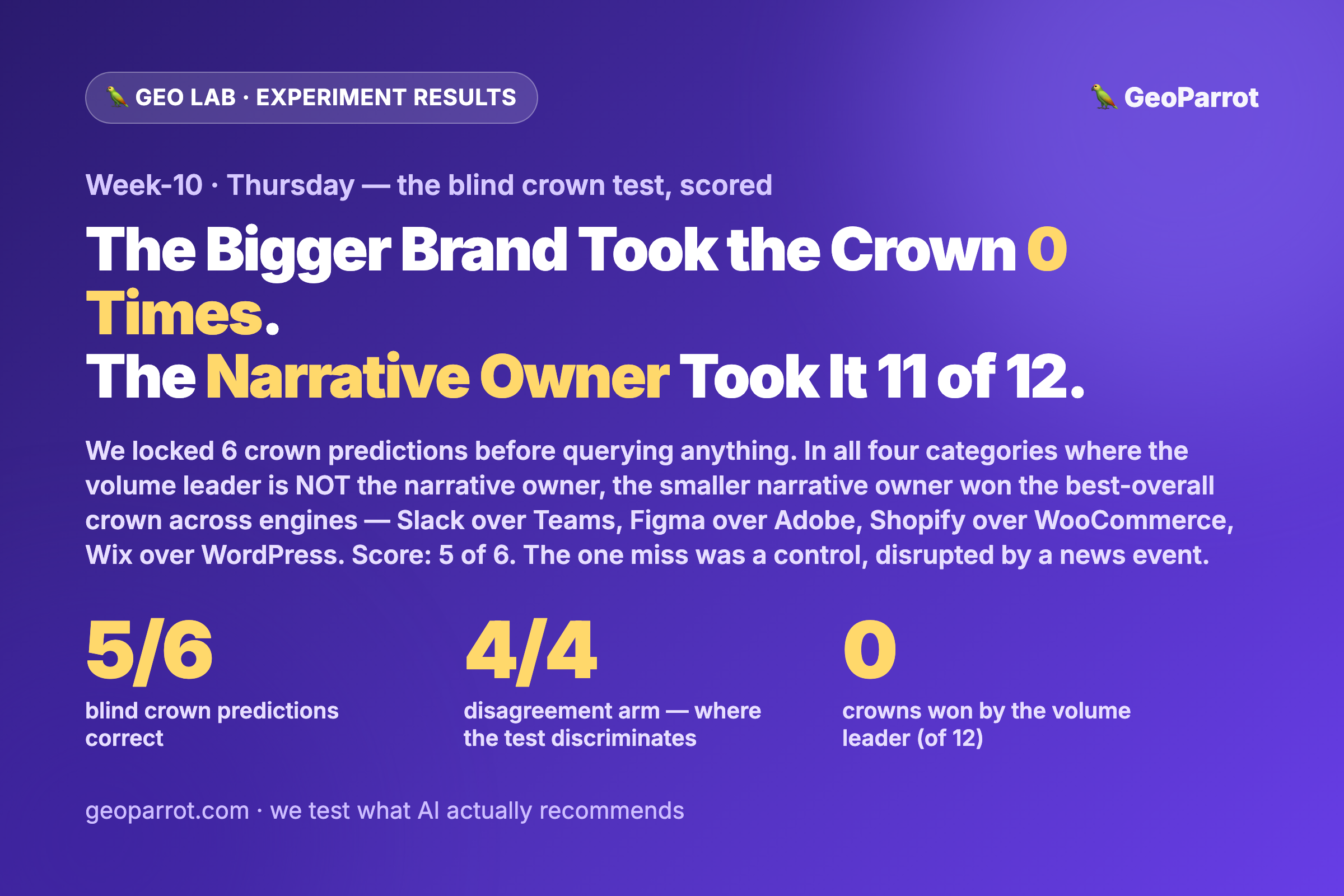
Quick answer: We scored the 6 crown predictions we locked on Tuesday against fresh queries to ChatGPT (logged out), Perplexity, and Google AI Mode — and hit 5 of 6. Every prediction bet the same thing: that the best-overall crown in each category goes to the narrative owner — the brand that owns the category’s defining sentence — not the volume leader with more installs, sites, or seats. In the four disagreement categories, where those two brands are different companies, the smaller narrative owner won the crown every time: Slack over Microsoft Teams, Figma over Adobe, Shopify over WooCommerce, Wix over WordPress. Counting each engine separately, the volume leader was crowned 0 times out of 12; the narrative owner, 11 of 12. Both control categories were supposed to be easy — and only one was: Zoom held its crown 3/3, but Canva’s crown split three ways after a 2026 news event (the Affinity suite going free) handed ChatGPT a different answer. By our pre-registered bands — ≥5 promotes the model, 4 is inconclusive, ≤3 forces a retraction — 5/6 clears the bar. The honest asterisk: the one miss is a control, so Friday’s verdict has to decide whether a clean pass is really clean when the failure is in the arm that was meant to be a gimme.
This is Thursday’s result in this week’s GEO Lab arc. Monday we argued that “AI share of voice” is being sold as the new SEO rank, but it’s half a vanity metric — because when the AI names almost everyone, being mentioned stops separating winners from losers. The only score that moves a buyer is the best-overall crown. Tuesday we pre-registered 6 crown predictions and locked them before a single engine was queried, precisely to avoid the hindsight trap that shadowed last week’s appearance-level test, where “did the challenger show up at all?” turned out to be too loose a bar. Today we escalated the resolution from appearance to crown and scored blind. Nothing in the prediction table was edited after collection — that is the entire point of pre-registration.
How did the blind crown test score?
5 of 6. The scoring rule was locked in advance: for each category we ran the neutral prompt “best [category] in 2026?” once per engine, read each engine’s single best-overall pick (the brand it named first, called best overall, or nominated as the one to choose), and recorded the observed crown as the brand that a majority — at least 2 of 3 engines — put on top. A three-way split counts as no crown, i.e. a miss, the conservative call. Here’s the frozen scorecard.
| Category | Arm | Volume leader | Predicted crown (narrative) | Observed crown | Verdict |
|---|---|---|---|---|---|
| Team chat | disagreement | Microsoft Teams | Slack | Slack — 3/3 | ✅ hit |
| UI design | disagreement | Adobe | Figma | Figma — 2/3 | ✅ hit |
| E-commerce | disagreement | WooCommerce | Shopify | Shopify — 3/3 | ✅ hit |
| Website builder | disagreement | WordPress | Wix | Wix — 3/3 | ✅ hit |
| Video conferencing | control | Zoom | Zoom | Zoom — 3/3 | ✅ hit |
| Graphic design | control | Canva | Canva | split — no majority | ❌ miss |
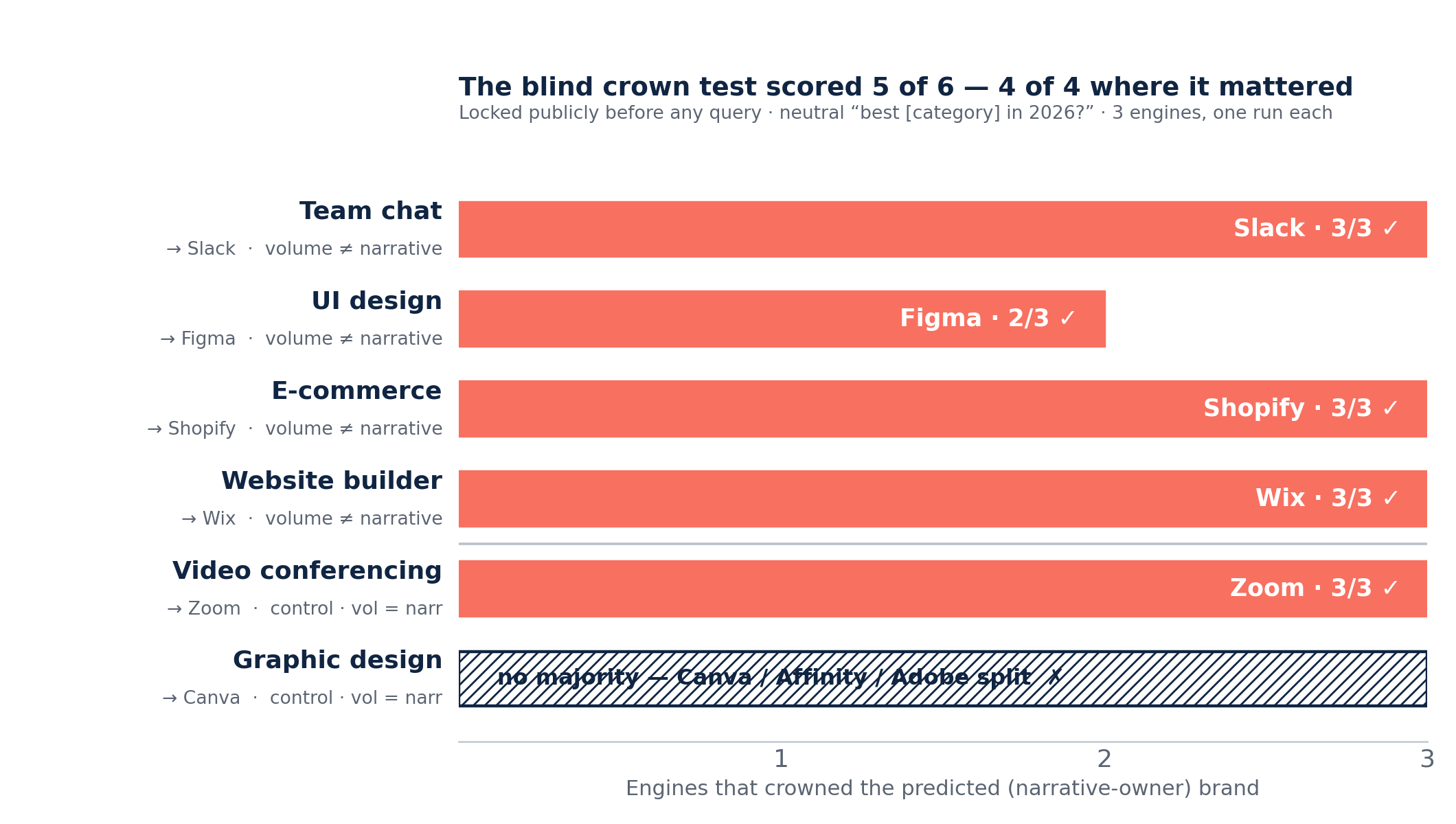
Read against the locked bands, 5/6 is a pass — it clears the ≥5 line that promotes the narrative-crown model to something we’ll trust predictively, and it’s nowhere near the ≤3 coin-flip line that would have forced a retraction of Monday’s argument. But the composition matters more than the headline number, so let’s look at where the signal actually lives.
Why did the narrative owner win every disagreement category?
The four disagreement categories are the whole experiment. A control where the volume leader is the narrative owner (Zoom, Canva) can’t tell the two theories apart — both models predict the same winner. The test only discriminates where the biggest brand and the defining-sentence brand are different companies. In all four of those, the smaller narrative owner took the crown.
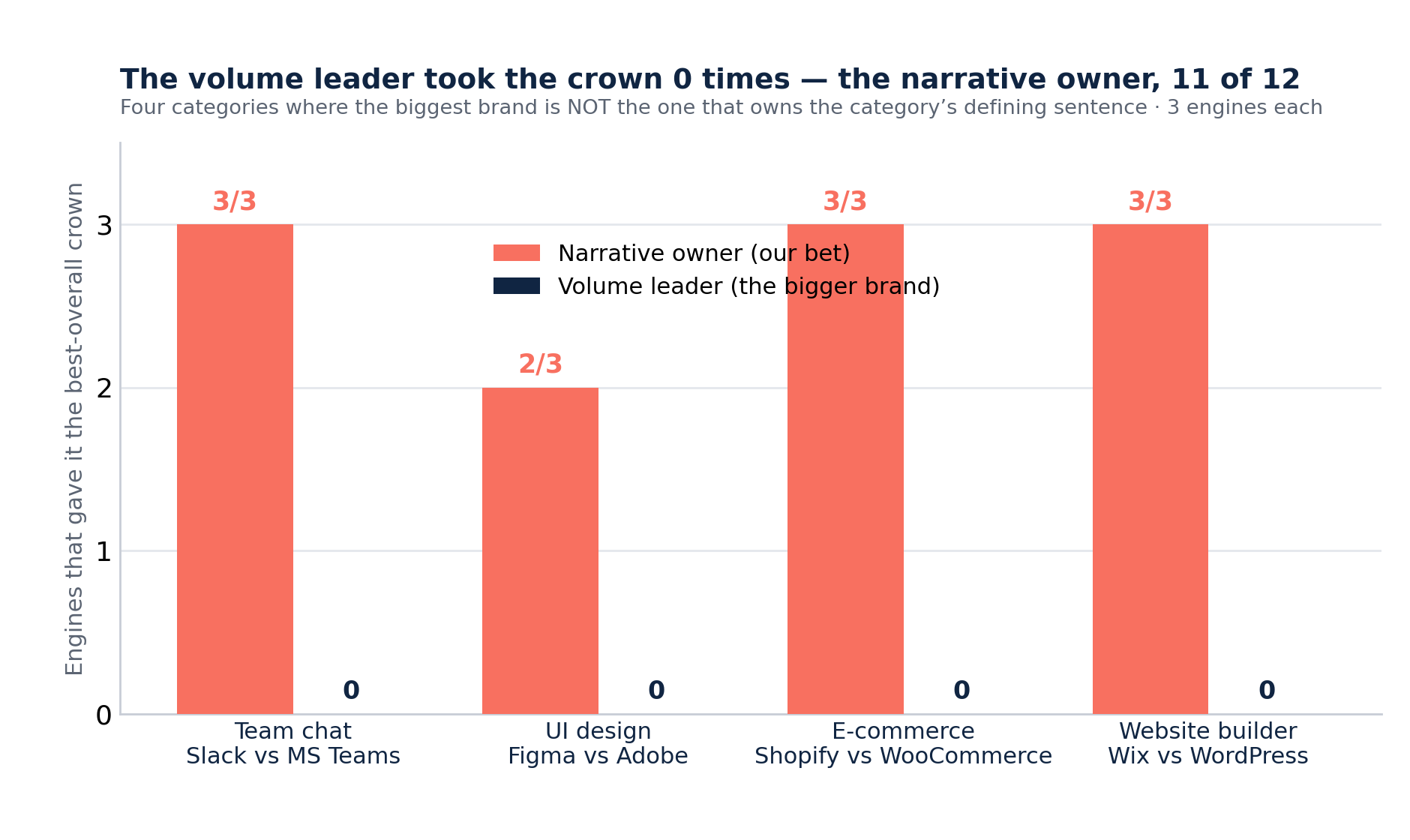
The margin is not subtle. WordPress powers more of the web than any other builder, yet all three engines crowned Wix as the overall pick — Google AI Mode called it “종합 1위” (overall #1), Perplexity said “Wix is the best website builder for most people in 2026,” ChatGPT put a 🏆 next to it. WooCommerce runs on more stores than any hosted rival, yet Google AI Mode called Shopify the “undisputed best overall e-commerce platform in 2026” and the other two agreed. Microsoft Teams has vastly more seats than Slack through Office bundling, yet ChatGPT’s verdict was blunt — “🥇 Slack — best overall” — with Perplexity and Google leading on Slack too. Adobe dwarfs Figma in revenue and product breadth, yet Perplexity opened with “Figma is the best all-around UI design tool in 2026.”
Why? Because a neutral “best X” answer isn’t a market-share report — it’s a recommendation, and recommendations run on the sentence that defines the category. “Slack is the standard for workplace chat,” “Figma is where product teams design,” “Shopify is how you build a store” — those are the lines the training corpus repeats, and the engine reaches for the brand that owns them. Volume tells the model who is big; narrative tells the model who is the answer. When you ask for the single best, it returns the answer.
So what did the volume leaders actually get?
They didn’t vanish — they got demoted to a segment. This is the same mechanism we flagged in last week’s appearance test: the modern AI answer is a segmented listicle, and almost every credible brand earns a “best for ___” slot. So the volume leaders appeared in nearly every answer — as the qualified pick, never the crown. Microsoft Teams was consistently “best if you already pay for Microsoft 365.” WooCommerce was “best for WordPress users who want maximum control.” WordPress itself was filed under “자유도 & 확장성” (freedom and extensibility). Adobe was “the professional standard” — a status label, not a recommendation to a newcomer.
That gap between appearing and being crowned is exactly why Monday’s vanity-metric argument holds. A share-of-voice dashboard would have logged Teams, WooCommerce, WordPress and Adobe as present and prominent in almost every answer — high mention rate, healthy “SOV.” And it would have completely missed that not one of them is the brand a buyer is actually pointed to. Mention rate counts the room. The crown counts the decision.
Why did the one control miss — and why is it the most useful data point?
The miss is instructive precisely because it’s a control. Graphic design was supposed to be a gimme: Canva is both the volume leader and the narrative owner for non-designers, so both theories predicted Canva. Instead the crown split three ways. Perplexity led with Canva for “most users.” Google AI Mode opened with Adobe Creative Cloud as the “절대적인 업계 표준” (absolute industry standard). And ChatGPT crowned Affinity outright — “If I had to recommend just one: Affinity” — explicitly citing a live 2026 event: “the professional Affinity suite is now available free, making it an unusually strong alternative to Adobe.” No brand got 2 of 3, so by our rule the observed crown is “none,” and Canva’s prediction misses.
That single miss carries a real lesson: a narrative owner’s crown is contestable when a fresh news event rewrites the category’s defining sentence. Affinity going free is exactly the kind of event that flips “Canva is the easy default” into “wait, the pro suite is now free too” — and the engine that had that event in its context (ChatGPT) changed its answer. The narrative-crown model isn’t a law of nature; it’s a strong prior that a big enough news shock can override. For a control that was meant to prove nothing, that’s the most honest and most portable finding of the day.
What does this prove — and what doesn’t it?
Let’s be precise about the weight this can bear, because pre-registration only matters if we hold ourselves to it afterward.
- It’s blind and out-of-sample. The 6 predictions were public before any query, so this doesn’t inherit the retrodiction weakness of a rule fitted to the data it “predicts.”
- The signal is where it should be. The four discriminating cases went 4/4 with a 11-of-12 engine margin over the volume leader — the test discriminated exactly in the arm built to discriminate.
- But n is tiny. Six categories, four of them discriminating, one query per engine, one run. No repeat sampling means we can’t separate a stable crown from a lucky snapshot; a re-run on a different day could wobble a 2/3 into a split.
- “Crown” is a judgment call. We coded each engine’s best-overall pick from prose. We were conservative (majority-or-none), but a stricter or looser reading could move a borderline case like UI design (Figma 2/3, with Google hedging toward newer AI tools).
- The miss is in the control arm. A perfectly clean result would have both controls hold. One splitting means even our “easy” assumption has an exception, which is a caution against over-claiming the model as universal.
What does this mean for your GEO strategy right now?
The practical takeaway is the same across all three engines, and it’s the opposite of what a share-of-voice tool will tell you to do:
- Stop optimizing for mention rate. Being named in the listicle is table stakes — your bigger competitors are already there and it isn’t winning them the crown. Chasing a higher “SOV” number optimizes the metric that our data shows doesn’t move the pick.
- Own one defining sentence. The crown went to the brand with a clean, repeated category definition — “the design tool for product teams,” “how you build a store.” Decide the one sentence you want the AI to complete with your name, and make the whole web say it consistently.
- You don’t need to be the biggest. Slack, Figma, Shopify and Wix all beat larger incumbents. Narrative ownership is a lever a smaller brand can actually pull, in a way that raw install-base volume is not.
- Watch for category-reframing events. Affinity going free rewrote graphic design’s defining sentence overnight. A pricing change, an acquisition, or a standout launch is your opening to contest a crown — and a threat to one you hold.
That leaves one crack for Friday’s verdict to settle: 5/6 clears our pass band, but the fifth hit was an easy control and the one miss was the other control. Do we graduate the narrative-crown model on the strength of a flawless 4/4 disagreement arm — or does a control-arm miss mean the honest score for the model’s core claim is 4/4-plus-an-asterisk, not a clean 5/6? We locked the bands in advance; Friday we have to live with them. We’ll also re-examine whether Monday’s harder claim — that mention rate is a vanity metric — is fully carried by “volume leader crowned 0 of 12,” or whether that overstates a six-category snapshot.
Frequently asked questions
What is the difference between the “volume leader” and the “narrative owner”?
The volume leader is the brand with the most installs, sites, seats, or mentions in a category — the biggest by raw usage. The narrative owner is the brand that owns the category’s defining sentence, the one people reach for when they describe what the category is (for example, Figma as where product teams design). In four of our categories these are different companies, and that gap is what the experiment was built to test.
What exactly counts as the “crown” in this test?
The crown is the single brand an engine names as best overall — the one it lists first, labels best overall, or nominates as the one to pick if you can only choose one. We recorded the observed crown as the brand a majority of the three engines put on top. If no brand got at least 2 of 3, we scored it as no crown, which counts as a miss. That is the conservative call, and it’s what cost us the graphic-design control.
Which engines were queried, and was ChatGPT logged in?
Three engines: ChatGPT (queried logged out, web-grounded — its answers carried live citations), Perplexity, and Google AI Mode. Each got the neutral prompt “best [category] in 2026?” once, in a single run, matching the protocol we locked on Tuesday. Logging out keeps the test free of personalization, so the result reflects the default answer a new user would see.
Doesn’t a sample of six categories make this too small to trust?
Yes, and we say so plainly. Six categories with one query per engine is a snapshot, not a census — it can’t separate a stable crown from a lucky day, and a re-run could wobble a borderline 2/3 into a split. What raises our confidence is that the predictions were locked publicly before any query and the discriminating arm went 4 of 4 with a wide margin. It’s a strong blind signal at small scale, which is why the model still faces Friday’s verdict rather than a victory lap.
How can a smaller brand actually win the crown?
By owning one defining sentence rather than chasing a higher mention rate. The crowns went to brands with a clean, repeated category definition, not to the biggest incumbents. Decide the single sentence you want an AI to complete with your name, make the web state it consistently, and watch for category-reframing events — a pricing change or standout launch, like Affinity going free — that open a window to contest a crown you don’t yet hold.
Sources
- GEO Lab experiment #11 — raw answer capture from ChatGPT (logged out), Perplexity, and Google AI Mode, neutral prompt “best [category] in 2026?”, one run each, scored 2026-08-27.
- Predictions locked in advance: The Crown Prediction: A Blind, Pre-Registered Test (method).
- This week’s thesis: “AI Share of Voice” Is Being Sold as the New SEO Rank — and It’s a Vanity Metric.
- Prior arc — appearance-level blind test: The Blind Test Scored 4 of 6 (results) and its verdict.
- Related GEO Lab work: scoring narrative ownership, why share of voice is the wrong metric, reverse-engineering AI consensus, and the per-engine GEO checklist.
Leave a Reply