

Quick answer: AI-visibility tracker Promptwatch published a new breakdown on November 17 of 26 billion-plus citation data points (collected November 3 to 16) sorted by domain authority rank (DR, on a 0-100 scale) across four AI engines. Two patterns sit side by side. First, the middle of the authority range is nearly identical everywhere: DR 31-75 domains get 59% of ChatGPT’s citations, 59% of AI Overviews’, 66% of Perplexity’s, and 65% of AI Mode’s, and DR 1-30 domains get 10.9-12.2% in every engine. Second, the very top splits hard: domains at exactly DR 100 get 13.7% of AI Overviews’ citations but only 0.3% of ChatGPT’s, a roughly 46x gap, with Perplexity (1.0%) and AI Mode (4.4%) in between. We can’t independently verify Promptwatch’s DR methodology or confirm their 26-billion-point count, and they sell AI citation tracking, so the convergence finding is more interesting than the raw percentages. It also sits next to a finding of our own: when we checked which specific domains four AI engines cited for the same 15 questions, only 2 of 395 unique domains showed up in all four. Authority tier and domain identity are turning out to be two different axes, and they don’t move together.
Published November 19, 2026, in the GEO Lab. We’ve run this comparison before on a different axis: our own cross-engine citation experiment found almost no overlap in which exact domains four AI engines cite for the same questions. This new dataset asks a related but separate question, not which sites, but what tier of site, and gets a strikingly different answer.
What does Promptwatch’s new dataset actually show?
Promptwatch, an Amsterdam-based AI-citation monitoring vendor, published a domain-rank breakdown on November 17 drawn from real UI monitoring of ChatGPT, Google AI Overviews, Perplexity, and Google AI Mode between November 3 and 16. Here is the full split by authority tier.
| Domain rank tier | ChatGPT | AI Overviews | Perplexity | AI Mode |
|---|---|---|---|---|
| DR 100 (exact) | 0.3% | 13.7% | 1.0% | 4.4% |
| DR 91-100 | 3.0% | 17.9% | 3.6% | 8.2% |
| DR 61-90 | 41.2% | 25.6% | 40.1% | 34.8% |
| DR 31-75 | 61% | 59% | 66% | 65% |
| DR 1-30 | 10.9% to 12.2% in every engine (Promptwatch reports only this combined range, not a per-engine split) | |||
| DR 0 (no rank) | 5.1% | 1.5% to 2.1% for the other three engines (Promptwatch reports only this combined range, not a per-engine split) | ||
Two numbers do the real work here. The DR 31-75 row is close to identical across all four engines, a 7-point spread (59% to 66%). The DR 100 row is not close at all, a 13.4-point spread and a 46x ratio between the highest (AI Overviews) and lowest (ChatGPT). Whatever else is true about these four products, they are not applying one shared rule for how much perfect-authority status matters.
Why would Google’s own AI Overviews favor DR 100 domains so much more than ChatGPT?
Promptwatch’s writeup doesn’t offer a mechanism, and neither Google nor OpenAI has published anything that explains this specific gap, so anything beyond the number itself is a hypothesis, not a confirmed cause. The most obvious candidate: AI Overviews is generated from Google’s own organic index and ranking signals, the same system that already concentrates top positions on a small set of maximum-authority domains (Wikipedia, government sites, major reference publishers) for a huge share of queries. ChatGPT Search runs its own separate retrieval layer that isn’t built on top of Google’s ranking stack, so it has no equivalent structural reason to over-represent the exact same DR 100 tier. That’s a plausible story, not a verified one. It’s also exactly the kind of claim that deserves its own test rather than being accepted because it sounds reasonable, which is the trap we flagged in our OMNIFAMOUS fact-check two weeks ago: a clean-sounding number from a vendor with a reason to publish it is not the same thing as a replicated finding.
Does this contradict our own 0.5% domain-overlap finding?
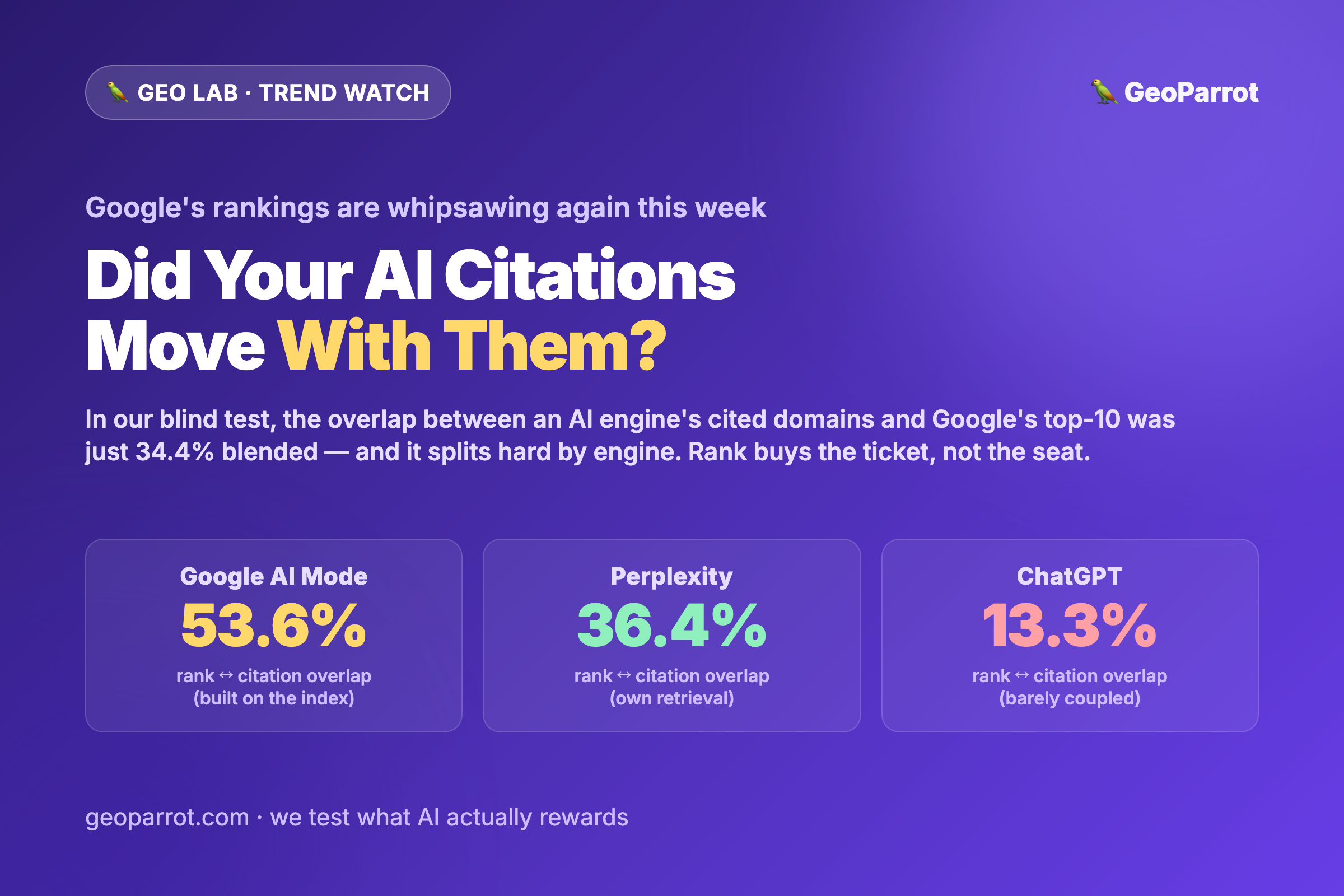
No, and that’s the part worth sitting with. Our cross-engine experiment measured domain identity: out of 395 unique domains cited across four engines answering the same 15 buyer-intent questions, only 2 (Reddit and Semrush) showed up in all four, and 85.1% of domains appeared in exactly one engine and nowhere else. Promptwatch’s dataset measures domain authority tier, a completely different axis. An engine can draw from an almost entirely different roster of specific sites while still pulling from the same general altitude of that roster, the same way two editors with opposite taste in restaurants can both insist on “somewhere mid-range,” naming completely different restaurants. The middle-tier convergence (59-66% everywhere) says all four engines agree on roughly what altitude of source quality counts as citable. The identity divergence (2 of 395 shared) says they still disagree almost completely on which specific source at that altitude to use. Our domain-concentration experiment found a related pattern from a third angle: a small number of domains punch above their weight in buyer-intent citations, but which small number differs sharply by engine and category.
What should you actually do with this?
- Don’t chase DR 100 as a universal goal. It pays off disproportionately for visibility in Google’s AI Overviews specifically. For ChatGPT and Perplexity, a DR 100 badge buys almost nothing extra over a solid mid-authority domain.
- The DR 31-75 band is the actual target for broad AI visibility. It’s the one tier all four engines treat almost the same way, and it’s realistically reachable for most established sites, unlike DR 100.
- Don’t assume winning one engine’s citation predicts winning another’s. Our own data says the specific domains barely overlap even when the authority tiers do. Track citations per engine, not as one pooled number.
- Treat single-vendor percentage claims, including this one, as a starting hypothesis. Promptwatch sells AI citation tracking and hasn’t published a replicable DR-scoring methodology alongside this dataset. The tier-convergence pattern is more trustworthy than any individual percentage in the table.
Frequently asked questions
What is domain rank (DR) in this dataset?
Domain rank is a 0-to-100 authority score meant to approximate a site’s overall link-based authority, similar to the DR metric popularized by backlink tools. Promptwatch doesn’t publish the exact scoring methodology behind its own DR figures in this report, so the absolute percentages should be read as one vendor’s estimate rather than an independently reproducible measurement.
Does getting a DR 100 domain help with AI citations?
It depends heavily on which engine you’re optimizing for. In this dataset, DR 100 domains captured 13.7% of Google AI Overviews citations but only 0.3% of ChatGPT’s, a roughly 46x difference. For AI Overviews specifically, perfect authority appears to carry real extra weight. For ChatGPT, it barely matters next to the mid-authority tier.
Why do AI engines agree on mid-authority domains but disagree on top-tier domains?
There’s no confirmed mechanism from Google or OpenAI. One plausible, unverified explanation: Google’s AI Overviews draws on the same organic ranking signals that already concentrate top search positions on a small set of maximum-authority sites, while ChatGPT Search runs an independent retrieval layer with no structural reason to replicate that same concentration. This is a hypothesis worth testing directly, not a confirmed cause.
Does domain-rank convergence mean AI engines cite the same websites?
No. Our own cross-engine experiment found the opposite at the level of specific domains: only 2 of 395 unique cited domains appeared across all four engines for the same set of questions, with 85.1% of domains appearing in exactly one engine. Authority tier and domain identity are separate axes. Engines can converge on one while diverging almost completely on the other.
Should I trust Promptwatch’s 26-billion-citation claim?
Treat it the way we treat any single-vendor statistic: plausible, useful as a directional signal, and unverified by an independent source. Promptwatch sells AI citation monitoring, which is a direct commercial interest in publishing data that makes AI citation tracking look important and precise. The specific percentages in this report haven’t been replicated elsewhere. The broader pattern they describe, convergence in the middle tier and divergence at the top, is the more durable takeaway than any single number.
GeoParrot is a GEO Lab: we run experiments to test what AI search engines actually reward, and we grade the industry’s claims, including vendor statistics like this one, against what we can verify ourselves. See the running scoreboard at our 2026 GEO benchmark. Related: our cross-engine citation experiment (0.5% domain overlap), the domain-concentration test this connects to, and our fact-check of an earlier unverifiable vendor citation claim.

Leave a Reply