
Category: GEO Lab
Our own GEO experiments — testing whether content actually gets cited by AI engines.
-
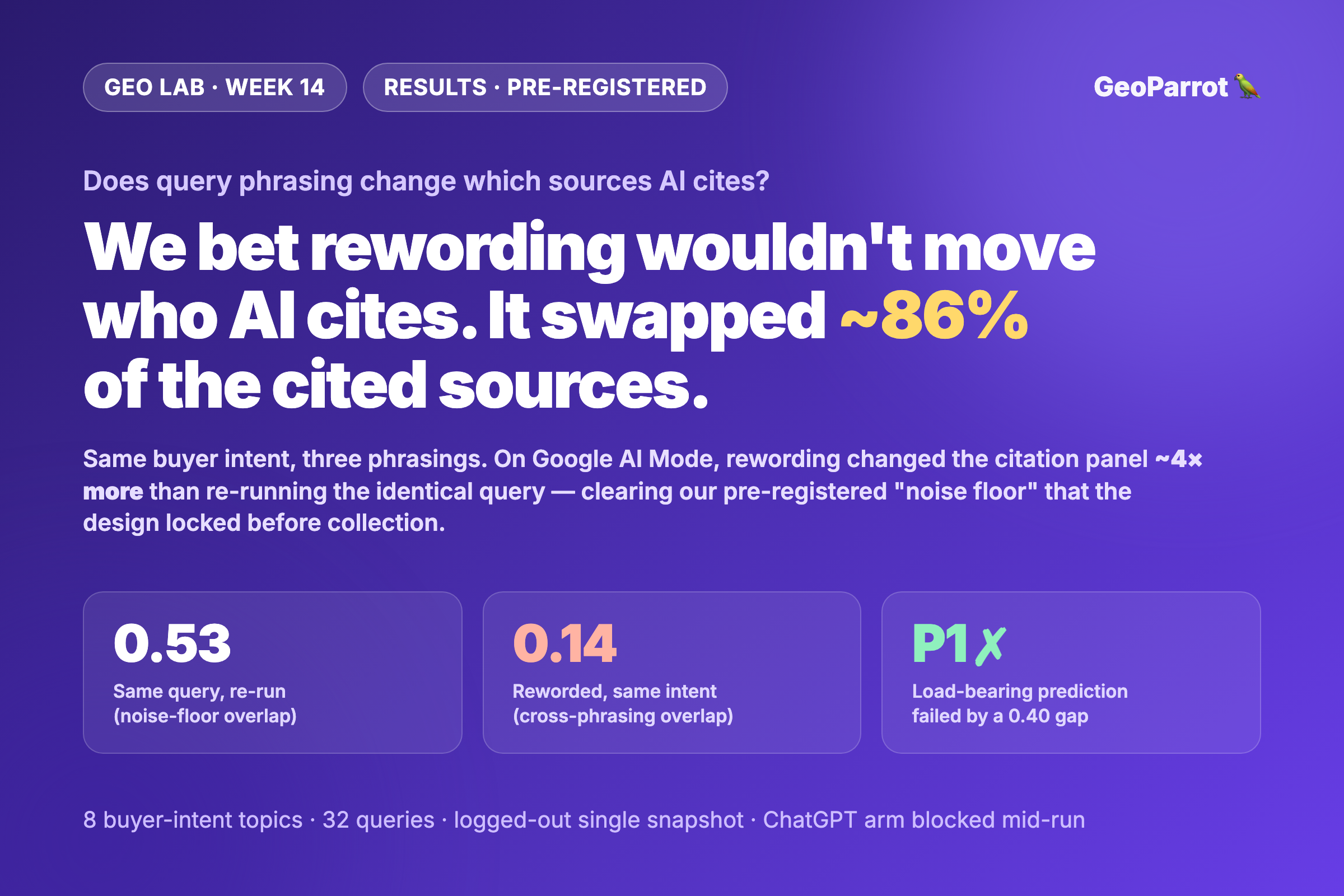
We Bet Rewording Wouldn’t Change Who AI Cites. On Google AI Mode, It Swapped ~86% of the Sources.
Tuesday we pre-registered a bet: query phrasing is a doorbell, not a gatekeeper — it changes whether AI answers, not who it cites. We collected 32 Google AI Mode queries (8 buyer intents x 3 phrasings, plus a noise-floor re-run). The load-bearing prediction failed by a 0.40 Jaccard gap: reworded queries shared only ~14% of…
-
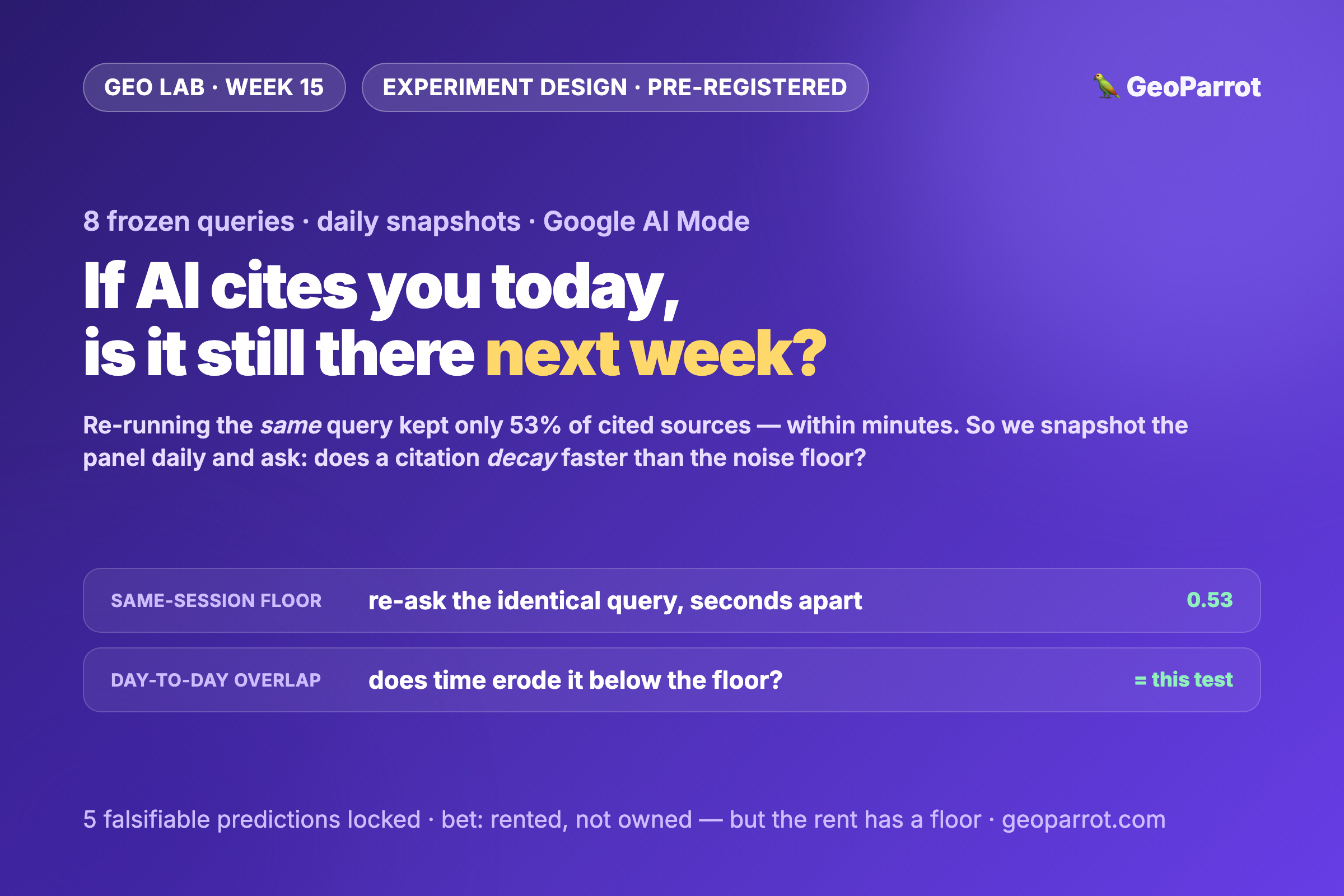
Rented, Not Owned? Our Pre-Registered Test of Whether an AI Citation You Win Today Is Still There Next Week
Last week we found something quietly alarming: re-running the identical query in the same session kept only 53% of the domains Google AI Mode cited — half the panel turned over with nothing changed. That was churn within minutes. This week we ask the higher-stakes version: if you win a citation today, is it still…
-
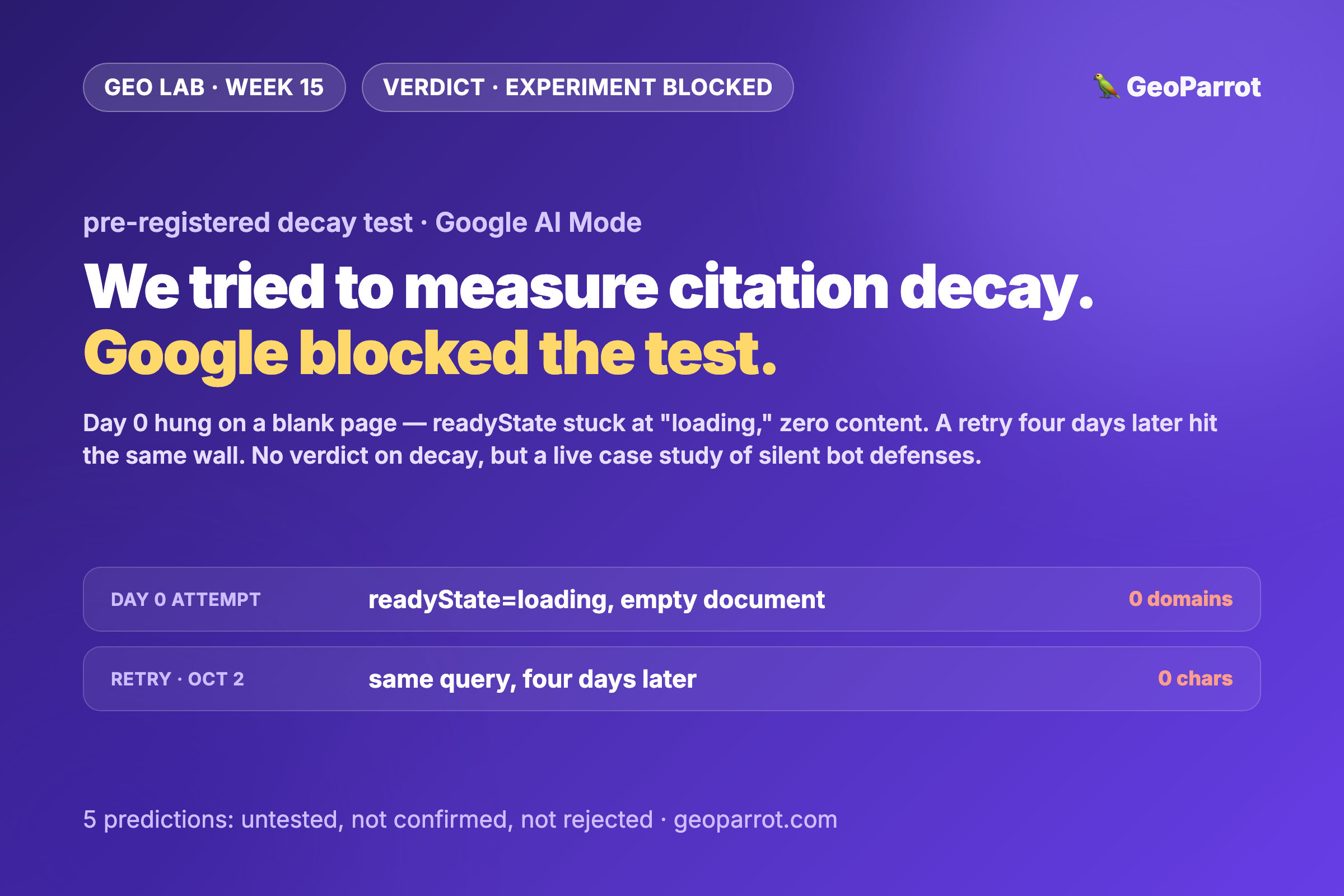
The Verdict: Our Pre-Registered AI-Citation Decay Test Never Ran — Google’s Bot Defense Blocked Every Snapshot
Tuesday we pre-registered five falsifiable predictions on whether AI citations decay day-to-day. Day 0 never collected — Google’s automation defenses silently returned empty pages instead of search results, and a retry four days later hit the same wall. No verdict on decay. But a live case study of why any tool that automates querying Google’s…
-
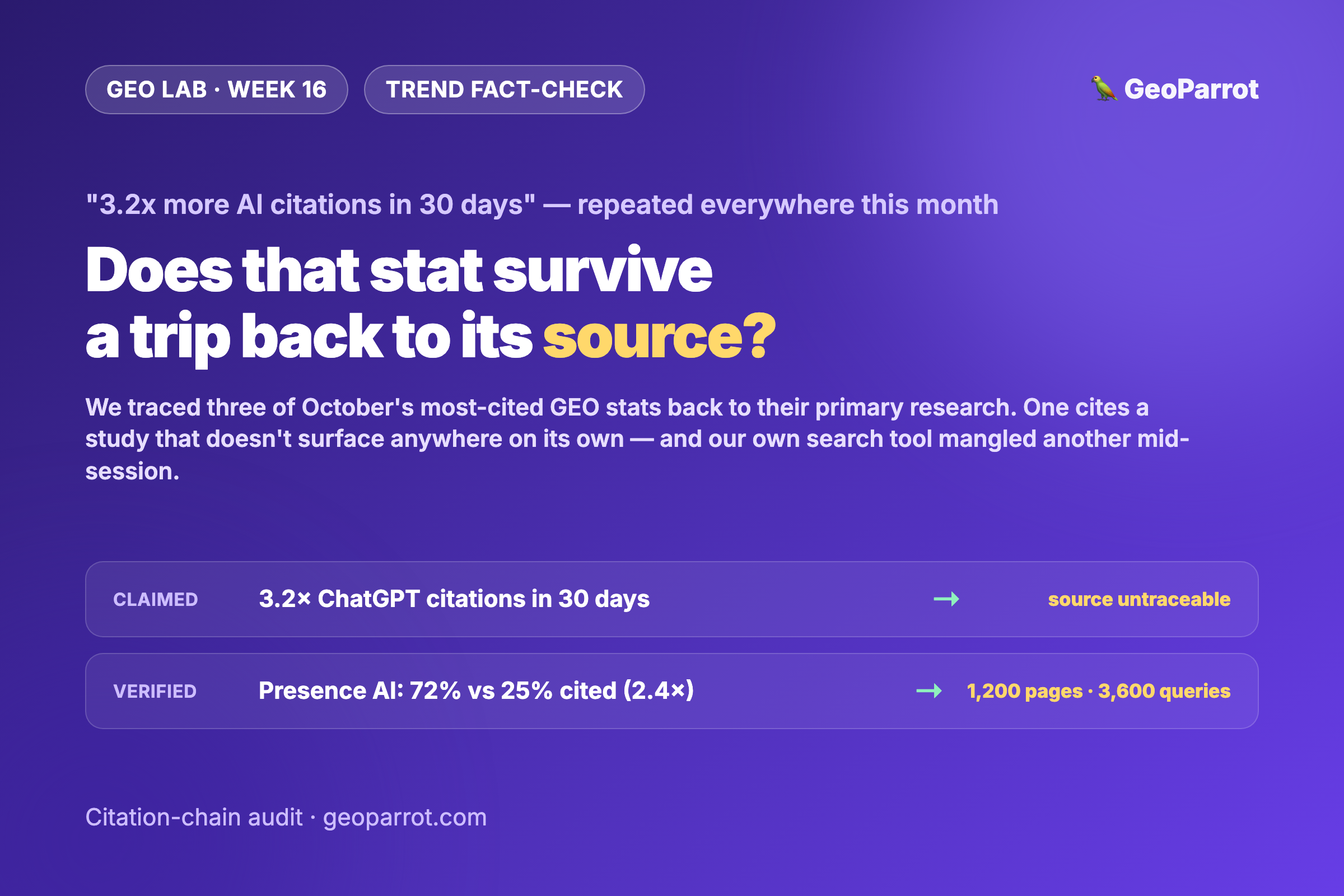
GEO Blogs Keep Citing a “3.2x More AI Citations” Stat. We Traced It to the Source. It Doesn’t Hold Up Cleanly.
This month’s GEO advice repeats precise numbers — 3x, 3.2x, 2.4x, 89% — for content freshness and author attribution driving AI citations. We traced three of the most-repeated stats back to their primary sources. One cites a study that doesn’t surface anywhere on its own. One is methodologically transparent but gets its own numbers garbled…
-
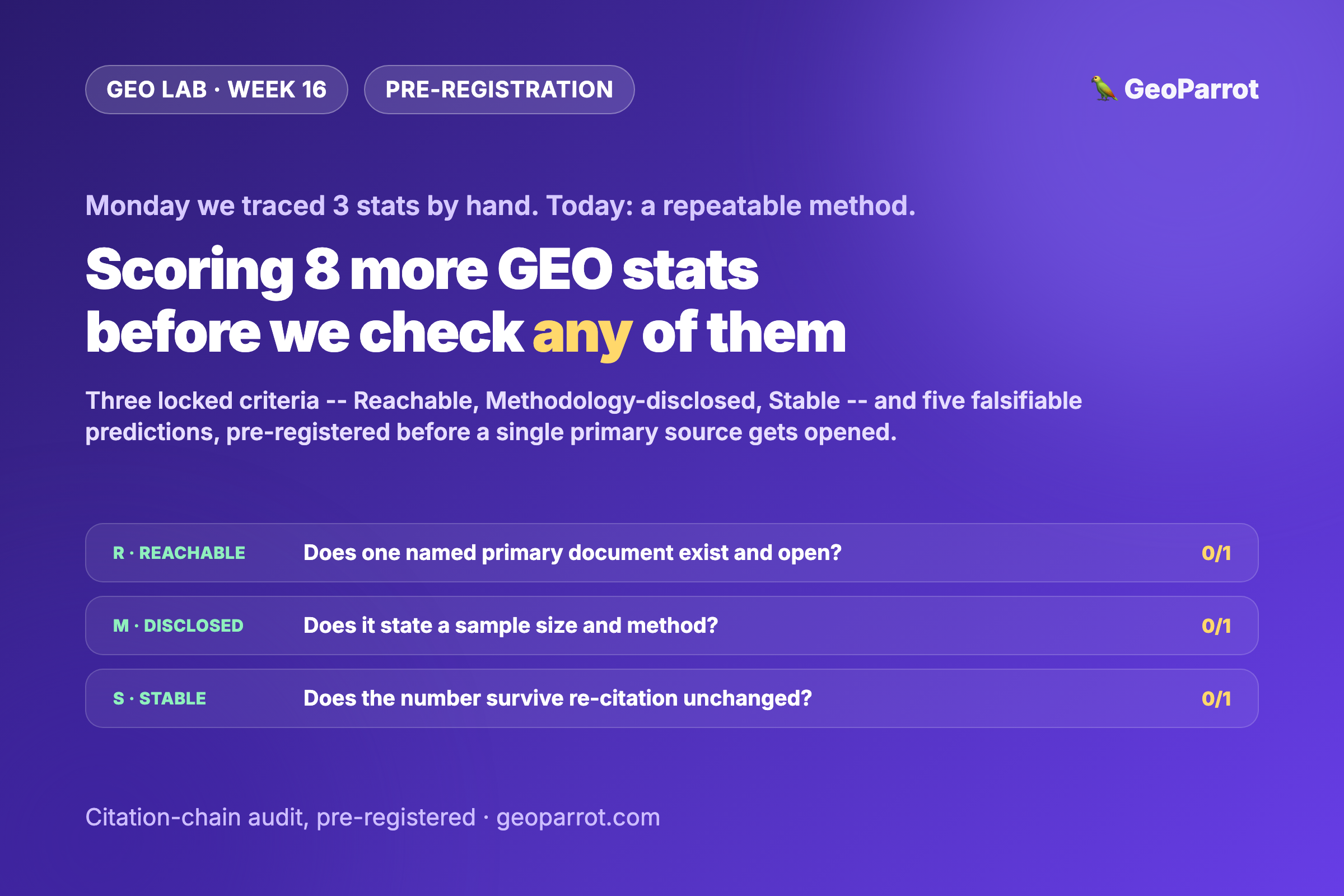
Monday We Traced 3 GEO Stats to Their Source. Today We’re Pre-Registering a Scoring Method to Audit 8 More.
Monday we traced three widely-repeated GEO citation stats back to their primary sources and found one was unreachable, one was methodologically transparent, and one got garbled by our own research tool mid-session. Today we lock a repeatable scoring method — Reachable, Methodology-disclosed, Stable — and pre-register it against 8 more stats circulating in October 2026…
-
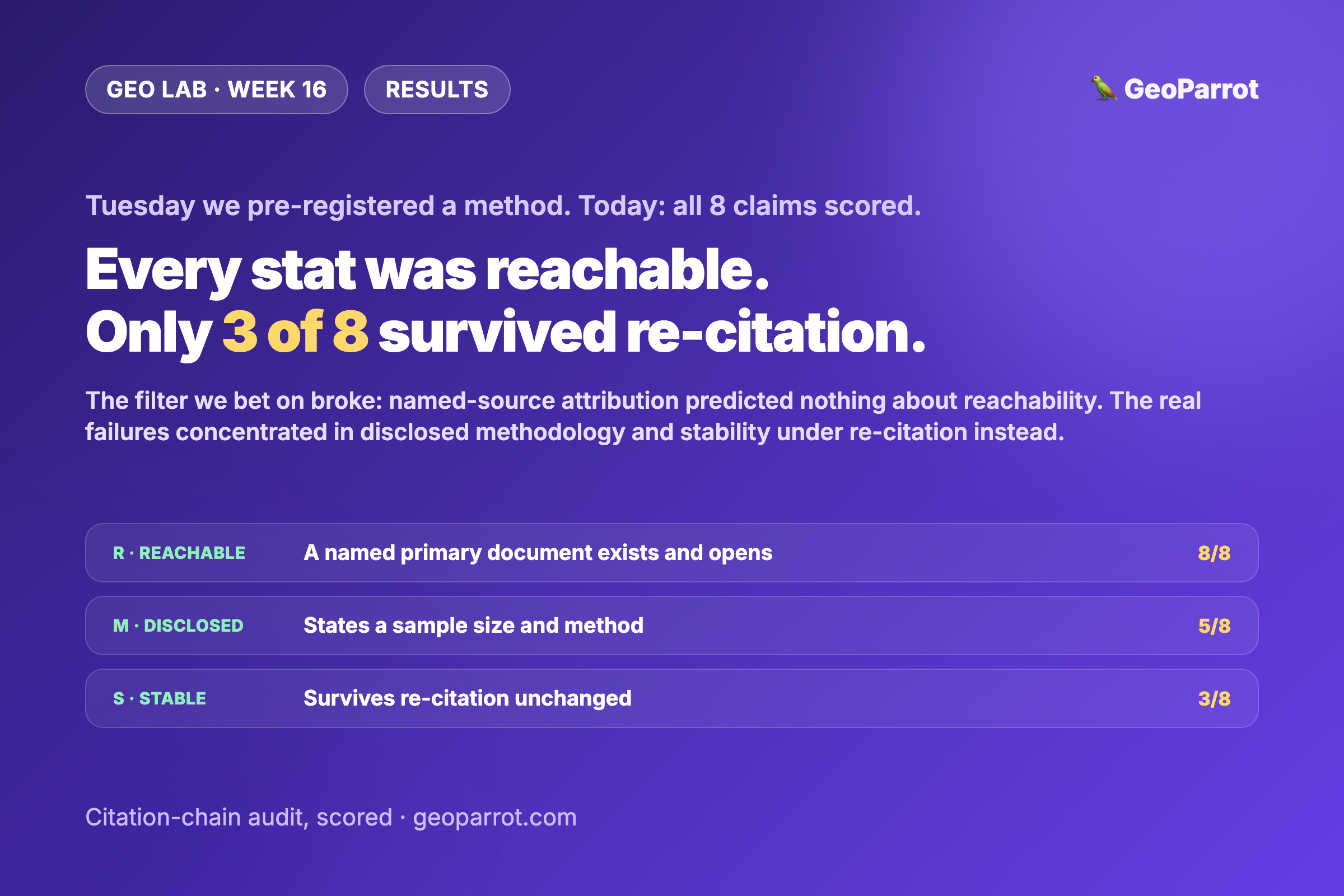
We Scored 8 GEO Citation Stats on 3 Criteria. The Filter We Bet On Broke.
We pre-registered a 3-criterion scoring method (Reachable, Methodology-disclosed, Stable) against 8 widely-repeated GEO citation stats, then scored all 8. Every single claim turned out to be reachable — the filter we bet would catch half the aggregator-sourced claims caught none of them. The real failures concentrated in disclosed methodology (5/8 pass) and stability under re-citation…
-
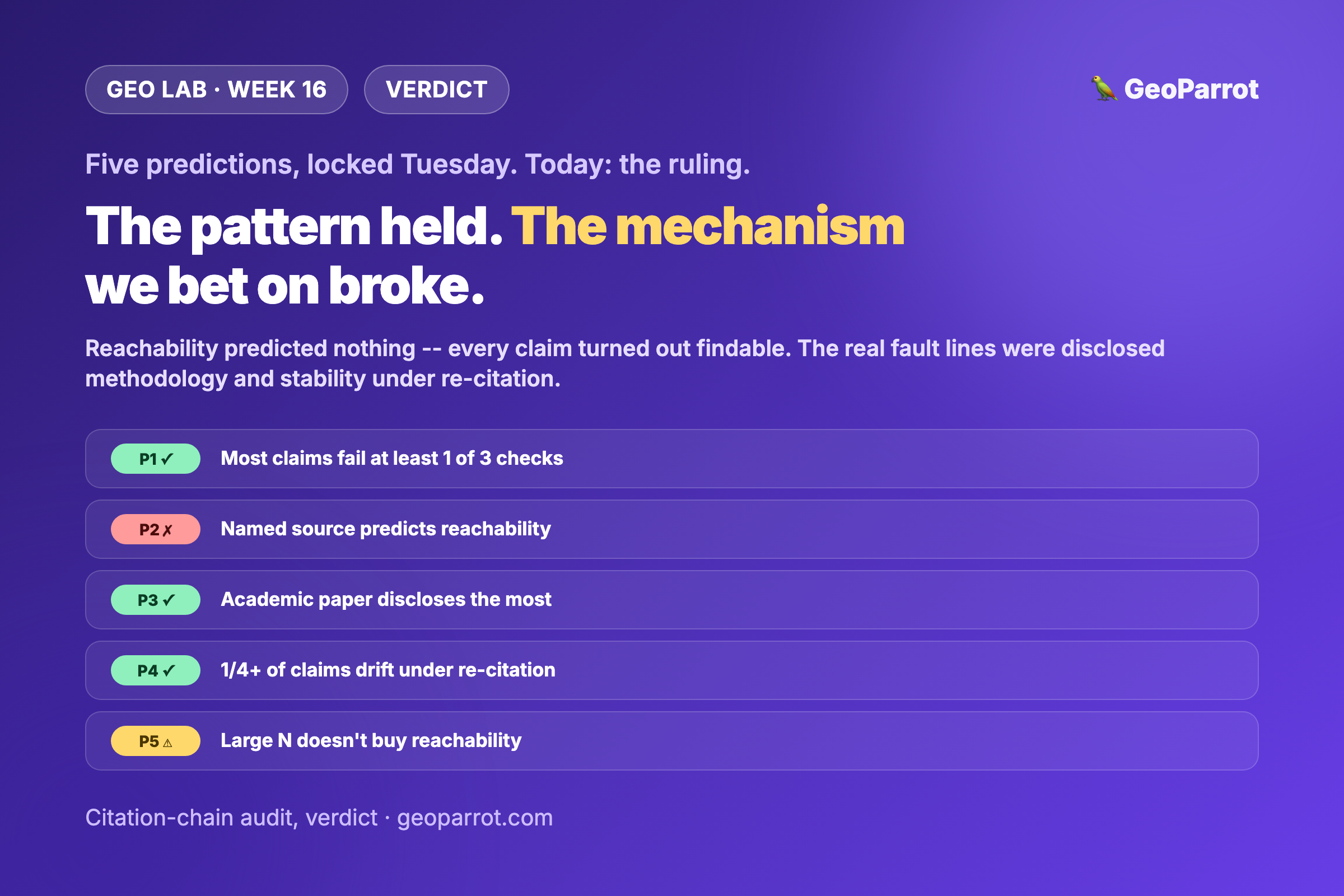
The Verdict: GEO’s Citation Chain Breaks — Just Not Where We Bet It Would
Monday we traced 3 GEO citation stats by hand and found a real problem. This week we pre-registered a method, scored 8 more, and judged five locked predictions against the data. The pattern held, harder than predicted — but the mechanism we bet would explain it was wrong, and our own research tooling broke the…
-
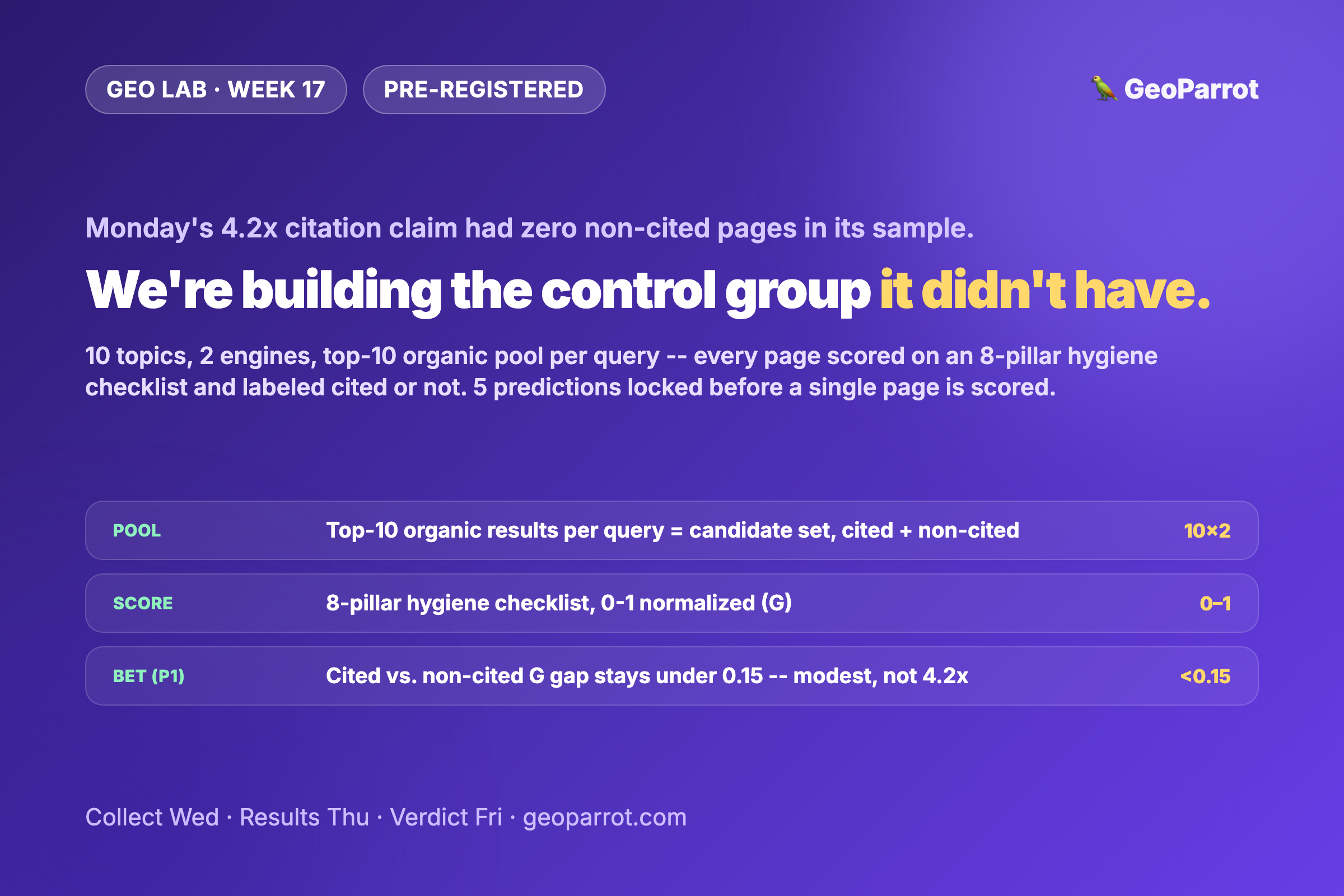
Cited vs. Never Cited: Our Pre-Registered Test of the Control Group a 4.2x Citation Claim Never Had
Monday we found that a “quality score predicts 4.2x more AI citations” study audited only pages that were already cited — no non-cited control group. This week we build the one it’s missing: 10 topics, two engines, and for each query a candidate pool of 10 organic pages scored on an 8-pillar hygiene checklist, labeled…
-
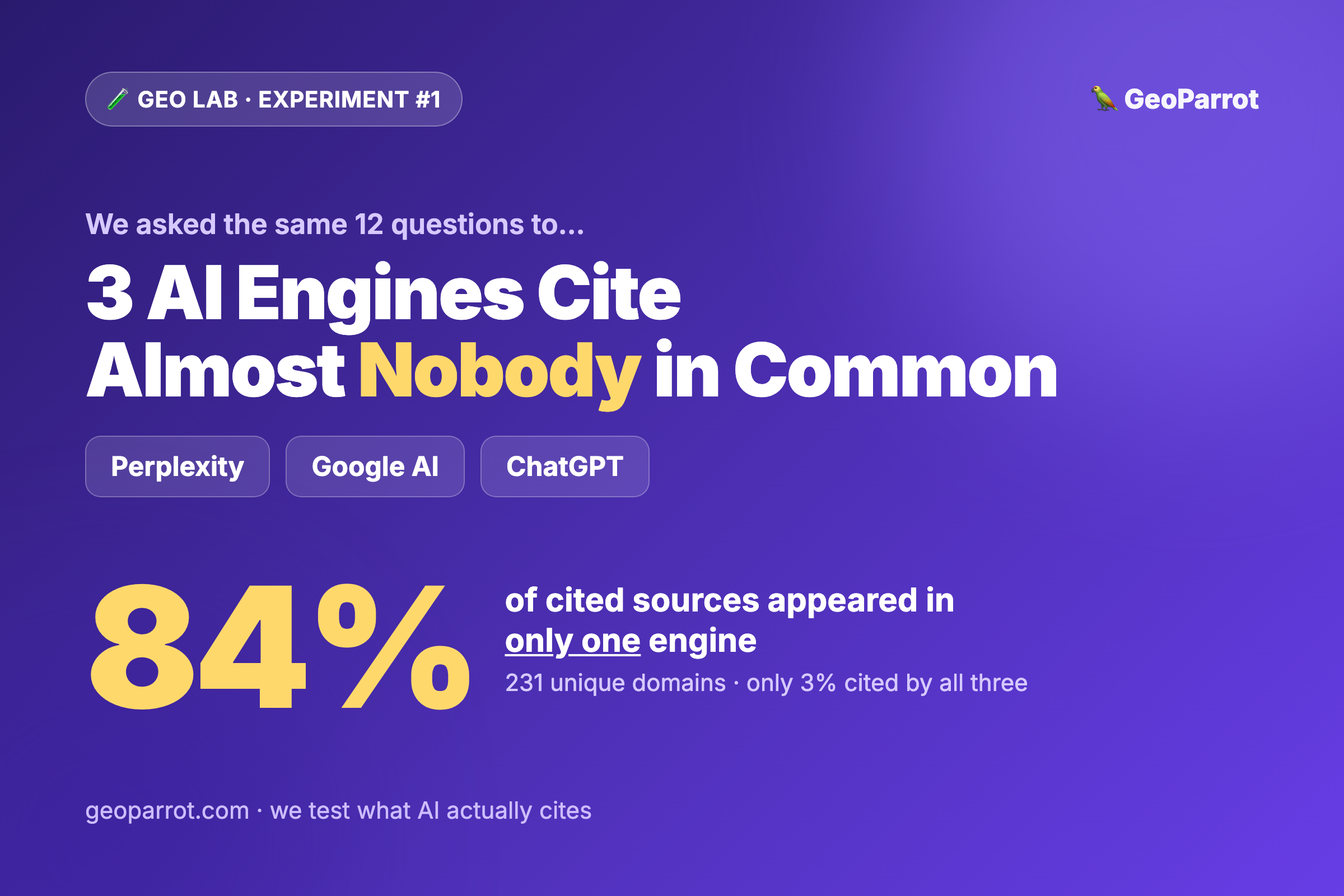
We Asked 3 AI Engines the Same 12 Questions — They Cite Almost Nobody in Common
GEO Lab experiment: we asked Perplexity, Google, and ChatGPT the same 12 GEO questions. Of 231 cited domains, only 3% were cited by all three and 84% by just one. There is no single “AI SEO” — here’s the data.
-
Welcome to GEO Lab: We Test What AI Actually Cites
GEO Lab is our running experiment series: we publish GEO-optimized content, then check whether ChatGPT, Perplexity, Google AI Overviews, and Claude actually cite us — and publish the raw results.