
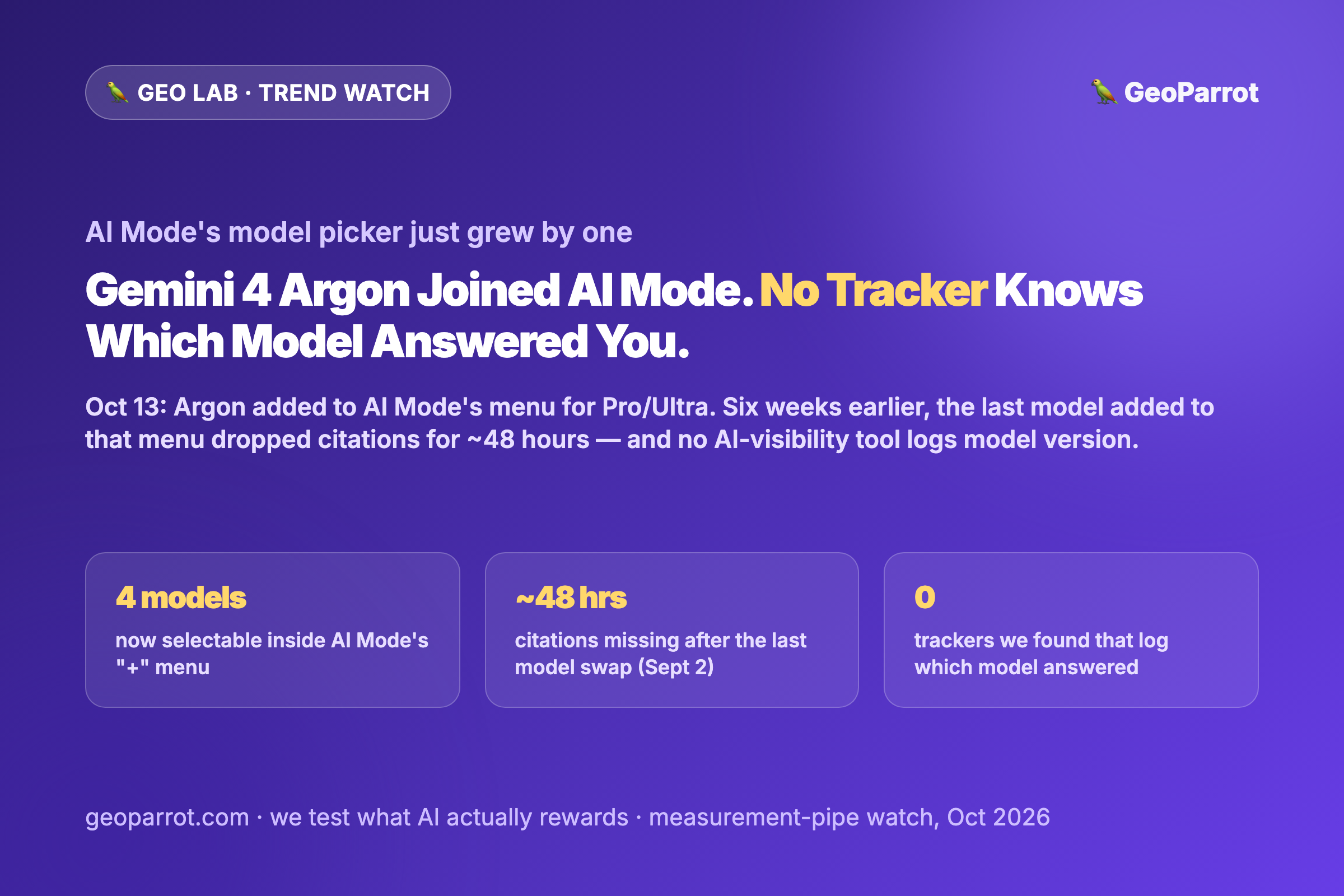
Quick answer: On October 13, 2026, Google rolled Gemini 4 Argon into AI Mode’s “+” model picker for Google AI Pro and Ultra subscribers, the same menu that previously added Gemini 3.7 Flash (August) and Gemini 3.8 Flash (September). The free tier’s default model is unchanged. What’s confirmed, separately: when 3.8 Flash joined that menu on September 2, some AI Mode answers using it came back with source links and citations missing entirely, a bug Google’s VP of Product for Search publicly acknowledged and fixed within roughly 48 hours. Put those two facts together and you get a real, checkable gap: AI Mode can now answer the same query with at least four different models, citation behavior has already varied measurably by model once, and we could not find a single AI-visibility or citation-tracking tool whose public methodology says it records, or controls for, which model generated the sampled answer.
Trend watch — published October 14, 2026. We read every AI-search measurement change the way the GEO Lab reads any claim: what’s actually confirmed, what’s inferred, and what it changes about whether your numbers mean what you think they mean.
What exactly happened, and how do we know?
Google shipped its flagship Gemini 4 Argon model on October 13, 2026 — globally available to developers via the Gemini API, and to Google AI Pro and Ultra subscribers in the Gemini app and in AI Mode in Search, per Google’s own announcement. Inside AI Mode, subscribers pick it from the same “+” icon in the “Ask anything” bar that previously surfaced Gemini 3.7 Flash and 3.8 Flash as optional models, confirmed independently by Search Engine Journal and 9to5Google. The rollout is gradual — one reporter noted Argon hadn’t yet appeared in their own Pro account menu hours after launch — and nothing in either Google’s post or follow-up reporting says Argon changes the default model for free-tier AI Mode users.
That’s the new fact. The relevant old fact: on September 2, 2026, Google added Gemini 3.8 Flash to that same AI Mode menu, and some answers generated with it came back with no source links or citations at all, even for queries where Google’s default model returned citations normally. Robby Stein, Google’s VP of Product for Search, confirmed it publicly: “This isn’t working as intended, and we’ll roll out a fix soon.” Source links were reported reappearing within roughly 48 hours.
Why does a model picker matter for GEO specifically?
Because AI Mode is no longer one engine with one citation behavior — it’s a menu, and the item a given user picks (or defaults into) can change whether your site gets cited at all, as the 3.8 Flash bug already demonstrated once at scale. That’s not a hypothetical “models differ” point; it’s a documented instance where a model swap in this exact interface measurably zeroed out citations for a stretch of real queries. Argon is a different, larger model built for “deep work” on multi-step tasks, not a Flash-tier swap-in — so we’re not predicting it will repeat the bug. The point is narrower: AI Mode’s citation behavior is now a function of which model answered, and that variable is invisible to everyone measuring from the outside.
We went looking for the AI-visibility and citation-tracking tools that marketers actually use — the Gemini and AI Mode trackers that run structured prompts and log which URLs get cited — to see if any of them record or filter by model version. We didn’t find one. Several vendor descriptions we reviewed don’t even separate “Gemini the chatbot” from “Google AI Overviews,” reporting both under one umbrella metric, which was already a known gap before model-picking existed. Layering an optional model choice on top means a tool could sample the same query twice, on the same day, and get a citation-or-no-citation split that has nothing to do with your content and everything to do with which model answered — with no way for the tool, or you, to tell the difference after the fact.
| What’s confirmed | What’s not confirmed |
|---|---|
| Gemini 4 Argon joined AI Mode’s model picker on Oct 13, 2026, for Pro/Ultra subscribers | Whether Argon changes citation behavior in any direction |
| Gemini 3.8 Flash’s Sept 2 rollout to the same menu caused missing source links for ~48 hours, publicly acknowledged by Google | Whether any paid or free AI-visibility tool logs the model version behind a sampled AI Mode answer |
| AI Mode’s UI does not display which model generated a given answer | How often real users (vs. the default) are actually selecting a non-default model |
| The free tier’s default model is unchanged by this release | Whether Google itself tracks citation-rate variance by model internally |
How does this connect to the measurement cracks we’ve already documented?
This is the fourth distinct crack we’ve logged this quarter in the instruments people use to measure AI visibility, and each one is a different failure mode. Google’s anti-scraping defenses choked third-party rank-tracker collection by roughly 80% — a collection failure. Search Console’s AI “position” metric turned out not to behave like a rank — a definitional gap. Search Console’s core report ran 44+ hours stale this month — a freshness failure. This is a fourth kind: a hidden variable. The instrument isn’t broken, delayed, or mislabeled — it’s silently sampling from a population (four possible models, and counting) without recording which member of that population it drew. That’s close to what Duane Forrester warned about when he said most 2027 GEO metrics won’t be independently checkable, except here the uncheckable variable already exists today, inside a live product, with one documented case of it mattering.
A checklist for what to actually do about this right now
- Don’t treat one AI Mode query as representative. If your tracker or your own spot-check gets a citation-free answer, re-run it a few times before concluding your content fell out of favor — it may just have landed on a different model.
- Ask your AI-visibility vendor directly whether they log model version. If their methodology page doesn’t mention it, assume they don’t, and discount single-sample citation drops accordingly.
- Watch for a repeat of the 3.8 Flash pattern over the next week. Argon’s initial rollout is gated to paid subscribers, so any citation anomaly would show up first in a smaller, higher-intent slice of traffic — worth a specific spot-check if you have Pro/Ultra access.
- Don’t optimize for “the AI Mode model.” There isn’t one anymore. Optimize for the structural things that have held up across every model and engine we’ve tested — clear sourcing, extractable passages, first-party data — rather than any single model’s quirks.
- If you build or buy a tracking dashboard, add a model-version field now, even if it stays empty today. The menu already has four entries; it’s not getting shorter.
The honest caveats
We have not tested Gemini 4 Argon’s citation behavior ourselves — it had not fully rolled out to our test accounts at the time of writing, so this piece makes no claim that Argon will repeat the 3.8 Flash bug, only that the structural gap (a model-dependent answer with no model disclosure) now exists regardless of whether Argon itself behaves well. Our search for tools that log model version was not exhaustive; we reviewed public methodology pages and marketing descriptions for the tools that turned up in a focused search, not a full market audit, so a tool that does this and simply doesn’t advertise it could exist. And we’re inferring “nobody tracks this” from absence of disclosure, which is weaker evidence than a direct denial from each vendor.
Frequently asked questions
What is Gemini 4 Argon?
Google’s flagship AI model, released October 13, 2026, built for complex multi-step tasks in coding, finance, law, and science. It’s available via the Gemini API, the Gemini app, and as an optional model inside AI Mode in Google Search for AI Pro and Ultra subscribers.
Does Gemini 4 Argon change AI Mode’s citation behavior?
Unconfirmed either way. We have no evidence Argon has the same bug the previous model addition had, and no evidence it doesn’t. The point of this piece is that the question is currently unanswerable from the outside, because nothing discloses which model produced a given answer.
What happened with Gemini 3.8 Flash and citations?
When Google added Gemini 3.8 Flash to AI Mode’s model menu on September 2, 2026, some answers generated with it came back without source links or citations, even on queries where the default model returned them normally. Google’s VP of Product for Search acknowledged the bug publicly and it was resolved within roughly 48 hours.
Can I see which model answered my AI Mode query?
Not from the standard AI Mode interface, as far as we could confirm. Subscribers can choose a model from the “+” menu before asking, but there’s no indication the answer itself is labeled with the model that generated it.
Do AI-visibility tools track which model generated a cited answer?
We couldn’t find one whose public methodology says it does. Several tools marketed as Gemini or AI Mode trackers don’t even distinguish the Gemini chatbot from Google AI Overviews in their reporting, which predates this specific gap. Treat single-query citation checks as noisier than they look until a vendor says otherwise.
GeoParrot is a GEO Lab: we run experiments to test what AI search engines actually reward, and we grade the industry’s claims — including our own — against what was actually measured. See the running scoreboard at our 2026 GEO benchmark. Related: why your “live” AI Overview numbers aren’t live, why Search Console’s AI “position” isn’t a rank, how Google’s anti-scraping defenses broke third-party AI visibility tools, and what you’ll still be able to count in 2027.
Leave a Reply