
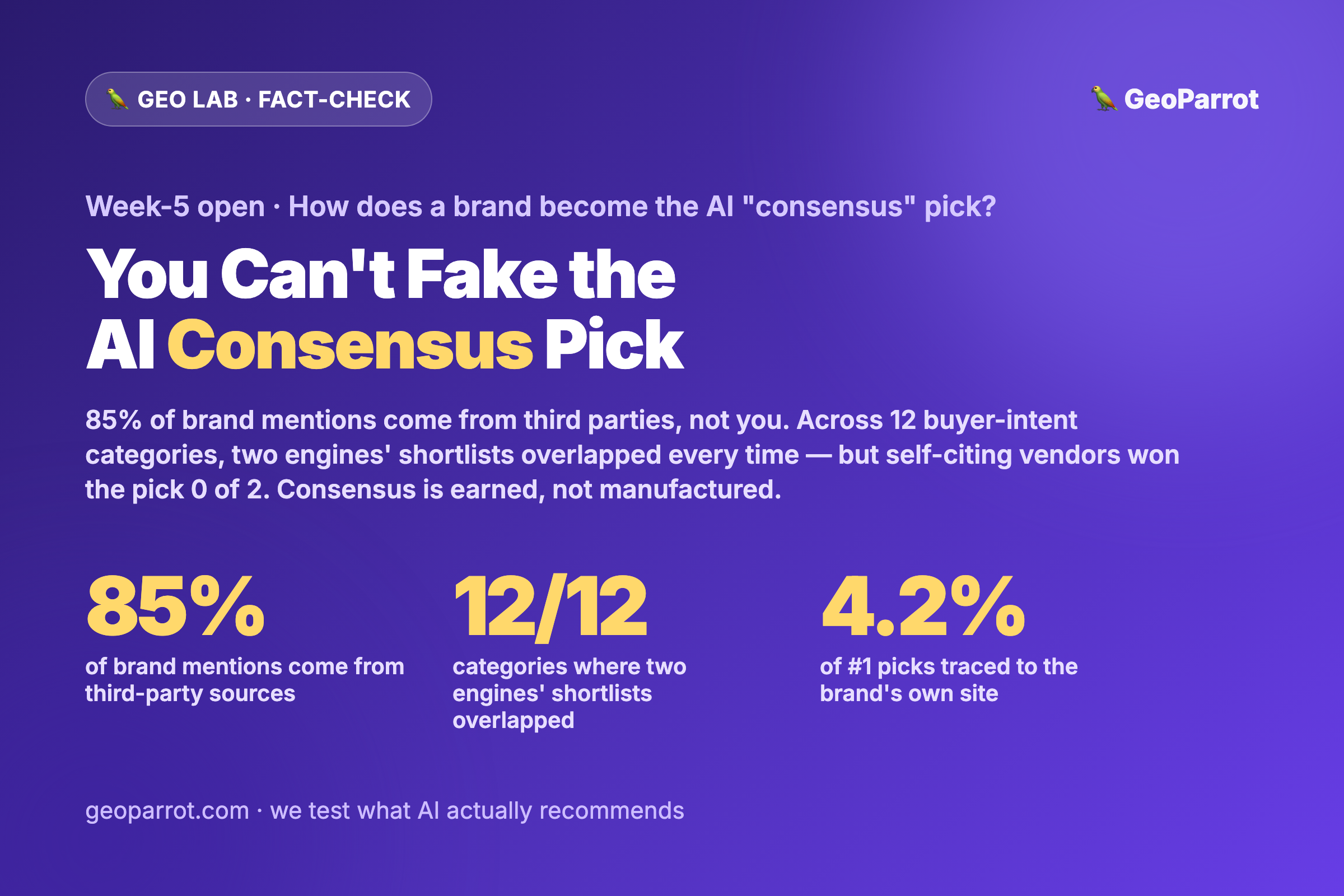
Quick answer: A brand becomes the AI “consensus” pick when independent third-party sources — reviews, best-of listicles, comparison media — repeatedly converge on it as a top option, and the engines treat that convergence as a verified fact. The 2026 advice gets the direction right: roughly 85% of brand mentions in AI answers come from off-site domains, not the brand’s own site, and review-rich brands get surfaced more (ChatGPT’s recommended companies averaged 4.3 stars). But our own first-party data adds the part the advice skips: the consensus is real and measurable — across 12 buyer-intent categories, two AI engines’ top recommendation sets overlapped 100% of the time and named the exact same #1 in 6 of 12 — and you can’t manufacture it yourself: self-citing vendors won the top pick 0 of 2 times. So consensus isn’t about raw mention volume you can pump out; it’s about independent sources agreeing on you. The open question — which reputation signals actually reverse-engineer to that status — is what we test all week.
This is Monday’s fact-check, and it opens this week’s GEO Lab question: how does a brand actually become the AI consensus pick, and can you reverse-engineer the reputation signals that get you there? Last week we proved you can’t self-rank your way into an AI recommendation. The obvious next question is the inverse — if crowning yourself doesn’t work, what does? This week we take the consensus pick apart signal by signal.
What does the “become the consensus pick” advice actually say?
The July 2026 GEO conversation has converged on a single prescription: stop optimizing your own pages and go earn off-site reputation. The supporting numbers are genuinely strong:
- Third-party mentions dominate. An analysis of 21,311 brand mentions across 500+ commercial-intent queries found ~85% came from external domains and only 13.2% from brand-owned sites — brands were 6.5× more likely to be mentioned through third parties than through their own domain. Nearly 90% of those third-party mentions were listicles, comparisons, or reviews.
- Reviews move the needle. Reputation-tracking studies report that AI engines lean on ratings when they choose whom to name: the average rating of companies recommended by ChatGPT was reported at 4.3 stars (Gemini 3.9, Perplexity 4.1), and Perplexity referenced reviews in a reported 100% of responses.
- Consensus across sources is the multiplier. When several credible, unrelated sources — a legacy media review, a niche YouTube test, an affiliate comparison — all reinforce the same claim, the model treats it as a verified fact and cites it with higher confidence. Brands with both mentions and citations were reported 40% more likely to resurface across consecutive queries than citation-only brands.
Distilled, the advice is: get mentioned everywhere independent, rack up reviews, and let the agreement between sources carry you. The direction is right. What the advice rarely does is prove the “consensus” is a real, stable thing you could aim at — or say which signals actually earn it. That’s the gap we can fill with first-party data.
Is there even a “consensus” pick to reverse-engineer? (Yes — and it’s remarkably stable.)
Before chasing reputation signals, the honest first question is whether AI engines even agree on a pick. If two engines named wildly different winners, “the consensus pick” would be marketing fiction. So we checked our own corpus. In our self-ranking experiment — 12 buyer-intent “best [category]” questions run across two engines (Gemini and Perplexity), every recommendation scored — the agreement was striking:
| What we measured (exp5, 12 categories × 2 engines) | Result |
|---|---|
| Categories where both engines’ top recommendation set overlapped | 12 of 12 (100%) |
| Categories where both engines named the exact same #1 | 6 of 12 (help desk, live chat, marketing automation, survey, accounting, VPN) |
| Same-#1 picks (identical across engines) | Zendesk, LiveChat, HubSpot, SurveyMonkey, QuickBooks, Mullvad |
| #1 recommendations that traced back to the brand’s own site | just 4.2% (1 of 24) |
Read the top row again: in every single category, the two engines’ shortlists overlapped, and in half of them they crowned the identical brand. That’s not noise — that’s a consensus. And it holds up against a finding that, on the surface, looks contradictory: we’ve also shown that engines cite almost entirely different source URLs (just 0.5% overlap across four engines). So the engines read different pages — yet arrive at the same recommendation. Divergent sources, convergent conclusion. The only thing that explains it is a reputation signal that lives outside any single page: a category-wide agreement the engines each rediscover independently. That agreement is exactly what we mean by the consensus pick — and it’s real enough to reverse-engineer.
So is it just mention volume and review counts? (No — you can’t self-manufacture it.)
Here’s where the popular advice needs a correction. “Get mentioned everywhere” quietly implies you can produce the consensus by generating enough of your own signals — publish your own best-of list, seed your own mentions, self-rank. Our data is blunt that this fails. In the same experiment, when a vendor cited itself as the answer, it won the top recommendation 0 of 2 times: Salesforce got cited for its own CRM roundup but the engine recommended Pipedrive; Wrike got cited for its own project-management list but the engine picked ClickUp. And only 4.2% of #1 picks across all 24 answers traced back to the recommended brand’s own domain — meaning ~96% of the time, the consensus pick was crowned by someone other than the brand itself.
That reframes the whole “become the consensus pick” project. It isn’t a volume game you win by out-publishing rivals with your own content — that’s the self-ranking trap we verified last week. Consensus is a convergence game: it’s earned when enough independent parties — the ones the engines actually trust — land on you without being told to. The reputation signal that counts is third-party agreement, not first-party frequency. Which raises the operational question we can’t answer from this corpus alone…
Which reputation signals actually reverse-engineer to consensus status?
We know the consensus exists (12/12 overlap) and that you can’t fake it (4.2% self-cited). What we don’t yet know is which measurable signals the consensus picks share — and that’s the thread we pull all week. The candidate signals, drawn from both the industry data and our own:
- Third-party best-of appearances. Do the consensus picks (Zendesk, HubSpot, QuickBooks…) simply appear on more independent listicles than the challengers — and is there a rough threshold count where a brand tips into “always named”? The domains engines actually choose are TechRadar/PCMag-class roundups, so appearance count there is measurable.
- Review recency and density. If review-rich brands average 4.3 stars in recommendations, is it the raw rating, the volume, or the recency that separates a consensus pick from a runner-up with similar quality?
- Challenger break-in speed. The most useful question for anyone who isn’t already the incumbent: can a challenger enter the consensus set within a quarter by earning the right third-party signals — or is the consensus a slow-moving reputation moat that punishes newcomers regardless of tactics?
Those are the hypotheses we’ll pre-register on Tuesday, test against a fresh corpus midweek, and rule on Friday. The stakes are practical: if consensus is reverse-engineerable, GEO becomes a checklist of earnable signals. If it’s a slow reputation moat, the honest advice for a newcomer is patience plus the handful of levers that actually compress the timeline. Either way, “just get mentioned more” is too blunt — and by Friday we’ll know which signals are worth your budget.
FAQ
What is the “consensus pick” in AI search?
It’s the brand that multiple AI engines independently converge on as a top recommendation for a category. In our data, two engines’ recommendation sets overlapped in all 12 buyer-intent categories tested, and they named the identical #1 in 6 of them — evidence that a stable, cross-engine consensus really exists rather than each engine picking at random.
Do third-party mentions really matter more than my own website?
By the numbers, yes. An analysis of 21,311 brand mentions found ~85% came from external domains versus 13.2% from brand-owned sites, and brands were 6.5× more likely to be mentioned through third parties. In our own data, only 4.2% of #1 recommendations traced back to the brand’s own domain — the pick is almost always crowned by someone else.
Can I manufacture the consensus by publishing my own best-of listicle?
No. When vendors cited their own listicle in our experiment, they won the top recommendation 0 of 2 times — the engine pulled a competitor from their own list instead. Consensus comes from independent sources agreeing on you, which is why self-ranking earns a citation but not the recommendation. We verified this in last week’s verdict.
Do reviews affect whether AI recommends my brand?
Reputation-tracking studies suggest they do: the average rating of companies recommended by ChatGPT was reported at 4.3 stars, and some engines reference reviews in most or all responses. But rating alone doesn’t explain who becomes the consensus pick — recency, volume, and third-party agreement likely matter more, which is what we’re testing this week.
Can a newcomer break into the consensus set?
That’s the open question we’re spending the week on. The consensus picks in our data are established category leaders, which hints at a reputation moat — but whether a challenger can earn its way in within a quarter by accumulating the right third-party signals is exactly what Friday’s verdict will address.
Sources
- AirOps — The Influence of Off-Site Signals in AI Search (21,311 brand mentions, 500+ commercial queries; the 85% / 6.5× / ~90%-listicle figures)
- Trustmary — The Impact of Reviews on AI Search (2026) (the 4.3-star ChatGPT recommendation average and review-reference rates)
- GEO Lab — Can You Self-Rank Your Way Into an AI Recommendation? What 24 Answers Show (this post’s first-party consensus and self-citing data)
- GEO Lab — You Can’t Self-Rank Into an AI Recommendation — The Verdict (the self-manufacture failure, per-engine playbook)
- GEO Lab — AI Engines Cite Different Sources — But Do They Agree? (the 0.5% source overlap that makes convergent recommendations so striking)
- GEO Lab — Do 15 Domains Control 68% of AI Citations? Our Data Says 23% (the third-party best-of domains engines actually choose)
- GEO Lab — Does AI Search Use Backlinks? What Actually Drives Citations (Google’s guidance on earned vs. manufactured signals)
Leave a Reply