Quick answer: Generative Engine Optimization (GEO) is the practice of structuring your content so that AI search engines — ChatGPT, Perplexity, Gemini, Copilot, and Google’s AI Overviews — quote and cite it in their generated answers. Unlike SEO, which competes for a link in a list, GEO aims to make your page the source the AI repeats.
What is Generative Engine Optimization (GEO)?
GEO is the discipline of making your content easy for large language models to retrieve, trust, and cite. When an AI answer names a source, that brand wins the visibility — and the click that’s left. GEO optimizes for being that named source, not for a blue-link ranking.
Why does GEO matter right now?
AI search increasingly answers questions directly, so fewer users scroll a list of ten links. If your brand isn’t inside the generated answer, you’re invisible to a fast-growing share of search demand. Brands that adapt early compound an authority advantage as this behavior becomes the default.
GEO vs. AEO vs. SEO: what’s the difference?
| Approach | Goal | Wins when… |
|---|---|---|
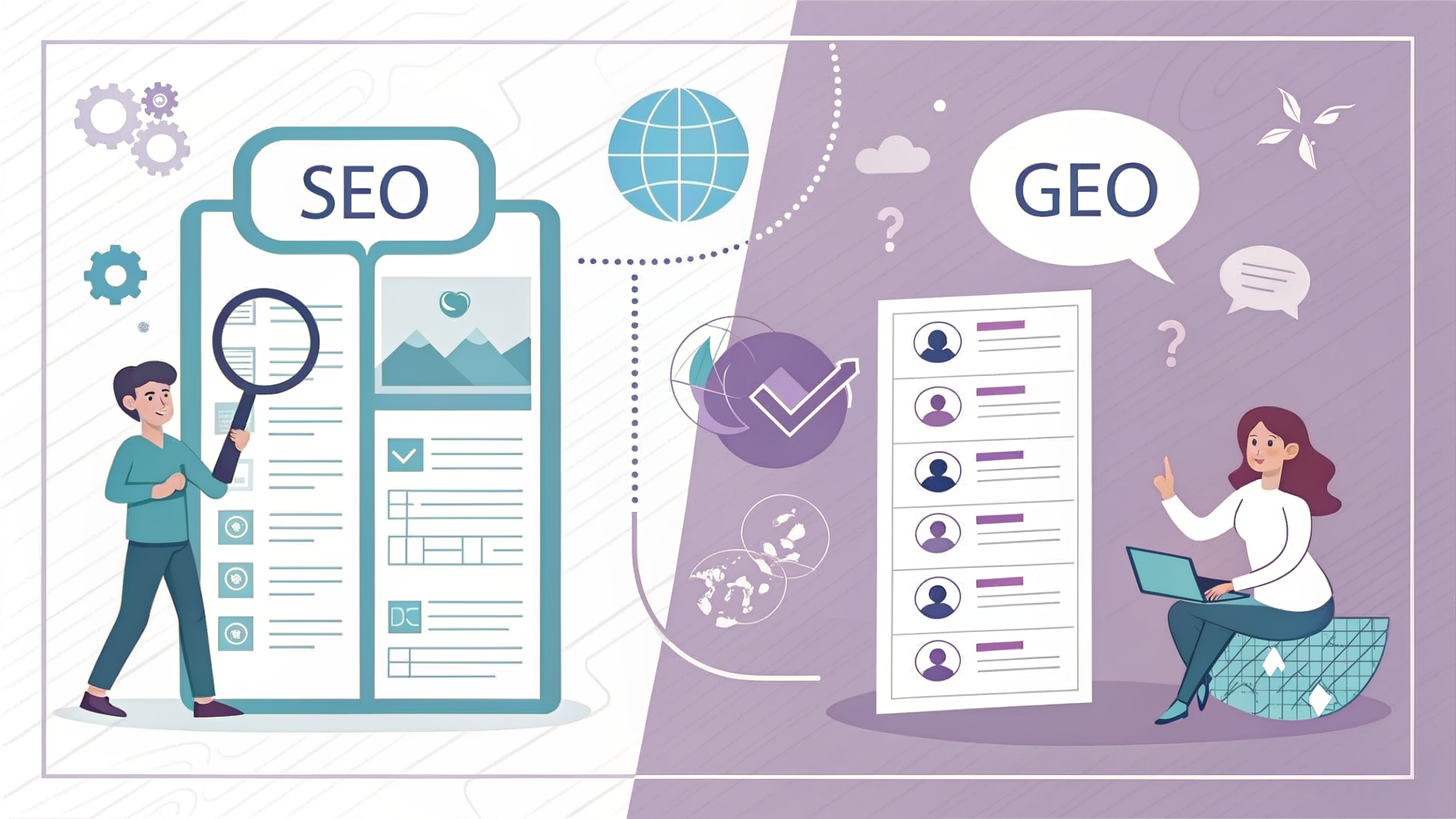
| SEO | Rank a page in a list of results | Users click through a results page |
| AEO | Become the direct answer (snippets, voice, “People also ask”) | One concise answer is surfaced |
| GEO | Get cited inside a generated AI answer | An LLM synthesizes and attributes sources |
They overlap — strong SEO foundations still help — but GEO rewards a different content shape: clear, self-contained, citation-worthy passages a model can lift and attribute with confidence.
How do AI engines decide what to cite?
No engine publishes its exact recipe, but consistent patterns appear across retrieval-augmented systems. AI answers tend to favor sources that are:
- Structurally clean — clear headings, short answer-first paragraphs, and lists are easy to chunk and retrieve.
- Self-contained — a passage that answers the question without the rest of the page is far more “liftable.”
- Specific and verifiable — concrete numbers, dates, definitions, and named entities signal reliability.
- Authoritative — first-hand experience, clear authorship, and external references build trust.
- Fresh — recently updated content wins in fast-moving topics.
What should you do right now? (The 2026 GEO playbook)
- Write answer-first. Lead each section with a one- or two-sentence answer, then expand.
- Add structured data (schema). Mark up articles, FAQs, and your organization so machines know what your content means.
- Strengthen entity clarity. Name products, people, and concepts explicitly and consistently.
- Earn citations with original substance. Proprietary data and first-hand testing get quoted because they can’t be found everywhere else.
- Keep it current. Show “last updated” dates and refresh cornerstone pages on a schedule.
Frequently asked questions
Is GEO different from SEO?
Yes. SEO optimizes to rank a page in a list; GEO optimizes to be cited inside an AI-generated answer. They share fundamentals (clarity, authority, structure) but GEO rewards self-contained, citation-ready passages.
Which AI engines does GEO target?
ChatGPT, Perplexity, Google AI Overviews, Gemini, Microsoft Copilot, and Claude — any system that generates an answer and may attribute sources.
How do I know if my content is “GEO-ready”?
Check that each section opens with a direct answer, headings are question-shaped, Article and FAQ schema are present, key facts are specific, authorship is clear, and the page was updated recently.
The bottom line
GEO isn’t a trick — it’s writing so clearly and credibly that a machine is comfortable putting your name next to its answer. Get the structure, specificity, and authority right, and you stop competing for a link; you become the answer.
Further reading
- Google Search Central — guidance on AI features and helpful, people-first content.
- Schema.org — Article and FAQPage structured data references.
- OpenAI & Perplexity documentation on how their answer engines surface and cite sources.