
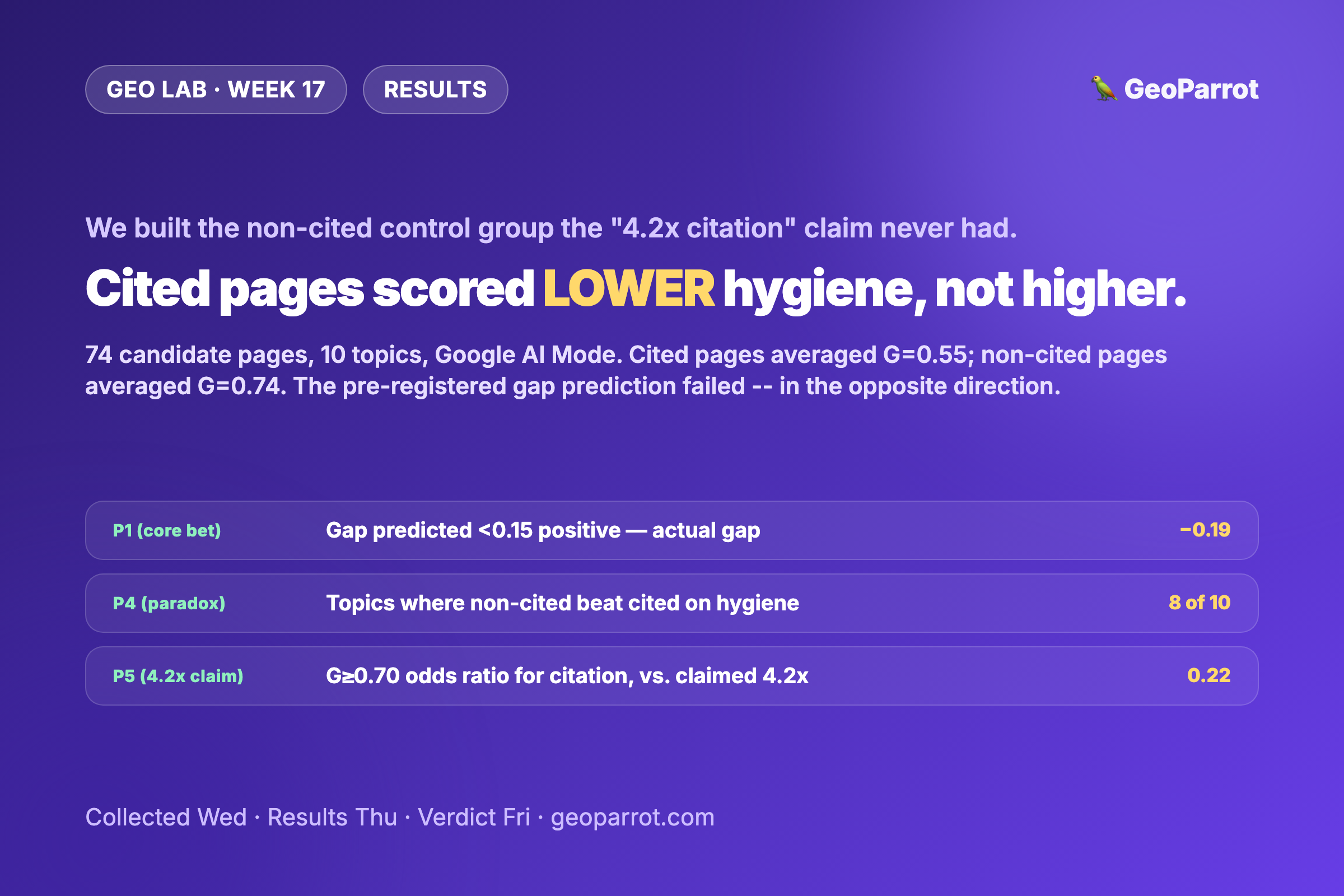
Quick answer: Our load-bearing prediction (P1) failed, and not by being merely wrong about size — it was wrong about direction. We predicted cited pages would score modestly higher hygiene than non-cited pages (gap under 0.15). Instead, across 74 pages in a Google AI Mode candidate pool (10 topics), cited pages averaged G=0.55 and non-cited pages averaged G=0.74 — a −0.19 gap, the wrong sign entirely. Pages scoring G≥0.70 (the threshold Monday’s “4.2x” claim used) were cited less often than low-scoring pages, not more: odds ratio 0.22, versus the claimed 4.2. The paradox (non-cited beats cited) showed up in 8 of 10 topics, more than our pre-registered floor of 6. Part of the gap is a measurement artifact — Reddit accounts for a fifth of all citations and scores G=0 under static HTML fetch — but even stripping Reddit out, the gap stays negative (−0.08). ChatGPT’s arm broke differently and is reported separately below. This is the results post for Tuesday’s pre-registered design; nothing below was reframed after the numbers came in.
Experiment results — published October 15, 2026, in the GEO Lab. We locked the candidate-pool design, the 8-pillar checklist, and five falsifiable predictions on Tuesday, collected citations Wednesday, scored every page Thursday morning, and wrote this post from the numbers.
What did we actually measure?
Monday’s post found the hole: a widely-cited “GEO quality score ≥0.70 → 4.2x citation odds” statistic came from a study that audited only already-cited pages — it never built a non-cited control group, so it couldn’t actually test whether quality predicts citation. We built that control group ourselves. For 10 topics (6 product-comparison, 4 informational), we pulled each query’s Google top-10 organic results as the candidate pool — every page that was available to be cited, whether or not it was. Then we ran the same 10 queries on Google AI Mode and captured which of those pool URLs it actually cited.
Every one of the 74 distinct candidate pages (reachable URLs across the 10 pools) was scored on our 8-pillar hygiene checklist, normalized to a single G score from 0 to 1: visible publish date, named author/byline, JSON-LD structured data, FAQ markup or FAQ-shaped headings, a direct answer within the first paragraph, 2+ concrete data points (numbers, %, $), a table or list, and 3+ subheadings. This is a deliberately simpler proxy than GEO-16’s full 16-pillar framework — we say so, because the point isn’t replicating their exact rubric, it’s testing whether any reasonable hygiene/structure signal separates cited from non-cited pages.
Did cited pages score higher hygiene, like we predicted? (P1)
No — and not by a little. We predicted a small, positive gap (cited G minus non-cited G, under 0.15). The actual gap is negative: cited pages averaged G=0.55, non-cited pages averaged G=0.74, a gap of −0.19. If hygiene drove citation the way Monday’s claim implied, this bar chart should tilt the other way.
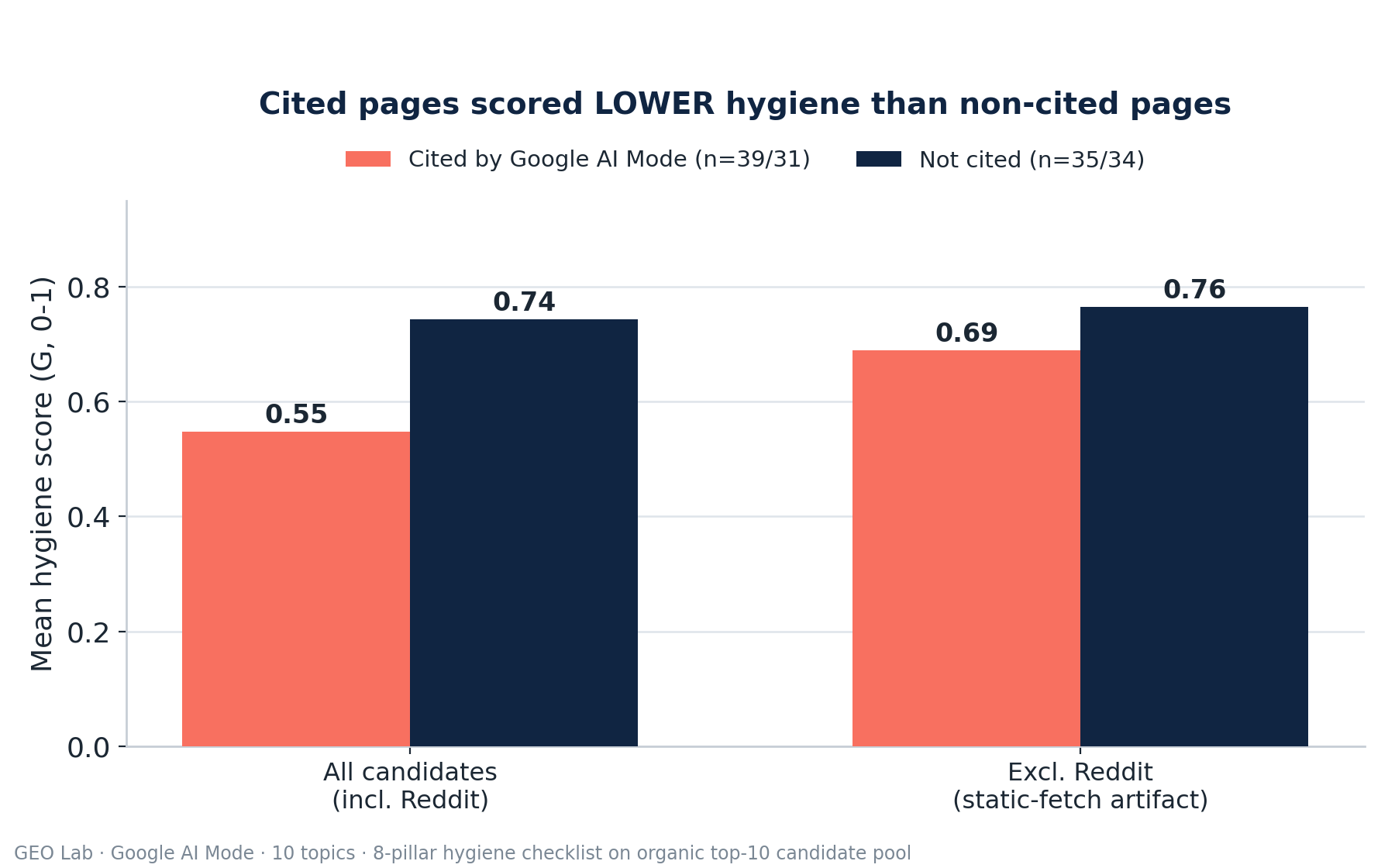
One real confound narrows this, and we want to own it rather than bury it: Reddit accounts for 8 of the 39 citations (21%) across our 10 topics — consistent with our earlier finding that Reddit dominates AI citations across engines. Our scorer fetches pages with a plain HTTP request, and Reddit’s pages render almost entirely client-side — so every Reddit URL in our pool scores G=0.00, not because Reddit threads genuinely lack a byline or a data point, but because our static fetch can’t see past the loading shell. Strip Reddit out of both groups and the gap narrows from −0.19 to −0.08 — still the wrong sign for the “hygiene predicts citation” story, just a smaller wrong.
Was the paradox a fluke in one or two topics, or everywhere? (P4)
Everywhere, essentially. We pre-registered a prediction that 6 or more of the 10 topics would show non-cited pages out-scoring cited pages on hygiene — our hedge against P1 being driven by one outlier category. The actual count: 8 of 10.
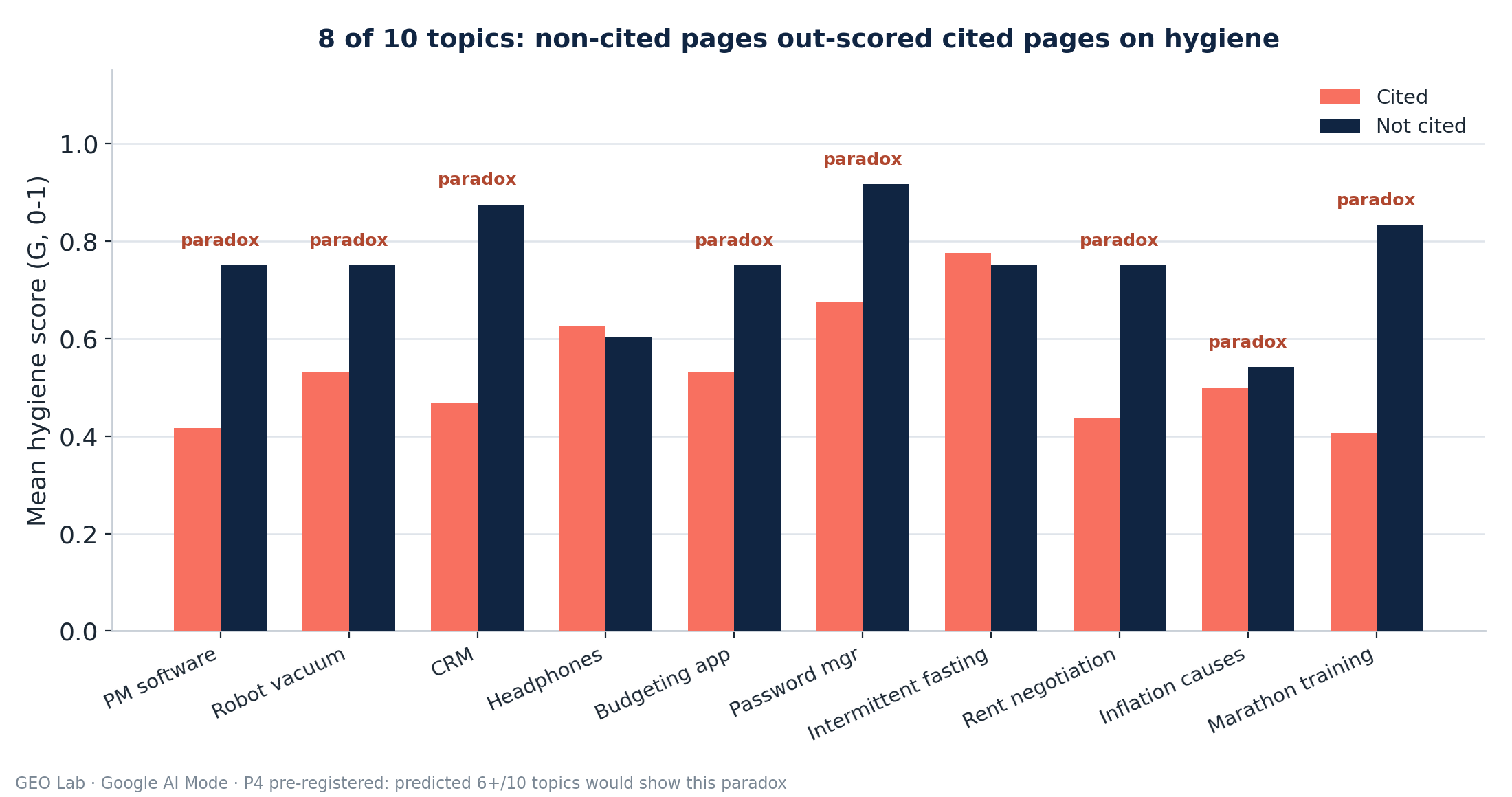
The two exceptions — headphones and intermittent fasting — aren’t close wins for the “hygiene matters” story either; both gaps are under 0.03, functionally a tie. Read plainly: in 8 of 10 buyer-and-informational intents we tested, picking the higher-hygiene page from the candidate pool would have been the wrong bet for predicting AI citation.
Did the 4.2x citation-odds claim survive at all? (P5)
No, and this is the sharpest result. We pre-registered that G≥0.70 pages would show an odds ratio well under 2x for citation (nowhere near Monday’s reported 4.2x). The actual odds ratio is 0.22 — inverted. High-hygiene pages were cited less often, not more.
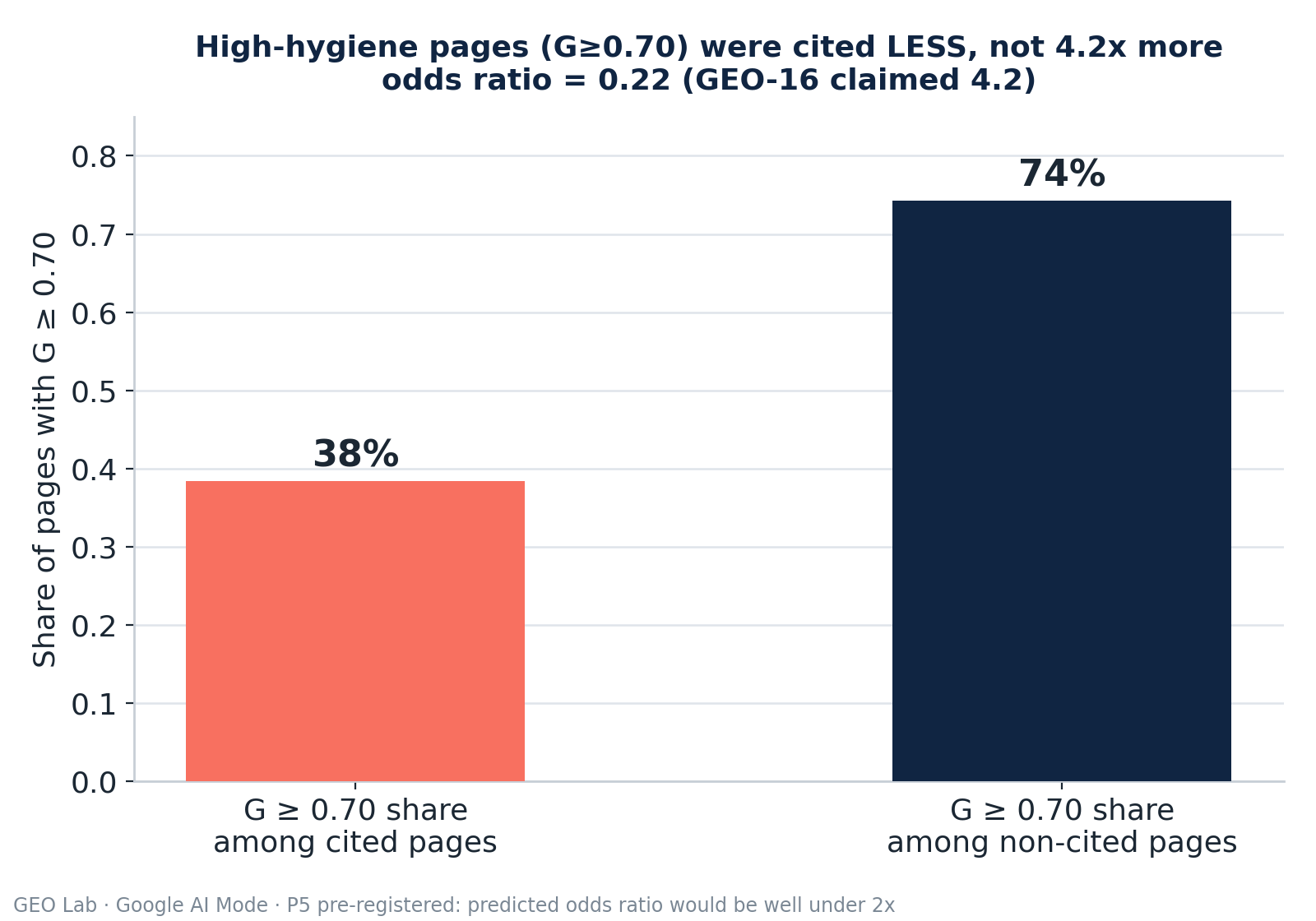
To be exact about what this does and doesn’t say: we are not claiming GEO-16’s original 1,100-URL audit was wrong on its own narrower terms (cross-engine vs. single-engine citations within already-cited pages). We’re reporting that when you ask the actual question people hear in “quality score predicts citation” — does scoring well on structure/hygiene make a page more likely to be cited at all, compared to pages that weren’t — our data says the opposite.
Does authority explain the inversion instead? (P2)
Partly, and only partly. We pre-registered that a simple authority-tier flag (a fixed list of ~19 major media/.gov/.edu/reference domains) would be a stronger predictor than G, and that controlling for tier would cut the P1 gap by half or more. Tier membership is indeed higher among cited pages (36% of citations were tier domains, vs. 20% of non-citations) — authority clearly pulls weight. And controlling for it does shrink the gap, from −0.19 to −0.12 among non-tier pages only — about a 40% reduction, close to our “cut in half” bar but not quite there.
What we didn’t predict: within the authority-tier subset alone, the gap doesn’t close — it widens, to −0.27. Big, trusted domains (think: brand homepages, major outlets) get cited by Google AI Mode even when they score worse than other tier pages on our structure checklist. Authority is a real factor, but it isn’t simply standing in for “the hygiene checklist was measuring the wrong thing” — trusted domains appear to earn citation on trust itself, structure checklist be damned.
What happened to the ChatGPT arm? (P3)
Full transparency, because this is the part of the design that broke hardest. We planned to test GEO-16’s narrower surviving claim — that cross-engine citations (cited by both ChatGPT and Google AI Mode) score higher hygiene than single-engine citations — using domain overlap between our two engines.
We couldn’t. ChatGPT’s current web-search UI exposes citation links two different ways depending on query type, and neither gave us clean, comparable data:
- Product-comparison queries (6 of 10 topics) rendered shopping-style cards with explicit “Official website” links — but for 4 of those 6, the raw link-crawl also picked up sponsored “Learn more” placements (ChatGPT’s ad rollout: Criteo redirects, utm_source=openai click-throughs) mixed into the same DOM elements as real citations. We filtered those out by URL pattern, which left usable data for only 4 of 10 topics.
- Informational queries (the other 4 topics, plus 2 of the product ones) rendered plain prose with zero crawlable citation links — no
<cite>elements, no footnote markers with real hrefs, nothing our DOM crawl could match to the organic candidate pool. The answers were real and substantive; the sourcing, if any existed, wasn’t exposed as a scrapable link.
And even where ChatGPT citations were clean, most pointed at brand homepages (asana.com, clickup.com, 1password.com) that don’t rank in the Google organic top-10 for “best X” queries — third-party listicles crowd brand sites out of organic results, so our candidate-pool design structurally excludes most of what ChatGPT cites for shopping queries. The result: only 3 domains overlapped between engines across usable topics — far too few to test cross-engine vs. single-engine hygiene with any confidence. P3 is untested, not failed; we’re reporting the breakage rather than forcing a number out of 3 data points.
So what actually predicts citation, if not hygiene?
Three reads, held to what one engine’s snapshot can support:
- Trust and reach beat on-page structure. Reddit (21% of citations) and authority-tier domains (36% of citations) together account for well over half of what Google AI Mode cited — and both groups score worse, not better, on our hygiene checklist than the non-cited pages they beat out. If you’re optimizing a page’s structure hoping it tips a citation decision, this data says that lever is weaker than where the page already lives.
- Our checklist may be measuring the wrong unit. An 8-pillar page-level score can’t capture “a forum thread full of real buyer opinions” or “a homepage a billion people already trust” — it was built for editorial content, and editorial content is exactly what’s losing this comparison.
- The GEO-16 methodology gap from Monday is confirmed, not just theorized. We built the missing non-cited control group it never had, and with it in place, the clean “quality score predicts citation” story doesn’t survive contact with data — at least not on this engine, this week.
The honest limits
- One engine with clean data. Google AI Mode only. ChatGPT’s citation UI did not expose comparable data this week (see above) — this is not evidence either way for ChatGPT.
- A simplified checklist. Our 8 pillars approximate, not replicate, GEO-16’s 16-pillar framework. A different checklist could shift individual pillar rates, though the overall direction (cited pages are not structurally “cleaner”) is consistent across every pillar except early-answer.
- Static-fetch bias. JS-heavy pages (Reddit, some app sites) score artificially low because our scorer doesn’t render client-side content. We quantified this (Reddit) rather than hiding it, but other JS-heavy candidates may be under-scored too.
- Candidate pool = organic top-10 only. Pages that rank well in AI citations but poorly (or not at all) in classic organic search — like brand homepages for comparison queries — are systematically under-represented in our pool. This is the same limitation that broke the ChatGPT arm.
- Small per-topic samples. 3–17 candidate pages per topic; individual topic results (the per-topic chart) should be read as direction, not precision.
None of these limits soften the headline: on the one engine we could cleanly measure, a structured hygiene score didn’t just fail to predict citation with the claimed strength — it pointed the opposite direction. Tomorrow’s verdict post scores all five predictions against the locked thresholds, closes the loop Week 16 opened, and sets up next week’s question.
Frequently asked questions
Does a higher GEO quality/hygiene score make a page more likely to be cited by AI?
In our data, no. Across 74 candidate pages for 10 queries on Google AI Mode, cited pages averaged a hygiene score of 0.55 versus 0.74 for non-cited pages in the same pool — the opposite of what a “quality predicts citation” claim would predict. Pages clearing the 0.70 threshold were cited less often, not more (odds ratio 0.22).
What is the “8-pillar hygiene checklist”?
A simplified structural score (0–1) we built to approximate industry GEO quality frameworks: visible publish date, named author, JSON-LD structured data, FAQ markup, a direct answer in the opening paragraph, 2+ data points, a table or list, and 3+ subheadings. It is not a replica of any single vendor’s full framework.
Why did Reddit score 0 on hygiene despite being cited often?
Our scorer fetches pages with a plain HTTP request and can’t render Reddit’s client-side JavaScript shell, so every Reddit URL scores G=0 regardless of thread quality. Reddit accounted for 21% of all citations in our dataset. Excluding Reddit narrows the cited-vs-non-cited gap from −0.19 to −0.08, but doesn’t reverse it.
Why wasn’t ChatGPT included in the main results?
ChatGPT’s current web-search UI exposed real citation links for only 4 of 10 topics (product-comparison queries), mixed in with sponsored ad click-throughs we had to filter out. Informational queries returned zero crawlable citation links. The resulting 3-domain cross-engine overlap was too small to test reliably, so that prediction (P3) is reported as untested rather than forced.
If not hygiene, what does predict AI citation?
In this dataset, domain trust and reach (Reddit threads, major authority-tier brands) explained more of the citation pattern than on-page structural hygiene did. Authority-tier domains made up 36% of citations versus 20% of non-citations, even though those same domains didn’t consistently score higher on the hygiene checklist.
Leave a Reply