
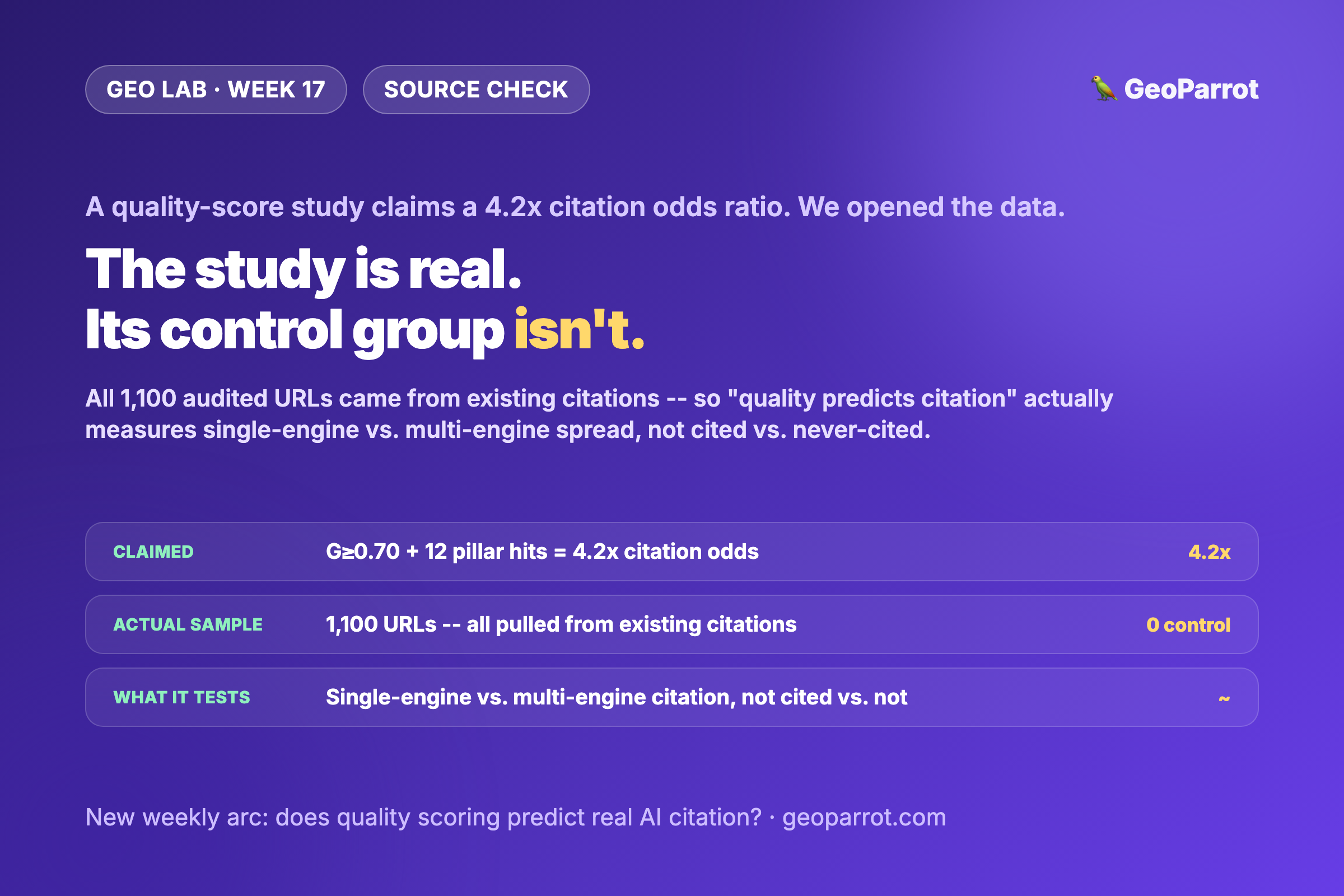
Quick answer: A September 2025 academic framework called GEO-16 scores web pages on 16 on-page “quality pillars” into a normalized score G (0 to 1), and reports that pages hitting G≥0.70 with 12+ pillar hits reach a 78% “cross-engine citation rate,” with an overall odds ratio of 4.2 (95% CI 3.1–5.7) for quality predicting citation. GEO statistics round-ups are now repeating the 4.2x figure as evidence that a high quality score gets you cited by AI. We opened the paper directly. All 1,100 URLs it audited came from citations the study already collected — there is no disclosed set of non-cited candidate pages to compare against. The paper’s own text never defines “cross-engine” as anything other than cited-by-multiple-engines versus cited-by-one, among pages that were already cited. That’s a real, disclosed, reasonably rigorous finding — it just isn’t the claim being marketed on top of it.
Published October 12, 2026, in the GEO Lab. This opens a new weekly arc. Last week we audited 8 industry citation stats on whether they survive a source check (3 kinds of GEO Lab, R/M/S scoring) and found reachability was a weak filter — almost every claim had a named document somewhere if we dug enough. What actually separated the clean claims from the messy ones was methodology disclosure and stability under re-citation. This week flips the lens: instead of auditing whether stats about GEO survive a source check, we’re testing whether quality/hygiene scores themselves — ours and the industry’s — actually predict what AI engines cite, closing the loop Friday’s verdict left open.
What is the “4.2x more AI citations” claim, and where does it come from?
Searching for current GEO citation-prediction claims turned up a specific number repeating across statistics round-ups: pages with a “GEO quality score” above a threshold get cited roughly 4x more often. Tracing it back, the number resolves to one paper — “AI Answer Engine Citation Behavior: An Empirical Analysis of the GEO16 Framework” by Arlen Kumar and Leanid Palkhouski, submitted to arXiv on September 13, 2025. The paper introduces GEO-16: sixteen on-page quality pillars (things like Metadata & Freshness, Semantic HTML, Structured Data), each scored in bands, summed and normalized into a single score G from 0 to 1. The abstract states the finding plainly: “simple operating points (for example, G at least 0.70 combined with at least 12 pillar hits) align with substantially higher citation rates in our data.” The body reports the specific number — “pages with G≥0.70 and ≥12 pillar hits achieve a 78% cross-engine citation rate” — and a logistic-regression odds ratio of 4.2 (95% CI 3.1–5.7) for quality as a predictor of citation. That’s the chain: one disclosed academic study, with a real sample and real statistics, now being repeated by vendor content as “score 0.70+ and get cited 4.2x more.”
On a Reachable / Methodology-disclosed / Stable check, does this claim pass?
Running the same three-criteria method from last week’s pre-registered audit against this one claim, before getting into the deeper issue below:
| Criterion | Score | Why |
|---|---|---|
| R — Reachable | 1 | A single named document exists and opens: arXiv 2509.10762, with two named authors, full methods and results sections. |
| M — Methodology disclosed | 1 | Sample size and method are stated explicitly: 70 product-intent prompts, 3 engines (Brave Summary, Google AI Overviews, Perplexity), 1,702 citations collected, 1,100 unique URLs audited, logistic models with domain-clustered standard errors. |
| S — Stable under re-citation | 1 | The 4.2 figure and the G≥0.70/12-pillar threshold both appear consistently across the round-ups repeating this paper — no drift found in this case. |
That’s the uncomfortable part. On every check that caught last week’s problem claims — does a real document exist, does it disclose its basis, does the number hold up under re-citation — this one passes cleanly. The study is real, the authors are named, the numbers are stated with confidence intervals, and nobody’s garbling them on the way to a round-up post. R/M/S alone would wave this claim through. It’s only once you read what the study actually measured, not just whether it discloses that it measured something, that the gap shows up.
So what’s actually wrong with the 4.2x claim?
The paper’s sample is 1,100 URLs that the authors audited. Where did those 1,100 URLs come from? From the 1,702 citations the three engines produced across 70 prompts — meaning every single audited URL got into the dataset because an engine had already cited it at least once. There is no disclosed sample of candidate pages that were eligible to be cited for those same 70 prompts but weren’t. Without that non-cited comparison group, you can measure how quality varies among already-cited pages, but you cannot measure whether quality predicts getting cited over a page that wasn’t. Those are different claims, and the paper’s own number confirms which one it’s actually testing: it reports “cross-engine citations (134 URLs) exhibit 71% higher quality scores than single-engine citations” — the comparison running throughout is single-engine-citation versus multi-engine-citation, not cited versus not-cited.
Put plainly: the defensible finding is “among pages an AI engine already cited, higher-quality pages are more likely to also get picked up by a second or third engine.” The marketed version — “score 0.70+ and your odds of being cited by AI go up 4.2x” — implies a comparison against pages that never got cited at all, which this dataset doesn’t contain. The 4.2 odds ratio itself has a second ambiguity sitting right next to the first: the paper’s text doesn’t specify whether that ratio applies to the continuous G score (per unit, or per standard deviation) or specifically to the dichotomized G≥0.70-and-12-pillars threshold reported two sentences earlier as the “78% cross-engine citation rate.” Those could be the same number stated two ways, or two different statistics that got collapsed into one headline figure on the way out. The paper doesn’t say which, and neither do the round-ups repeating it.
Is this the same problem as last week’s citation-chain audit, or a different one?
Different, and that’s the point of opening this week with it. Last week’s eight claims mostly failed on whether the underlying document existed and disclosed itself at all — aggregator round-ups citing “a study” with no name attached, or a number that drifted between re-citations. This claim fails on none of that. The GEO-16 paper is exactly the kind of source last week’s audit was designed to reward: named authors, disclosed sample, stated confidence intervals, consistent restatement. The failure here is one level up — a well-disclosed study’s own research design can’t support the outcome variable the marketing layer assigns to it. Selection on an outcome (auditing only pages that were already cited, then treating within-sample variation as if it predicted the sample boundary itself) is a textbook methodology gap, and it’s invisible to a checklist that only asks “does a document exist and say what it did.” R/M/S catches citation laundering. It doesn’t catch a transparent study being asked to answer a question its own design can’t reach.
That gap sets up this week’s arc. Friday’s verdict left a specific loop open: does a citation-hygiene or quality score we assign to content actually predict what AI engines go on to cite, or does it only describe what already-cited content tends to look like after the fact — the exact distinction the GEO-16 paper blurs? Tuesday we pre-register a small test built with the control group this paper is missing: a matched set of content variants, some meeting a quality/hygiene threshold and some not, sent through the same prompts to real AI engines, scored on whether each one gets cited at all — not just whether a cited page also gets picked up twice.
What should you do with the GEO-16 study right now?
Treat the pillar list as a reasonable quality checklist — Metadata & Freshness, Semantic HTML, and Structured Data showing the strongest associations with citation is a sensible, checkable finding, and lines up with other disclosed research. Don’t treat “4.2x” as a prediction of your odds of getting cited versus a competitor who never gets cited, because the dataset behind it can’t test that. The practical checklist, by context:
- Reading a vendor round-up citing a “Xx more citations” number: check whether the underlying study’s sample is drawn from already-cited pages only (selection on the outcome) before treating the multiplier as a citation-odds prediction.
- Reading an academic paper directly: look specifically for a disclosed non-cited control or comparison group — its absence doesn’t make the study worthless, but it caps what the headline statistic can mean.
- Using a quality score (GEO-16, our own R/M/S, or any other) to prioritize work: treat it as a checklist for content hygiene, not a verified citation-probability model, until it’s been tested against a sample that includes content that didn’t get cited.
Frequently asked questions
What is the GEO-16 framework?
A 16-pillar auditing framework from an arXiv paper (Kumar & Palkhouski, submitted September 2025) that scores on-page quality signals into a normalized score G from 0 to 1, built from 70 product-intent prompts across three AI answer engines (Brave Summary, Google AI Overviews, Perplexity), 1,702 citations, and 1,100 audited URLs.
Does scoring 0.70+ on GEO-16 actually get a page cited 4.2x more often?
Not provably, based on the paper’s own disclosed design. All 1,100 audited URLs came from existing citations, with no non-cited control group, so the 4.2 odds ratio and the 78% “cross-engine citation rate” measure quality differences among already-cited pages — specifically, single-engine versus multi-engine citation — not quality’s effect on getting cited over a page that wasn’t.
Why did this claim pass a Reachable / Methodology-disclosed / Stable check if there’s a real problem with it?
Because R/M/S checks whether a claim’s source exists, discloses its basis, and holds up under re-citation — all true here. It doesn’t check whether the study’s own sampling design can support the outcome being marketed on top of it. That’s a different, higher-order failure than last week’s audit was built to catch.
What’s this week’s GEO Lab arc testing?
Whether a citation-hygiene or content-quality score — ours or the industry’s — actually predicts what AI engines cite, using a design that includes a genuine non-cited control group. Tuesday locks the method and predictions; Wednesday collects; Thursday publishes results; Friday delivers the verdict.
Is the GEO-16 pillar list still useful?
As a content-hygiene checklist, yes — Metadata & Freshness, Semantic HTML, and Structured Data showing the strongest associations with citation is a reasonable, checkable signal. As a verified prediction of citation odds against non-cited competitors, no — the underlying data doesn’t contain that comparison.
Sources
- AI Answer Engine Citation Behavior: An Empirical Analysis of the GEO16 Framework — Kumar & Palkhouski, arXiv, submitted September 13, 2025. The primary source for the 4.2 odds ratio and 78% cross-engine citation rate figures.
- The Verdict: GEO’s Citation Chain Breaks — Just Not Where We Bet It Would — last week’s closing judgment, and the source of the three-criteria (R/M/S) method applied above.
- Pre-registering a citation-hygiene scoring method — the original method definition this post reuses.
- 8 GEO citation stats, scored — last week’s full score sheet.
- Do GEO citation stats survive a source check? — the arc opener this format is modeled on.
- Counted vs. inferred GEO metrics — the broader distinction between numbers someone actually counted and numbers inferred from a biased sample, directly relevant to GEO-16’s missing control group.
- Query phrasing citation experiment results — an earlier GEO Lab test built with the same pre-registration discipline this week’s arc reuses.
GeoParrot is a GEO Lab: we test what AI search actually cites and recommends, then publish the method and the misses — including our own. This opens a new weekly arc. Tuesday we pre-register a controlled test of whether quality/hygiene scoring predicts real AI citation, with the non-cited control group this week’s source claim is missing.
Leave a Reply