
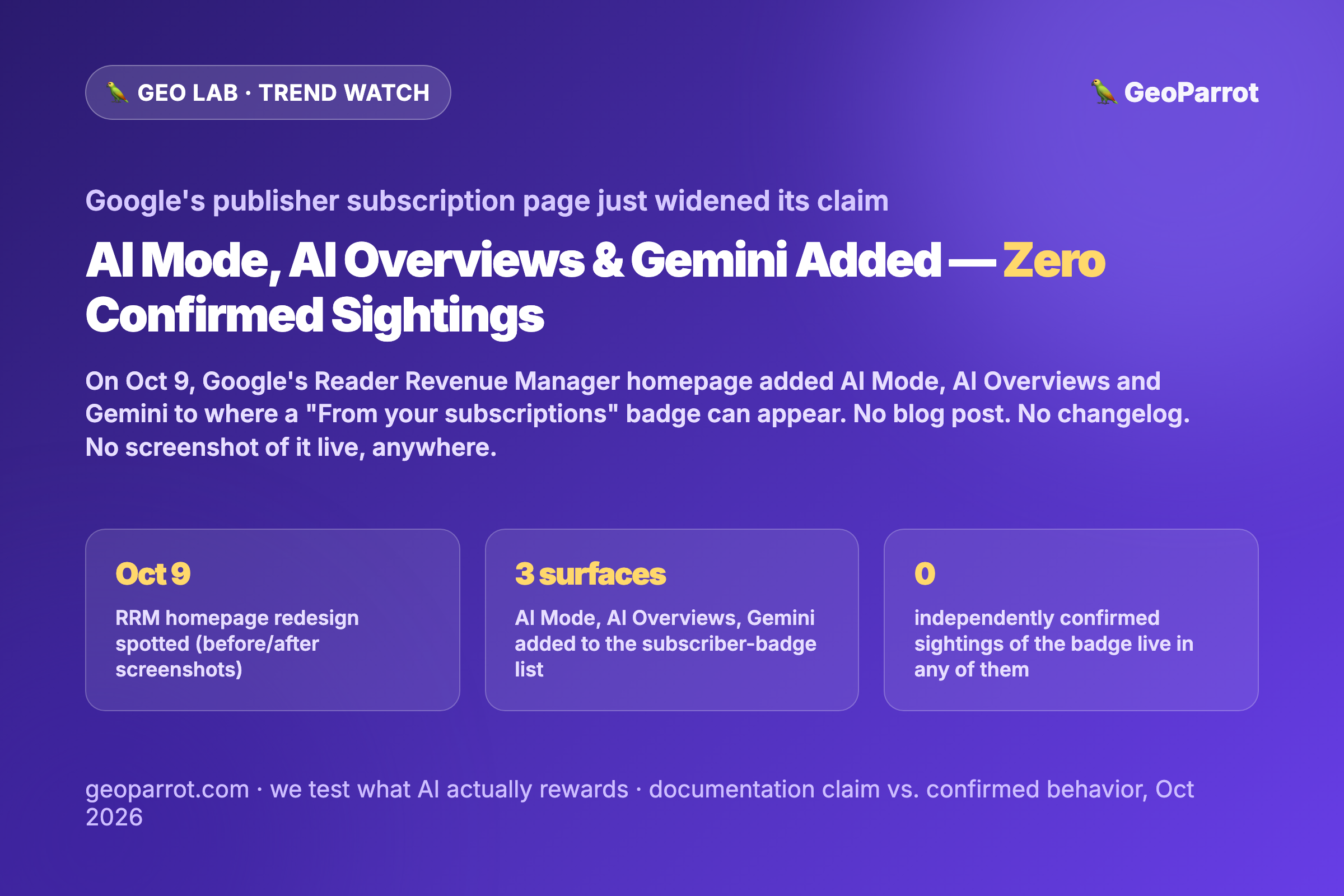
Quick answer: On October 9, 2026, Google redesigned the homepage for Reader Revenue Manager (RRM) — its free subscription/contribution tool for publishers — and quietly widened one line of copy. The old page said subscriber content could carry a “From your subscriptions” distinction on Google Search, Discover and News. The new page adds AI Mode, AI Overviews and Gemini to that list. That’s the entire change we can verify: updated documentation language, spotted via before/after screenshots. There’s no Google blog post announcing it, no changelog entry, and — as of publication — no independently confirmed screenshot of the badge actually rendering inside an AI Mode or AI Overviews answer. Whether this is a shipped capability or forward-looking copy on a redesigned page is, right now, unconfirmed.
Trend watch — published October 11, 2026. We read every AI-search interface change the way the GEO Lab reads any claim: what’s actually confirmed, what’s inferred, and what we’d need to see measured before acting on it.
What exactly changed, and who spotted it?
Reader Revenue Manager is Google’s free tool that lets publishers without their own membership infrastructure bolt on a subscription, metering or contribution model — it’s the system behind the “From your subscriptions” badge some readers see on articles from outlets they already pay for. On October 9, Search Engine Roundtable’s Barry Schwartz flagged a large redesign of the RRM homepage: reorganized sections, a new “Advanced features” block, and — the detail that matters here — an expanded surface list for where that subscription badge can appear. The old copy scoped it to Search, Discover and News. The new copy adds AI Mode, AI Overviews and Gemini. The article preserved before/after screenshots and a link to the archived prior version, which is how we’re able to confirm the wording actually changed and isn’t a misread.
What the article does not contain, and what we couldn’t find anywhere else as of publication: a Google statement explaining the mechanism, a timeline for rollout, or a single confirmed screenshot of the “From your subscriptions” distinction actually rendering inside an AI Mode conversation, an AI Overview, or a Gemini response. That’s three specific, checkable things that are all currently missing.
| What’s confirmed | What’s not confirmed |
|---|---|
| RRM homepage copy changed Oct 9, 2026 (before/after screenshots exist) | Whether the badge has actually appeared in any AI Mode, AI Overviews or Gemini response |
| The page now lists AI Mode, AI Overviews, Gemini alongside Search, Discover, News | What mechanism triggers it — automatic, opt-in, tied to a specific RRM feature tier |
| A new “Advanced features” section was added to the page | Whether this is a live capability or forward-looking language ahead of a rollout |
| No Google blog post or changelog entry accompanies the change | A rollout timeline or publisher eligibility criteria |
Why would a documentation-page tweak matter to GEO at all?
Because if it’s real, it answers a question we don’t currently have good data on: what happens to paywalled or metered content inside generative AI answers. Up to now, “does AI Mode cite paywalled content, and does it tell the reader where that content came from” has mostly been guesswork — publishers assume either their paywalled articles get skipped by AI retrieval entirely, or get cited with no indication the source requires a subscription. A “From your subscriptions” distinction appearing inside an AI Mode or Gemini answer would be the first confirmed mechanism for a generative surface to visually flag “this source is from an outlet you already subscribe to” — which is a meaningfully different and more valuable outcome for a publisher than an anonymous citation link buried in a sources panel.
But notice what that distinction is not: it’s not a new citation mechanism, and it’s not evidence that paywalled content is newly eligible for retrieval or citation. RRM’s badge has always been a recognition layer for readers who are already subscribers — it doesn’t change whether a model can see or cite the content in the first place. If this ships, the honest framing is “a UI nicety for an existing subscriber relationship extends to a new surface,” not “Google just solved AI citation economics for paywalled publishers.” Those are very different claims, and the RRM page copy only supports the first one, if it supports anything at all yet.
How does this fit the pattern of claims we keep having to downgrade?
This is close to a recurring shape in GEO news this quarter: a screenshot or a documentation change implies a new AI-search behavior, and the actual confirmed fact turns out to be narrower than the headline suggests. We’ve reported that a viral “Google AI Overview attribution” story turned out to be a browser extension, not a Google feature at all — the screenshot was real, the attribution to Google wasn’t. We’ve also covered Google testing AI Overview links that route into AI Mode instead of out to a publisher, which was a confirmed test but scoped to a single spotted query, not a rollout. And just three days ago we covered OpenAI’s own rollout language for GPT-6’s Sources button, which hedges with “might include… whenever it’s available” — a conditional, not a guarantee, that nobody had measured the real-world rate of one day after launch.
The RRM page change sits even earlier on that confidence scale than any of those three. At least GPT-6’s Sources button is a feature OpenAI confirmed shipped, even if its appearance rate is unknown. At least the AI Overview-to-AI-Mode links were a test someone actually witnessed live. The RRM change is documentation copy with zero accompanying sighting of the described behavior anywhere. It could be completely accurate forward-looking language for a feature rolling out this week. It could also be marketing copy updated ahead of an actual capability, the same way product pages sometimes list “coming soon” features as already-available ones. We can’t tell which from what’s public right now, and neither can anyone writing about this today.
A checklist for what to actually do about this right now
- Do nothing yet based on the copy change alone. There is no confirmed live sighting of the badge in AI Mode, AI Overviews, or Gemini as of this writing. Reacting to documentation language before a feature is observed is exactly the pattern this piece and the ones linked above keep warning against.
- If you run Reader Revenue Manager, check your own dashboard for any new setting, toggle, or eligibility notice tied to AI surfaces. Google sometimes ships backend eligibility before any public announcement.
- Don’t confuse this with a paywalled-content citation unlock. Even if the badge ships exactly as described, it’s a recognition layer for existing subscribers, not a new signal that changes whether your metered content gets retrieved or cited in the first place.
- Watch for the first independently verified screenshot of the badge actually appearing in an AI Mode conversation or Gemini answer. That’s the fact that would move this from “documentation says” to “confirmed.”
- Keep separating “Google says X can appear here” from “X appears here.” It’s the same discipline we’ve applied to counted-vs-inferred GEO metrics generally — a platform’s own claim about its own surface is a starting point for verification, not the end of it.
The honest caveats
Everything here rests on one source: Search Engine Roundtable’s before/after screenshots of a documentation page, published roughly 48 hours before this piece. We have not seen the live RRM dashboard ourselves, we have no Google statement confirming intent or timeline, and we have not found any independent sighting of the badge in an actual AI Mode, AI Overviews, or Gemini response anywhere — not from Search Engine Roundtable, not from Search Engine Land, not from Search Engine Journal, not from any SEO commentator we checked. It’s entirely possible this ships cleanly within weeks and the copy was simply ahead of the rollout by a few days. It’s also possible this is stale forward-looking language that sits on the page for months before (or without) a matching feature. We’re flagging the gap between the claim and the confirmation, not predicting which way it resolves.
Frequently asked questions
What is Google Reader Revenue Manager?
A free Google tool that lets publishers add a subscription, metering, or contribution model to their site without building their own payment and access infrastructure. It also powers the “From your subscriptions” badge shown to readers who already subscribe to a given outlet.
Does Google AI Mode now show a “From your subscriptions” badge?
Not confirmed. Google’s Reader Revenue Manager homepage was updated on October 9, 2026 to list AI Mode, AI Overviews, and Gemini as places the distinction can appear, but no independent sighting of it actually rendering in any of those surfaces has surfaced yet.
Does this mean paywalled content is now eligible for AI citations?
No. Even if the badge ships as described, it’s a recognition layer for readers who are already subscribers — it doesn’t change whether a model retrieves or cites metered content in the first place. Those are separate questions.
Should publishers change anything based on this?
Not yet. There’s no confirmed live behavior to optimize for. If you use Reader Revenue Manager, check your own dashboard for new settings, and watch for the first verified screenshot of the badge actually appearing in an AI surface.
Where can I verify this myself?
Search Engine Roundtable’s October 9, 2026 article on the Reader Revenue Manager homepage redesign, which includes before/after screenshots and a link to the archived prior version of the page.
GeoParrot is a GEO Lab: we run experiments to test what AI search engines actually reward, and we grade the industry’s claims — including our own — against what was actually measured. See the running scoreboard at our 2026 GEO benchmark. Related: the viral AI Overview attribution story that was actually a browser extension, Google’s tested AI Overview links that route into AI Mode, GPT-6’s conditional Sources button, and what you’ll still be able to count in 2027.
Leave a Reply